
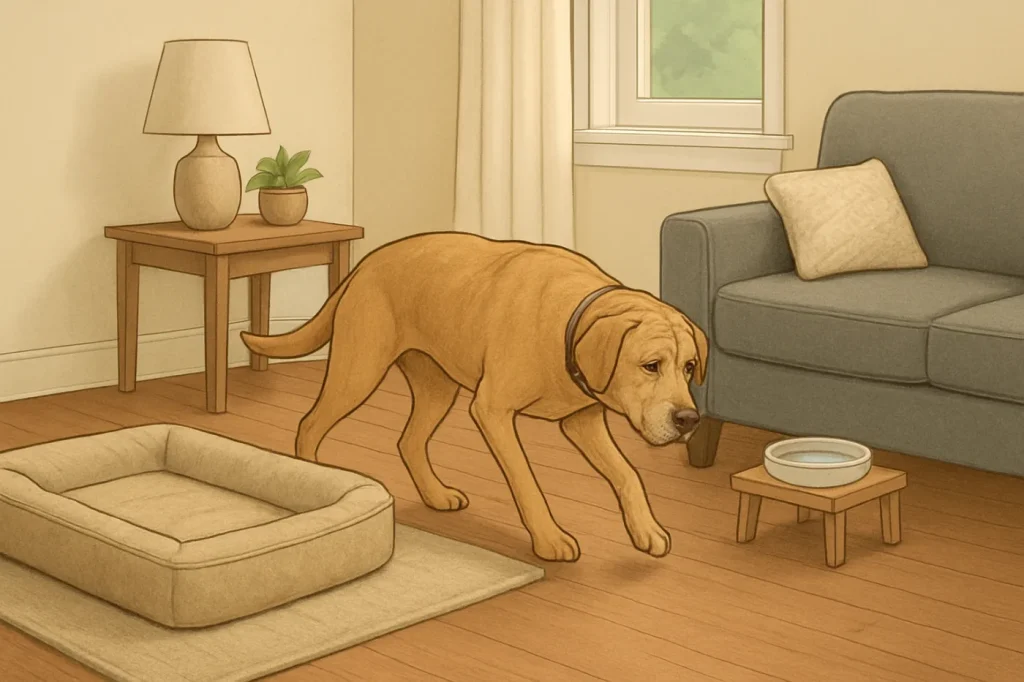
Making a house comfortable for a dog with arthritis comes down to three goals: reduce slipping, reduce jumping and climbing, and give them supportive, easy-to-reach places to rest, eat, and drink. If you focus on those three things in every room, your dog can move more safely and rest with less pain.
How your home environment affects arthritic joints
Arthritis makes your dog’s joints inflamed and stiff. That changes how they move and how your home feels to them:
- Slippery floors (hardwood, tile, laminate) make them splay their legs, strain muscles, and jar painful joints.
- Jumping up or down (sofas, beds, cars, stairs) adds impact to already sore hips, knees, and elbows.
- Cold, hard surfaces increase stiffness, especially after naps.
- Long distances between essentials (bed, water, door) force them to walk more than they comfortably can.
- Clutter and tight spaces make tripping and bumping more likely when they cannot lift their paws well.
When you adapt your house, you are not just “spoiling” your dog. You are:
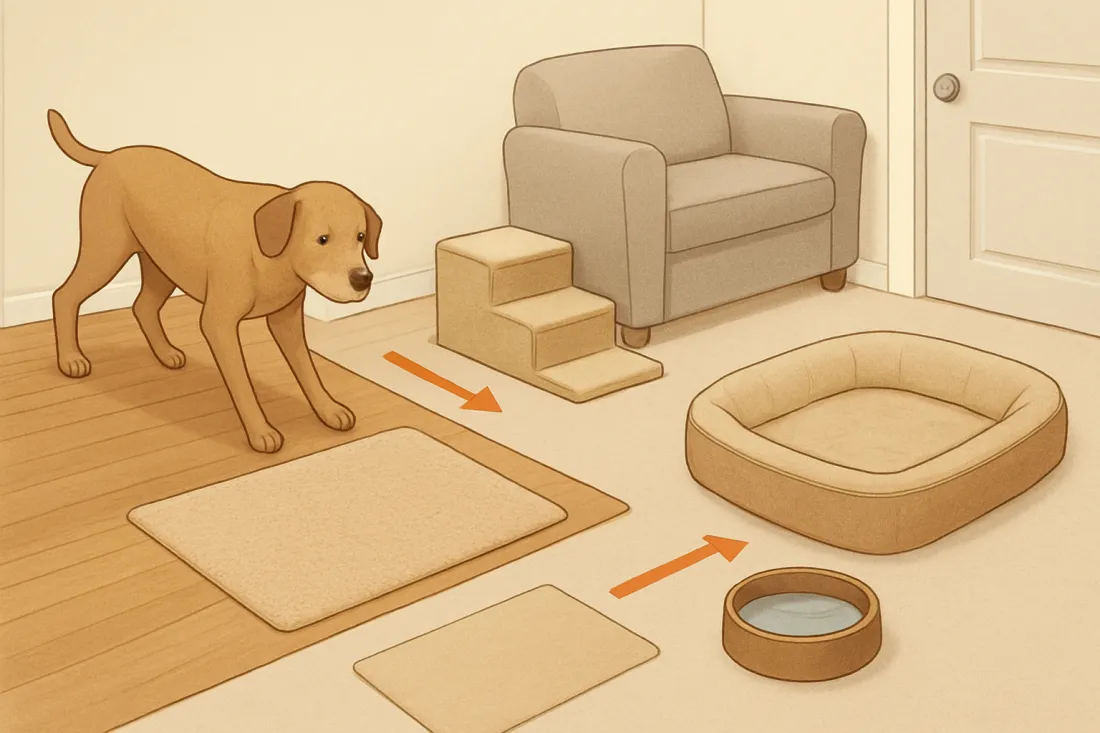
- Reducing pain from slips and hard landings.
- Slowing joint wear by cutting down on impact.
- Helping them stay mobile longer because moving is less scary and painful.
Medical care still matters. If you have not already, talk with your veterinarian about treatment options and costs for dogs with arthritis. Home changes work best alongside proper pain control, weight management, and exercise guidance.
Room-by-room guide to a more comfortable home
Walk through your home from your dog’s point of view. For each area, ask: Can they get here without slipping, climbing, or jumping? Can they rest here comfortably? Use the ideas below as a checklist.
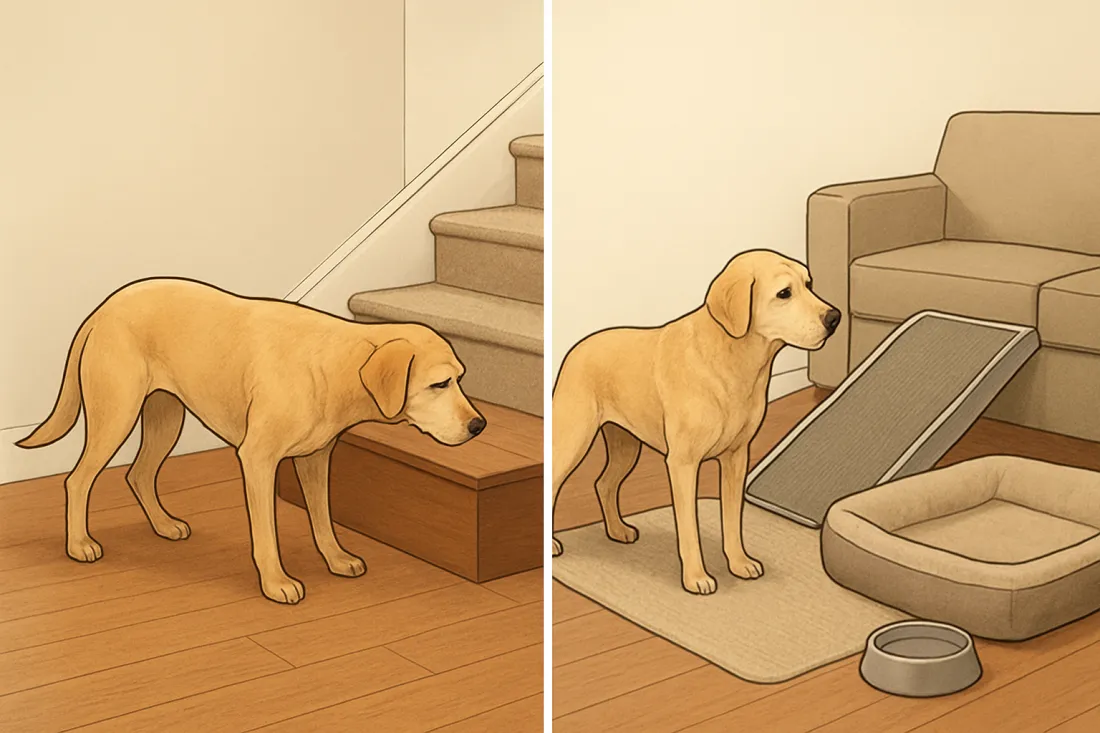
Living room: safe movement and low, soft resting spots
- Add traction paths from the doorway to their favorite spots using rugs or runners (details in the flooring section below). Aim to cover at least 80–100% of the route they walk most often.
- Lower the “hangout” height. Instead of letting them jump on a high sofa, offer:
- A thick orthopedic dog bed (about 3–6 inches of supportive foam) next to the sofa so they can still be near you.
- Or a sturdy ramp/steps to a low sofa if you truly want them on furniture.
- Clear walking lanes. Move coffee tables or footstools so your dog can walk in a straight line without weaving and bumping sore joints. Leave at least a 2–3 foot wide path where possible.
- Protect corners and sharp edges if your dog is wobbly. Corner guards or simply moving furniture a few inches can prevent painful knocks.
- Provide a warm, draft-free spot. Place their bed away from doors that open often or vents that blow directly on them; gentle warmth usually eases stiffness.
Bedroom: easy access to sleep near you
- Decide: bed access or floor bed?
- If your dog is small or very attached to sleeping on your bed, consider a sturdy ramp with a gentle incline and non-slip surface.
- If your dog is large or has advanced arthritis, it is often kinder to transition them to a floor-level orthopedic bed next to your bed instead of encouraging jumping.
- Non-slip landing zones. Put a rug or mat where they jump down or step off the ramp so they do not land on bare slippery flooring. A mat about 2–3 feet long gives them room to land and steady themselves.
- Night-time water access. Place a small, stable water bowl on a non-slip mat near their bed so they do not have to walk far at night.
- Lighting for night trips. A dim night-light in the hallway or bedroom helps older dogs with vision changes avoid stumbles.
Kitchen and dining area: safe feeding and water stations
- Use non-slip mats under food and water bowls so your dog does not have to chase bowls around, twisting sore joints.
- Consider raised bowls if your dog struggles to bend down. As a rough guide, the bowl rim often works well when it sits a few inches below the bottom of your dog’s chest; check that they can stand with a relaxed neck.
- Keep the area dry. Wipe spills quickly and choose absorbent mats so drips do not create slippery patches.
- Minimize walking distance. Place bowls somewhere easy to reach from their main resting area, but not where you will constantly step over them.
Hallways and entryways: reduce slipping and sudden turns
- Lay runners along the full length of slippery hallways so your dog can walk without skating. Try to cover at least 90% of the route they actually use.
- Secure mats at doors inside and outside so they do not slide when your dog braces to go in or out.
- Slow transitions. If there is a step at the door, consider a small ramp or a wide, stable step to reduce the height difference.
Yard and outdoor areas: gentle access and safe surfaces
- Ramps for steps leading off decks or porches so your dog does not have to jump down. Choose a gentle slope and a non-slip surface (more on ramps below).
- Level potty area. If possible, create a relatively flat, close-by potty spot so your dog does not have to navigate steep slopes or long distances. Even moving the potty area 10–20 feet closer can make a difference for a stiff dog.
- Shade and shelter. Provide a shaded resting spot with a raised or padded bed so they are not lying on cold, wet, or very hot ground.
- Clear obstacles like garden tools, hoses, or toys that can trip a dog who cannot lift their paws well.
Flooring and traction options for arthritic dogs
Good traction is one of the biggest day-to-day reliefs you can give a dog with arthritis. Here are practical options and how to choose between them.
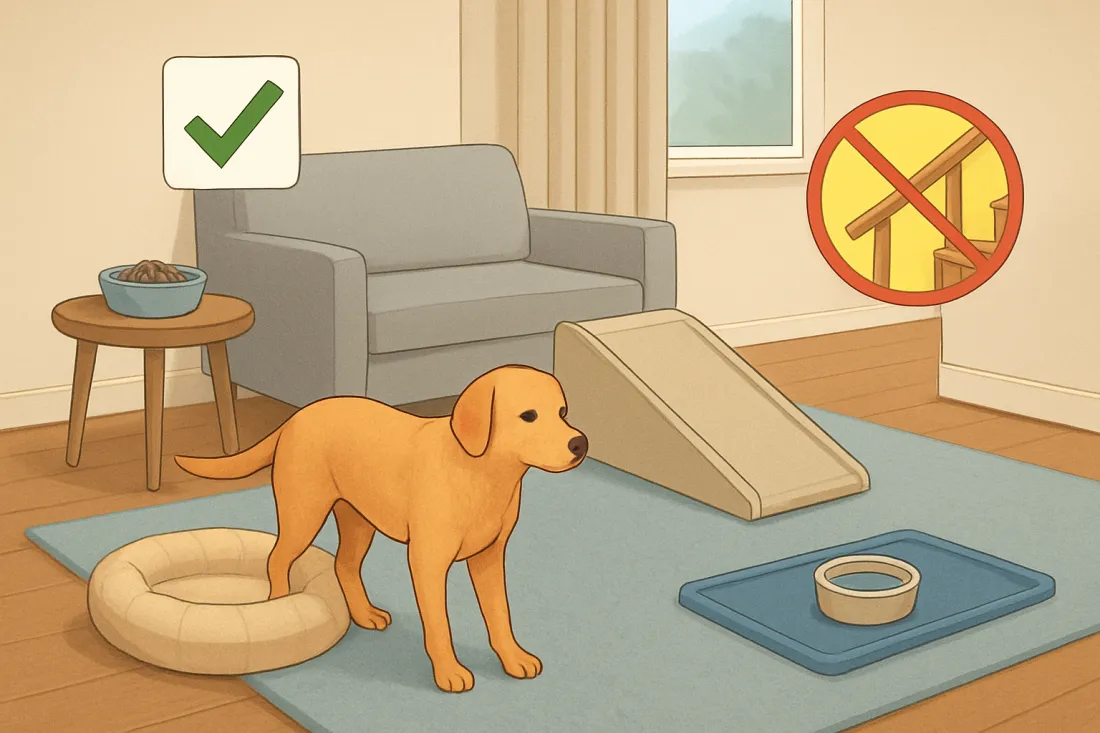
| Traction option | Best for | Pros | Cons / Risks | Tips for choosing and using |
|---|---|---|---|---|
| Area rugs with non-slip backing | Living rooms, bedrooms, large open spaces | Comfortable, easy to move, adds warmth and padding | Can bunch up or slide if backing is weak | Choose low- to medium-pile rugs with a quality rug pad; aim for at least 2–3 feet of rug width on main paths from doorways to beds. |
| Carpet runners | Hallways, stairs, narrow paths | Creates a clear, continuous path; easy to cut to length | Edges can curl; may shift if not secured | Use rug tape or non-slip pads; run them wall-to-wall where your dog walks most so there are no bare slippery gaps. |
| Interlocking foam or rubber tiles | Play areas, near food bowls, temporary setups | Soft, shock-absorbing, easy to clean and rearrange | Some dogs may chew; can be too soft for unstable dogs | Choose firm, textured tiles; lock them tightly and trim edges so they do not lift. Cover at least a 4–6 foot square around bowls or beds. |
| Non-slip socks or booties | Short-term use, visiting homes with slippery floors | Portable; no need to change the house | Many dogs dislike them; can twist or fall off | Introduce slowly with treats; check every 30–60 minutes for twisting that could strain joints or cut circulation. |
| Traction sprays or paw wax | Dogs who refuse socks; spot help on slippery floors | Nothing on the floor; only on paws | Needs frequent reapplication; some products can be messy | Test on a small area first; follow product directions and wipe paws if buildup occurs. Recheck grip every few hours. |
Decision tips:
- Start with the floor, not the dog. Rugs and runners are usually more comfortable and less annoying than socks or booties.
- Cover key routes first: door to favorite bed, bed to water bowl, and bed to yard door.
- Secure everything. Use rug pads, rug tape, or non-slip backing so nothing slides when your dog pushes off.
Ramps and stairs: how to make climbing safer
Any time your dog has to jump or climb, their joints take extra strain. Ramps and pet stairs can help, but only if they are chosen and set up correctly.
When a ramp makes sense vs. when steps are better
- Choose a ramp if your dog:
- Has hip, knee, or spinal arthritis.
- Is a large or giant breed (jumping down is especially risky).
- Struggles with coordination or has weak back legs.
- Choose pet steps if your dog:
- Is small or medium-sized and still fairly steady.
- Is used to stairs and only needs help with a modest height (like a low sofa).
Practical ramp and stair safety tips
- Keep the slope gentle. As a rough rule of thumb, a longer ramp is easier to climb. For example, if you need to reach a bed that is about 2 feet high, a ramp that is at least several times longer than that height will usually feel more comfortable than a very short, steep one. If the ramp looks steep to you, it is probably too steep for an arthritic dog.
- Use non-slip surfaces. Look for textured rubber, carpeted treads, or add non-slip tape. Avoid bare plastic or smooth wood.
- Stabilize the base. The ramp or steps should not wobble, bounce, or shift. Test by stepping on it yourself and gently rocking it.
- Secure the top. Make sure the top edge hooks or braces firmly against the furniture, bed, or car so it cannot slide away.
- Train slowly. Lure your dog with treats, one step at a time. Many dogs need several short sessions over a few days before they trust a new ramp.
- Block unsafe shortcuts. If you add a ramp to a bed or sofa, use furniture placement or baby gates to discourage your dog from jumping off the side instead.
Bedding: choosing and placing a comfortable bed
Arthritic dogs need beds that support joints, keep them warm, and are easy to get on and off.
What to look for in an orthopedic dog bed
- Supportive, not squishy. Look for thick foam that springs back when you press it, rather than thin stuffing that flattens. Many owners find memory foam or layered foam beds helpful because they distribute weight more evenly.
- Enough thickness for your dog’s size. A small dog may do well on a thinner pad, while a large dog often needs several inches of foam so their joints do not sink to the hard floor.
- Low, stable edges. Bolsters can be comforting, but make sure your dog can step over the edge without lifting sore legs too high.
- Non-slip bottom. A bed that skates away when they try to lie down can cause falls.
- Washable cover. Arthritis often comes with reduced mobility and sometimes accidents. A removable, machine-washable cover makes life easier.
Where to place beds for maximum comfort
- Near family activity so your dog can rest without feeling isolated.
- Away from drafts from doors or windows, which can increase stiffness.
- On non-slip flooring or on top of a rug so the bed stays put.
- In multiple key locations if possible: one in the main living area, one in the bedroom, and one near the door they use most.
Temperature and comfort adjustments
- Cold-sensitive dogs may benefit from a slightly warmer spot or a self-warming mat placed on top of their bed. Always allow them to move away if they get too warm.
- Heat-sensitive dogs (thick-coated breeds, brachycephalic breeds) may prefer a cooling mat or a bed in a naturally cooler room.
- Avoid direct heat sources like space heaters or fireplaces close to the bed; arthritic dogs may be slow to move away if they overheat.
Feeding and water station setup for arthritic dogs
Eating and drinking should not be a balancing act. A few small changes can make a big difference.
- Use a stable base. Heavy bowls or bowls in a stand are less likely to slide and make your dog chase them.
- Consider raised bowls. If your dog hesitates to lower their head or seems stiff after eating, try a raised stand. Start with a modest height and watch their posture; they should stand comfortably with a relaxed neck.
- Non-slip mat underneath. A rubber or textured mat under the bowls prevents slipping and catches spills.
- Keep water always accessible. Older arthritic dogs may drink more if water is easy to reach in more than one room.
- Allow enough space. Place bowls where your dog can stand straight, not twisted around furniture or walls. A clear area about 2 feet around the bowls helps them turn and step away safely.
Structured checklist: arthritis-friendly home setup audit
Use this checklist to walk through your home and spot quick wins. You do not need to do everything at once; start with the items that will clearly reduce slipping and jumping for your dog.
Whole-house basics
- Main walking paths (door to bed, bed to bowls, bed to yard) have non-slip surfaces for most of their length.
- Clutter is cleared from floors so your dog can walk in straight lines.
- Your dog does not need to use steep stairs many times a day, or you have a plan (ramps, gates, or moving essentials downstairs).
- Family members know not to call or tempt the dog onto slippery floors or high furniture.
Living room
- There is a non-slip path from the entry to your dog’s favorite resting spot.
- Your dog has a supportive bed at floor level in the room where you spend the most time.
- If your dog is allowed on furniture, there is a safe ramp or steps, and you have blocked unsafe jumping routes.
- Furniture is arranged so your dog can turn around without tight corners.
Bedroom
- Your dog can reach their nighttime sleeping spot without jumping from a height.
- There is a non-slip mat where they get on and off the bed or ramp.
- A water bowl is available nearby at night, or the route to water is short and non-slip.
- Night lighting is bright enough for you to see your dog and avoid bumping them.
Kitchen and feeding area
- Food and water bowls sit on a non-slip mat.
- Bowl height matches your dog’s comfort (not too low, not too high).
- The feeding area is easy to reach without tight turns or obstacles.
- Spills are cleaned up promptly so the floor does not become slick.
Hallways, stairs, and entryways
- Slippery hallways have runners or rugs along the main route.
- Stairs your dog uses have good traction (carpet, stair treads) and are well lit.
- Steps at doors are minimized or supported with a ramp or extra step.
- Door thresholds are not so high that your dog has to trip over them.
Yard and outdoor access
- Your dog can get from the door to their potty area without steep slopes or long distances, as much as your space allows.
- Deck or porch steps have a ramp or are limited if your dog struggles with stairs.
- There is a shaded, comfortable resting spot outdoors with a padded or raised bed.
- Outdoor paths are free of hoses, tools, and other trip hazards.
Comfort and routine
- Your dog has at least one orthopedic or well-padded bed that supports their joints.
- You keep nails trimmed so they can grip floors better.
- Play sessions are shorter and gentler, avoiding high-impact games like repeated jumping.
- Everyone in the household follows the same rules so your dog gets a consistent, low-impact routine. For more help with consistency, you can also review house rules every responsible dog owner should have.
Common mistakes when adapting a home for a dog with arthritis
Even well-meaning changes can backfire. Watch out for these typical pitfalls.
- Relying on one small rug. A single rug in the middle of a slippery room still forces your dog to cross slick flooring to reach it. Instead, create continuous paths.
- Buying very soft, squishy beds. Beds that collapse under your dog may feel cozy at first but can make it harder to stand up and may not support joints well.
- Using steep, narrow ramps. If a ramp feels unstable or steep, your dog may refuse it or jump off halfway, risking injury.
- Letting them keep jumping “because they like it.” Many dogs will push through pain to stay close to you. It is kinder to prevent high-impact jumps even if they seem eager.
- Ignoring small slips. A little slide you barely notice can be a big jolt to arthritic joints. Treat any slipping as a sign to improve traction.
- Changing everything overnight. Too many changes at once can confuse or stress your dog. Introduce new beds, ramps, or room layouts gradually.
- Skipping vet input. Home changes help, but they do not replace medical care. If your dog’s mobility suddenly worsens, contact your veterinarian.
- Forgetting about visitors’ homes. If you often visit friends or family with slippery floors, keep a small “mobility kit” (booties, a foldable runner, or a portable mat) ready for those trips.
What to do next to help your arthritic dog at home
To avoid feeling overwhelmed, break the process into simple steps:
- Talk to your vet about your dog’s current pain level, ideal activity, and any restrictions. Ask which movements (stairs, jumping, long walks) are most important to limit.
- Walk your home once following the checklist above and note the biggest risks: slippery routes, high jumps, steep stairs.
- Fix traction first on the most-used paths with rugs, runners, or tiles.
- Address the highest jumps (bed, sofa, porch, car) with ramps, steps, or by changing routines so your dog stays at floor level.
- Upgrade one resting spot to a supportive orthopedic bed in the room where your dog spends the most time.
- Fine-tune feeding and water stations so your dog can eat and drink without straining.
- Observe and adjust over the next couple of weeks. Watch where your dog still hesitates, slips, or avoids, and improve those spots next.
- Review your overall routine. If your dog is new to your home, combining these changes with a calm, predictable schedule can help them relax. You may find it useful to read about the first 30 days with a rescue dog routine and adapt the ideas to an arthritic dog’s pace.
FAQ: Making a house comfortable for a dog with arthritis
What is the most important thing to understand about making a house comfortable for a dog with arthritis?
The key idea is that every slip and jump hurts more than it used to. Your dog may look “fine” in the moment, but repeated small jolts add up. A comfortable house for an arthritic dog is one where they can move between bed, bowls, and yard on secure footing, without needing to climb or leap, and where they always have a supportive, warm place to rest close to you.
How do I know which home changes to prioritize first for my arthritic dog?
Watch your dog for a day and note where they hesitate, scramble, or land hard. If you see them sliding on a particular floor, or jumping down from a height several times a day, those are your first targets. In most homes, that means starting with non-slip paths on main routes and solving the highest daily jump (often the bed, sofa, or porch).
What common mistakes should I avoid when setting up ramps and steps for an arthritic dog?
Avoid ramps that are too short and steep, steps that are narrow or wobbly, and surfaces that are smooth or glossy. Do not assume your dog will “figure it out” immediately; rushing training or luring them too fast can make them panic and jump off. Instead, choose a stable, gently sloped ramp or wide steps with good traction, and introduce them over several short, positive sessions.
Can changing my home setup really help if my dog already takes arthritis medication?
Yes. Medication can reduce pain and inflammation, but it cannot stop a dog from slipping on a slick floor or jarring their joints when they jump off a bed. Home changes reduce the physical stress on joints so the medication can work better and your dog does not undo the benefits with repeated minor injuries. Many owners notice that once they improve traction and reduce jumping, their dog moves more confidently even without changing the dose of medicine.
What should I do after I have made the basic home changes for my arthritic dog?
After you have improved traction, reduced jumping, and set up comfortable resting and feeding areas, focus on monitoring and fine-tuning. Over the next few weeks, watch how your dog uses the space. If they still avoid certain rooms, slip in specific spots, or seem sore after particular activities, adjust those areas next. Keep checking in with your veterinarian about pain control and exercise, and be ready to update your home setup as your dog’s arthritis changes over time.