
For many US pet owners, pet insurance is worth considering but not always worth buying. It tends to make the most sense if:
- You could not comfortably pay a large, unexpected vet bill out of pocket.
- Your dog or cat is young or middle‑aged and generally healthy.
- You want protection against rare but very expensive emergencies or serious illnesses.
It is less likely to pay off if your pet is already older with multiple health issues, or if you can easily self‑fund big vet bills from savings.
How to decide if pet insurance or self-funding fits your situation
Before diving into details, use this quick comparison to see which direction probably fits you better right now.
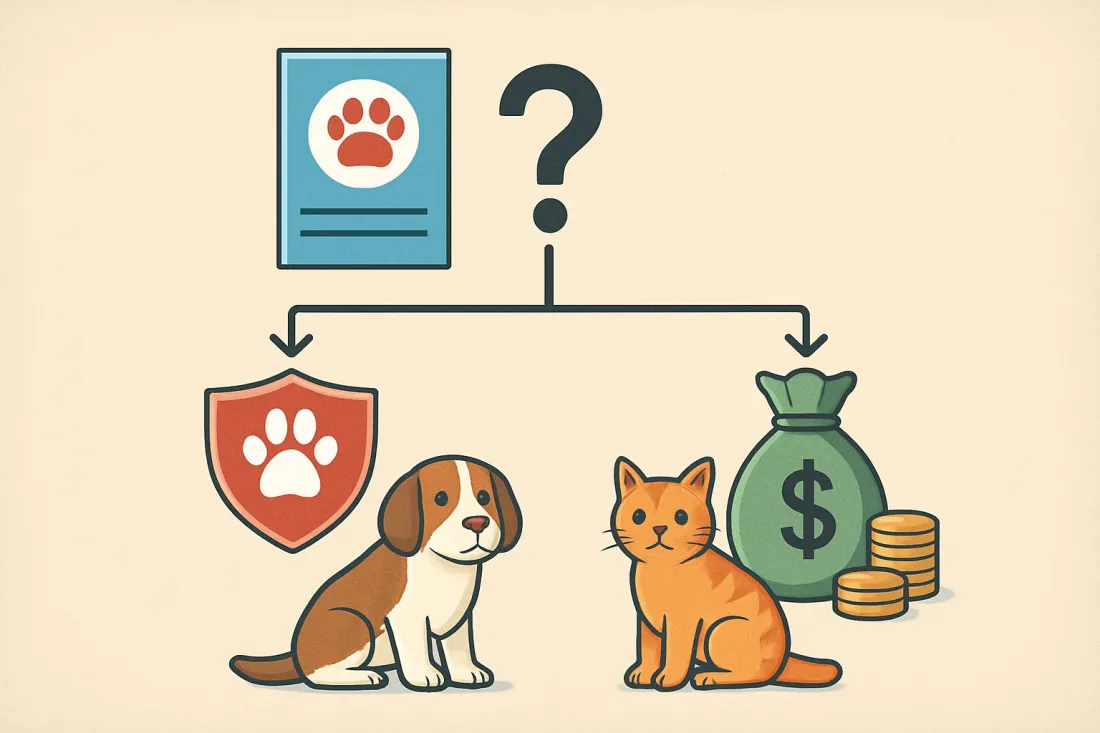
| Situation | Pet insurance may be worth it if… | Self-funding (emergency fund) may be better if… |
|---|---|---|
| Emergency savings | You do not have a dedicated pet emergency fund and a surprise four‑figure bill would be hard to cover. | You already keep a solid emergency cushion and could absorb a large vet bill without debt. |
| Pet age & health | Your pet is young or middle‑aged with no major diagnosed conditions yet. | Your pet is older, has chronic issues, or several pre‑existing conditions. |
| Risk tolerance | You want predictable monthly costs and peace of mind for worst‑case scenarios. | You are comfortable taking the risk that you may or may not face a big vet bill. |
| Budget style | You prefer to budget a recurring premium instead of managing a separate savings pot. | You are disciplined about saving regularly for future vet care. |
| Pet type & lifestyle | You have a dog or cat that is very active, adventurous, or a breed prone to certain conditions. | Your pet is mostly indoors, low‑risk, and not from a high‑risk breed. |
If you are still unsure, the rest of the guide walks through what pet insurance actually covers, realistic cost ranges, alternatives, and a decision checklist.
What pet insurance in the US is and is not
Understanding what pet insurance does not do is just as important as knowing what it covers.
What pet insurance usually is
- Reimbursement for unexpected vet costs – You typically pay the vet first, then file a claim and get reimbursed for covered expenses.
- Focused on accidents and illnesses – Most core policies are designed for things like broken bones, surgeries, infections, or serious diseases.
- Subject to deductibles and copays – You share costs with the insurer through an annual deductible and a reimbursement percentage (for example, the plan may reimburse part of each covered bill).
- Limited by annual or lifetime caps – Policies often have a maximum amount they will pay per year or over the pet’s lifetime.
What pet insurance usually is not
- Not a maintenance plan for routine care – Standard accident/illness policies usually do not cover routine checkups, vaccines, or flea prevention unless you buy an extra wellness add‑on.
- Not retroactive – Conditions that existed before your policy starts are usually excluded as “pre‑existing.”
- Not guaranteed to save money overall – You might pay premiums for years and never claim more than you pay in. The value is mainly in protection from rare, high‑cost events.
- Not a replacement for responsible budgeting – You still need money on hand for deductibles, uncovered items, and routine care.
If you are still deciding whether to get a pet at all, it can help to look at a broader view of costs and responsibilities using a resource like a responsible pet ownership checklist USA.
Typical monthly cost ranges: dogs vs cats
Exact prices vary by company, pet age, breed, and where you live, but you can think in broad ranges instead of precise numbers.
- Dogs – Accident and illness coverage for dogs generally costs more than for cats. Larger breeds and breeds prone to joint or heart issues tend to be at the higher end of the range.
- Cats – Cats are usually cheaper to insure than dogs with similar coverage, especially indoor cats with lower accident risk.
- Puppies and kittens – Often cheaper per month than older pets when you first enroll, but premiums can increase as they age.
- Senior pets – Monthly premiums can be significantly higher, and some insurers limit new enrollments after a certain age.
Because exact dollar amounts change over time and differ by ZIP code, get at least 3 quotes for your pet’s age and breed to see the real spread in your area. Compare those quotes to what you could realistically save each month in a dedicated pet emergency fund.
Comparing coverage types: accident-only, accident & illness, wellness add-ons
Most US pet insurance plans fall into three broad categories. Choosing the right one is a big part of whether the policy feels “worth it.”
| Coverage type | What it usually covers | What it usually does not cover | Best for |
|---|---|---|---|
| Accident‑only | Injuries from accidents: being hit by a car, broken bones, cuts, foreign body ingestion, some poisonings. | Illnesses (cancer, diabetes, infections), routine care, pre‑existing conditions. | Owners on a tight budget who mainly worry about traumatic accidents, especially for young, active pets. |
| Accident & illness | Accidents plus many illnesses: infections, some chronic diseases, some hereditary conditions (depending on the policy). | Routine checkups and vaccines (unless bundled), pre‑existing conditions, some breed‑specific exclusions. | Most owners who want broad protection from both injuries and common illnesses. |
| Wellness add‑ons | Routine care: annual exams, vaccines, flea/tick prevention, sometimes dental cleanings or spay/neuter. | Major accidents or illnesses (unless combined with another plan type). | Owners who like predictable monthly costs for routine care and will use all included services. |
When comparing, look beyond the label. Two “accident & illness” plans can differ a lot in what they consider hereditary, chronic, or excluded.
Common exclusions: pre-existing, breed-specific, and more
Exclusions are where many owners feel disappointed, so read this part of any policy slowly.
Pre‑existing conditions
- Most insurers will not cover conditions that showed signs or were diagnosed before your policy started or during a waiting period.
- Some may distinguish between “curable” and “incurable” pre‑existing conditions, but the definitions vary by company.
- If your pet already has a chronic disease, expect that disease and related complications to be excluded.
Breed‑specific and hereditary issues
- Certain breeds are prone to issues like hip or elbow problems, heart disease, or breathing difficulties.
- Some policies cover hereditary and congenital conditions if you enroll early and keep continuous coverage.
- Others exclude specific conditions for certain breeds, or cap payouts for them.
Routine and elective procedures
- Standard policies usually exclude spay/neuter, cosmetic procedures, and routine dental cleanings.
- Dental disease may be covered only for accidents (like a broken tooth) and not for periodontal disease, unless clearly stated.
Behavioral and alternative therapies
- Coverage for behavioral training, anxiety treatment, or alternative therapies (acupuncture, hydrotherapy) varies widely.
- Some plans cover them with limits; others exclude them entirely.
Because exclusions are so specific, always read the sample policy and ask the insurer to clarify gray areas in writing before you sign.
Example scenarios: with and without pet insurance
These simplified scenarios show how pet insurance can help in some situations and be less useful in others. The numbers are rounded and for illustration only; real costs depend on your vet, region, and policy.
Scenario 1: Young dog with a serious accident
Situation: A 2‑year‑old active dog swallows a toy and needs emergency surgery.
- Without insurance: You pay the full emergency exam, imaging, surgery, hospitalization, and follow‑up. The total can easily reach a level that strains many household budgets.
- With accident & illness insurance: After your deductible and copay, the insurer may reimburse a large portion of the surgery and hospital stay, significantly reducing your out‑of‑pocket cost.
Takeaway: For rare, high‑cost emergencies in young, otherwise healthy pets, insurance can prevent a major financial shock.
Scenario 2: Middle‑aged cat with a chronic illness
Situation: A 7‑year‑old cat develops a chronic condition that requires ongoing medication, periodic bloodwork, and occasional hospital stays.
- Without insurance: You pay each visit and medication refill yourself. Over several years, the total can add up to a substantial amount.
- With accident & illness insurance (purchased before diagnosis): Many policies help with covered tests, hospitalizations, and some medications, subject to deductibles, copays, and annual limits.
Takeaway: If you bought coverage before the illness appeared and the condition is not excluded, insurance can help spread out the cost of long‑term care.
Scenario 3: Senior dog with existing joint problems
Situation: A 10‑year‑old large‑breed dog already has diagnosed joint disease when you consider insurance.
- Without insurance: You pay for pain medications, joint supplements, and any related procedures yourself.
- With new insurance: The insurer will likely treat the joint disease as pre‑existing and exclude it. You may still get coverage for unrelated new issues, but the main problem you are worried about may not be covered.
Takeaway: Buying insurance late in life, after problems appear, often feels less worthwhile because the main condition is excluded while premiums are higher.
Who pet insurance tends to make sense for
There is no one‑size‑fits‑all answer, but certain patterns show up often.
Pet owners who may benefit most
- First‑time owners who are not yet familiar with how quickly vet bills can add up.
- Families without large savings who would struggle to pay for emergency surgery or intensive care.
- Owners of high‑risk breeds (for example, large dogs prone to joint issues, or breeds known for heart or breathing problems), especially if they enroll while the pet is young.
- People who value peace of mind and are willing to pay a premium for financial predictability.
Pet owners who may be fine without it
- Owners with strong emergency funds who can comfortably handle large, unexpected vet bills.
- Owners of older pets with multiple existing conditions where many issues will be excluded.
- People who prefer self‑insurance and are disciplined about saving monthly for future vet care.
If you are still at the stage of deciding what kind of pet fits your lifestyle and budget, a tool like a should I adopt a dog or cat quiz can help you think through long‑term responsibilities before layering in insurance decisions.
Alternatives to pet insurance: emergency fund, wellness plans, credit options
Pet insurance is not the only way to prepare for vet bills. Many owners mix and match options.
Dedicated pet emergency fund
- Set up a separate savings account just for pet expenses.
- Automate a monthly transfer (for example, the amount you might have paid in premiums).
- Use it only for vet bills, not general spending.
Pros: Money is yours if unused; no claim denials; no exclusions.
Cons: It takes time to build up, and a big emergency early on can still be hard to cover.
Clinic wellness plans
- Some vet clinics offer wellness plans that spread routine care costs (exams, vaccines, tests) over monthly payments.
- These are not insurance; they usually do not cover accidents or major illnesses.
Pros: Predictable routine care costs; may include discounts on services.
Cons: Does not protect against big, unexpected bills.
Credit and financing options
- Some owners rely on credit cards or medical credit lines for emergencies.
- This can work in a pinch but can also lead to high interest debt if not paid off quickly.
Pros: Immediate access to funds when savings are low.
Cons: Risk of long‑term debt and interest charges.
Combining approaches
Many owners use a hybrid strategy, such as:
- Accident & illness insurance for big, unpredictable events.
- Out‑of‑pocket payment or a wellness plan for routine care.
- A small emergency fund to cover deductibles and items insurance does not cover.
How to compare pet insurance policies: practical checklist
When you start collecting quotes, use this checklist to compare policies side by side.
Coverage and exclusions
- What exactly is covered: accidents, illnesses, hereditary conditions, behavioral issues, dental accidents, dental disease?
- What is clearly excluded: pre‑existing conditions, specific breed‑related issues, elective procedures?
- Are chronic conditions covered for the life of the pet as long as you keep the policy active?
- Are there separate limits for certain conditions (for example, joint problems or cancer)?
Financial structure
- Annual deductible amount and how it works (per year or per condition).
- Reimbursement percentage (for example, how much of each covered bill is reimbursed after the deductible).
- Annual or lifetime payout caps.
- How premiums may increase as your pet ages.
Practical details
- Waiting periods for accidents, illnesses, and specific conditions.
- How claims are submitted (app, online, mail) and typical processing times.
- Whether you can use any licensed vet in the US or must stay in a network.
- Customer support availability when you have urgent questions.
Owner experience
- Is the sample policy easy to understand, or full of confusing language?
- Does the company provide clear examples of what is and is not covered?
- Are there tools to estimate potential reimbursements before treatment?
Key questions to ask before signing a pet insurance policy
Before you commit, ask the insurer or read the policy carefully for answers to these questions:
- What counts as a pre‑existing condition for my pet? How far back do you look at medical records?
- Are hereditary and congenital conditions covered for my pet’s breed? Are there any breed‑specific exclusions?
- How do you handle chronic conditions that last multiple years? Are they covered as long as I keep renewing?
- What are the waiting periods for accidents, illnesses, and orthopedic issues?
- How do deductibles work? Is it per year or per condition, and does it reset annually?
- What are the annual and lifetime payout limits? Are there sub‑limits for certain conditions or treatments?
- How will my premium change as my pet ages? Are there typical increase patterns I should expect?
- Do you cover prescription medications, rehab, or alternative therapies? If so, are there caps?
- Can I visit any licensed vet in the US? Are emergency and specialty hospitals included?
- What is the claim process and typical reimbursement time?
Decision flow: is pet insurance worth it for you right now?
Use this simple step‑by‑step flow to reach a decision that fits your situation.
- Check your current financial buffer.
If a large, unexpected vet bill would force you into debt, move to step 2. If you could comfortably pay it from savings, insurance is optional and may be more about peace of mind. - Look at your pet’s age and health.
Young, healthy pets usually get broader coverage and lower premiums. Older pets with existing issues may face more exclusions and higher costs. - Consider your pet’s risk profile.
Is your pet a high‑energy dog, an outdoor explorer, or a breed prone to specific conditions? Higher risk makes insurance more attractive. - Estimate your long‑term commitment.
Are you willing to keep the policy for many years? Stopping and starting can leave gaps and new exclusions. - Compare 3–4 real quotes.
Get sample premiums and coverage details for your pet’s age, breed, and ZIP code. Compare them to what you could save monthly in an emergency fund. - Decide on a strategy.
- If premiums are manageable and coverage looks solid, choose a policy and start building a small emergency fund alongside it.
- If premiums feel too high for the coverage, commit to a self‑funding plan: set up a dedicated savings account and automate contributions.
- If you are unsure, you might start with a lower‑cost accident‑only plan while you build savings.
Common mistakes US pet owners make with insurance
Avoid these pitfalls that often lead to disappointment.
- Waiting until the pet is already sick or old. By then, the conditions you care about most are often excluded, and premiums are higher.
- Focusing only on the monthly price. A cheap plan with many exclusions and low payout limits may not help much when you need it.
- Not reading the exclusions. Surprises usually come from what is not covered, not from what is.
- Assuming all illnesses are covered the same way. Some policies treat hereditary, chronic, or orthopedic issues differently.
- Dropping coverage after a few healthy years. If you cancel and later try to re‑enroll, new conditions may be treated as pre‑existing.
- Over‑insuring routine care. Paying extra for wellness add‑ons that you do not fully use can make the policy feel expensive without adding much value.
FAQ: what does pet insurance cover for specific conditions?
Does pet insurance cover diabetes?
Many accident & illness policies may cover diabetes if it develops after your policy starts and is not considered pre‑existing or excluded. Coverage can include diagnostic tests, insulin, and monitoring, subject to deductibles, copays, and policy limits. If your pet showed signs of diabetes or was diagnosed before enrollment or during the waiting period, it is often excluded. Always confirm with the insurer how they treat chronic endocrine diseases.
Does any pet insurance cover hip dysplasia?
Some plans do cover hip dysplasia, especially if you enroll your dog while young and before any signs appear. Others exclude hip dysplasia entirely or only cover it under certain conditions, such as longer waiting periods or lower payout caps. Because hip dysplasia is common in certain breeds, read the policy’s orthopedic and hereditary condition sections carefully and ask the insurer to confirm coverage for your dog’s breed in writing.
Does pet insurance cover Addison’s disease?
Addison’s disease is a chronic condition that often requires lifelong management. Many accident & illness policies may cover it if it is diagnosed after your coverage begins and is not excluded as pre‑existing or hereditary. Coverage might include emergency treatment for crises, ongoing medications, and monitoring tests, within your policy’s limits. Because it is long‑term, check how the plan handles chronic conditions over multiple years.
Does pet insurance cover UTIs (urinary tract infections)?
Uncomplicated urinary tract infections are often covered under accident & illness plans as illnesses, as long as they are not pre‑existing and occur after any waiting period. However, if UTIs are part of a larger, chronic urinary issue that existed before enrollment, related costs may be excluded. Policies can also differ on coverage for prescription diets or repeated testing, so review the illness coverage details.
Bringing it all together: responsible ownership and emergencies
Pet insurance is one tool in a larger picture of responsible pet ownership. Whether you buy a policy or build your own emergency fund, the key is to plan ahead for the reality that most pets will need more than routine care at some point in their lives.
Think about:
- How you will handle a sudden, serious illness or injury.
- What level of financial risk you are comfortable taking.
- How pet costs fit into your broader household budget and goals.
If you are preparing for your first pet, combining an insurance decision with a broader planning resource like a first time dog owner checklist USA can help you see the full picture: training, daily care, emergencies, and long‑term health.
There is no universally “right” answer, but there is a right answer for your household. Take a clear look at your finances, your pet’s risk, and your comfort level with uncertainty, then choose the mix of insurance and savings that lets you care for your pet confidently when it matters most.