
If you live in the United States and want a realistic number, a typical cat often costs somewhere in the low-to-mid four figures per year once you add food, litter, and basic vet care, with frugal owners spending less and high-end or medically complex cats costing much more. The exact amount depends on your choices (indoor vs outdoor, insurance, premium food, number of cats) and on your cat’s health.
This guide walks through what drives the yearly cost of a cat, how indoor and outdoor lifestyles compare, what changes in a multi-cat home, and how to keep costs reasonable without cutting corners on welfare.
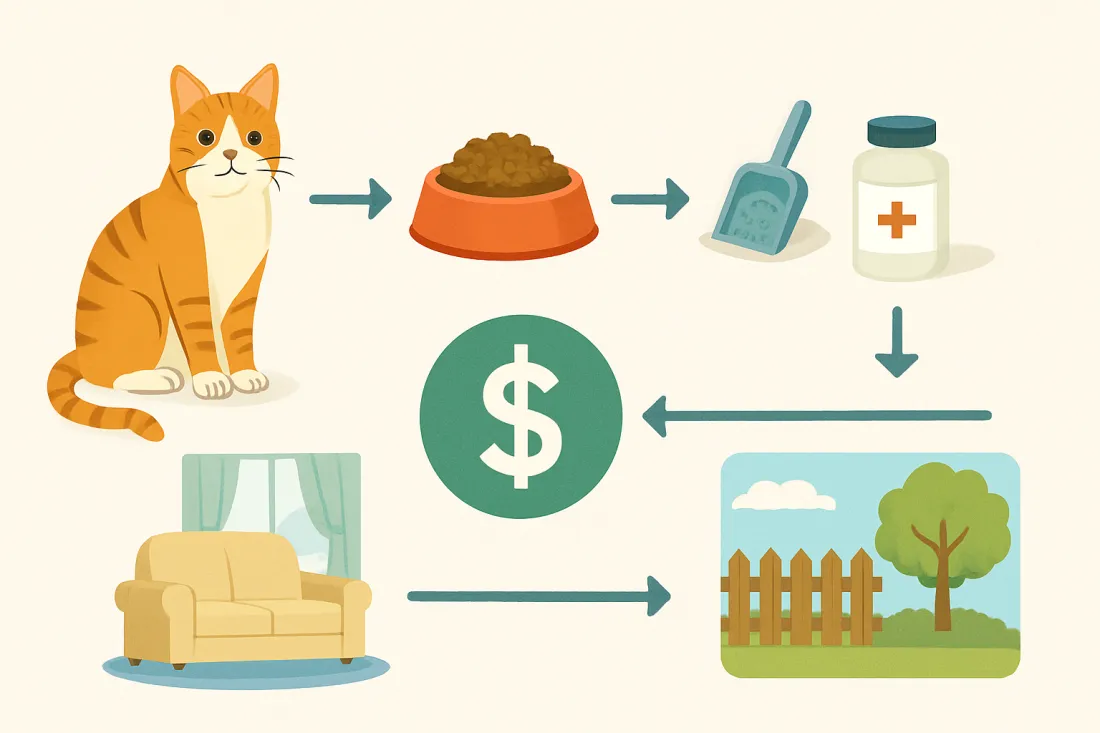
Average yearly cost of a cat vs realistic range
Because prices vary widely across the US, it is more honest to think in ranges than in one “magic” average. Recent breakdowns of cat ownership costs suggest:

- Upfront costs (first year setup and initial vet work) can run from the mid-hundreds into a couple thousand dollars or more, depending on adoption fees, spay/neuter, and gear quality.
- Ongoing yearly costs for an adult cat commonly fall somewhere between the high hundreds and a few thousand dollars, depending on lifestyle, health, and how premium your choices are.
- Some estimates for indoor cats show total annual costs in the mid-hundreds to a bit over a thousand dollars, while outdoor cats can run higher due to extra risks and medical needs.
- Other analyses show that many adult cats land in a broader band from under a thousand dollars up to several thousand dollars per year, especially when you factor in pet insurance or chronic medical conditions.
These ranges are not bills you are guaranteed to pay; they are a planning tool. Your own number will sit somewhere inside them depending on your decisions in this guide.
Key factors that change the yearly cost of a cat
Before looking at line items, it helps to understand what really moves the needle on cost:
- Indoor vs outdoor lifestyle – Outdoor cats tend to face more injuries, parasites, and accidents, which can mean more vet bills. Indoor cats often need more enrichment and litter but have fewer emergency costs.
- Health status and age – Kittens need more vaccines and spay/neuter. Seniors may need more frequent vet visits, special diets, or medications. Some breakdowns note that senior cat costs can even dip slightly if they eat less or need fewer toys, but chronic disease can reverse that quickly.
- Food quality and type – Premium wet food, prescription diets, and special formulas cost more than basic dry food. Large or very active cats may eat more.
- Vet care approach – Routine preventive care is predictable. Emergencies, dental work, and chronic conditions are not. Whether you buy pet insurance or self-insure also changes how your yearly budget feels.
- Location – Urban and coastal areas often have higher vet and service prices than small towns or rural areas.
- Number of cats – Some costs scale almost linearly (food, vet care), while others are shared (litter boxes, carriers, some toys).
Use these factors as a lens while you read the breakdowns and decide where your own cat is likely to land.

Itemized yearly cat cost breakdown
The list below covers the main categories you should plan for each year. Exact numbers will depend on your local prices and your cat’s needs, so treat this as a checklist of budget lines rather than a fixed quote.
1. Food
Food is usually one of the biggest predictable yearly costs.
- Dry food only – Often the most budget-friendly option. Many owners choose a mid-range dry food that balances cost and quality.
- Mixed dry and wet – Common in the US. Wet food adds moisture and variety but increases the food budget.
- Premium or prescription diets – Necessary for some medical conditions (urinary issues, allergies, kidney disease). These can significantly raise yearly food costs.
How to estimate locally: Check the price of your chosen food per pound or per can, multiply by how much your cat eats per day (your vet or the bag label can help), then multiply by 365.
2. Litter and litter supplies
Indoor cats need a steady supply of litter and basic accessories.
- Litter – Clay, clumping, silica, recycled paper, or wood pellets all have different price points and usage rates.
- Litter box liners or bags – Optional but common in many homes.
- Replacement boxes or scoops – Not yearly for most people, but worth factoring in occasionally.
How to estimate locally: Track how long one bag or box of litter lasts in your home, then multiply the cost by how many you use in a year.
3. Routine veterinary care
Preventive vet care is essential to responsible pet ownership and helps avoid larger bills later.
- Annual wellness exam – A yearly checkup to catch problems early.
- Vaccines – Core vaccines and any lifestyle-based extras (for example, if your cat goes outdoors or boards).
- Parasite prevention – Flea, tick, and worm prevention, especially for outdoor or multi-pet households.
Some national estimates suggest that, when you add up exams, vaccines, and basic parasite control, routine vet care can easily account for a meaningful portion of the yearly total, especially in higher-cost areas. For more detail on medical budgeting, you can also review the annual vet costs for dogs and cats in the US.
4. Emergency and illness care
This is the hardest category to predict but one of the most important to plan for.
- Accidents and injuries – Fights, falls, car accidents (especially for outdoor cats).
- Sudden illnesses – Urinary blockages, gastrointestinal issues, respiratory infections, and more.
- Diagnostics – Bloodwork, x-rays, ultrasounds, and hospital stays can add up quickly.
Practical approach: Many owners set aside an emergency fund or consider pet insurance so that a single bad week does not derail their finances.
5. Preventive medications and supplements
Beyond parasite control, some cats need:
- Joint supplements – For older or large cats.
- Dental chews or rinses – To support oral health between cleanings.
- Behavioral supplements – For anxiety or stress, under veterinary guidance.
These are optional for many cats but can be part of a realistic yearly budget for seniors or anxious cats.
6. Grooming and hygiene
Cats are generally low-maintenance, but some grooming costs still appear over a year.
- Brushes and combs – Especially for long-haired breeds.
- Nail clippers or grinder – Or occasional nail trims at a vet or groomer.
- Occasional professional grooming – For long-haired or elderly cats who cannot groom themselves well.
7. Supplies and enrichment
These are the items that keep your cat comfortable and your home intact.
- Scratching posts and pads – Essential to protect furniture and support healthy claws.
- Toys – Wand toys, balls, puzzle feeders, and catnip toys. Expect to replace worn or lost toys over the year.
- Beds and blankets – Not strictly necessary if your cat uses your furniture, but many owners like to provide dedicated spots.
- Carriers – Usually a one-time purchase, but may need replacement over the years.
- Bowls and fountains – Water fountains and sturdy bowls may need occasional replacement or filter changes.
8. Pet insurance or savings
Some owners pay a monthly premium for pet insurance to help with unexpected vet bills. Others set aside a fixed amount each month into a savings account as a self-funded “cat emergency fund.” Either way, it is wise to treat this as part of the yearly cost of a cat, not an optional extra.
9. Boarding, pet sitting, and travel
If you travel, you may need:
- Professional pet sitters – Daily visits or overnight stays.
- Boarding – At a cattery or vet clinic.
- Travel gear – Airline-approved carriers, harnesses, and health certificates if you travel with your cat.
Even if you only travel once or twice a year, these costs can noticeably increase your annual total.
Indoor vs outdoor cats: yearly cost comparison
Indoor and outdoor lifestyles change both the pattern and the level of yearly costs. The table below compares typical differences.
| Cost area | Primarily indoor cat | Indoor-outdoor or outdoor cat | Key risks and trade-offs |
|---|---|---|---|
| Food | Usually predictable; activity level is moderate, so intake is steady. | May need more calories for active or roaming cats. | Outdoor cats can lose weight quickly if food is not adjusted to activity. |
| Litter | Major recurring cost; all bathroom needs are indoors. | Lower litter use if the cat toilets outside part of the time. | Less litter cost, but outdoor toileting can annoy neighbors and expose the cat to parasites. |
| Routine vet care | Annual exams and core vaccines; parasite prevention based on local risk. | Often needs more frequent parasite control and additional vaccines. | Outdoor exposure increases risk of fleas, ticks, worms, and infectious disease. |
| Emergency and illness | Lower risk of trauma; emergencies still possible but less frequent. | Higher risk of fights, car accidents, and injuries. | Even one serious emergency can push yearly costs to the top of typical ranges. |
| Enrichment and toys | Needs more indoor play, climbing, and scratching options. | Gets some stimulation outdoors; may still need indoor enrichment. | Skimping on enrichment can lead to behavior issues and stress. |
| Overall yearly cost pattern | More predictable, centered on food, litter, and routine vet care. | Can look cheaper month-to-month (less litter) but spike with emergencies. | Outdoor lifestyle often shifts costs from predictable supplies to unpredictable vet bills. |
Some US estimates suggest that indoor cats can have yearly totals in the mid-hundreds to around a thousand dollars or more, while outdoor cats may run higher due to extra medical and preventive needs. Your own numbers will depend heavily on local vet prices and how often your cat gets into trouble.
Single cat vs multi-cat household costs
Many people assume that two cats cost exactly twice as much as one. In reality, some costs scale almost one-to-one, while others are shared.
Costs that mostly scale per cat
- Food – Each cat needs its own daily calories. A second cat roughly doubles your food budget.
- Routine vet care – Each cat needs its own exam, vaccines, and parasite prevention.
- Emergency care – Each cat can have its own accidents or illnesses.
- Insurance – Policies are typically per pet.
Costs that are partly shared
- Litter and boxes – You need at least one box per cat plus one extra, but litter use does not always double exactly; some households see a smaller increase.
- Toys and enrichment – Many toys, towers, and scratchers can be shared, though you may need more to avoid conflict.
- Grooming tools – Brushes, nail clippers, and combs can usually be shared.
- Carriers – You need at least one carrier per cat, but they last for years.
Financial pros and cons of multiple cats
- Pros
- Cats may entertain each other, reducing the need for constant human playtime.
- Shared enrichment items can spread costs over more than one pet.
- Cons
- Vet and food costs rise significantly with each additional cat.
- Illness can spread between cats, increasing treatment costs.
- Behavior issues (fighting, spraying) can lead to extra vet visits or behavior consults.
Before adding another cat, it helps to review a full cat ownership costs breakdown USA so you understand how your total budget might change over the coming years.
Who should choose a lower, mid, or higher yearly budget
Because the “average yearly cost of a cat” is really a band, it helps to think in tiers. The ranges below are descriptive, not fixed prices; they show how lifestyle choices shape your budget.
Lower-budget cat care (frugal but responsible)
This tier might fit if you:
- Adopt an adult indoor cat with no known health issues.
- Use mid-range dry or mixed food instead of premium or prescription diets.
- Buy sturdy but simple gear and replace it only when needed.
- Keep up with essential vet care but avoid optional extras.
You still need an emergency cushion, but your predictable monthly costs may feel modest.
Mid-range cat care (balanced comfort and cost)
This tier might fit if you:
- Provide a mix of dry and wet food from reputable brands.
- Keep your cat strictly indoors but invest in good enrichment (towers, puzzle feeders).
- Stay current on preventive vet care and parasite control.
- Set aside a regular amount for emergencies or pay for basic insurance.
Many US cat owners fall into this middle band, where yearly costs are noticeable but manageable with planning.
Higher-budget cat care (premium or medically complex)
This tier might fit if you:
- Have a cat with chronic medical needs (kidney disease, diabetes, allergies).
- Use prescription diets, frequent vet visits, or advanced diagnostics.
- Buy premium food, high-end litter, and frequent new toys or furniture.
- Rely on professional pet sitters or boarding whenever you travel.
In this tier, your yearly total can easily reach the upper end of the typical ranges mentioned earlier, especially if you face one or two emergencies in a year.
Comparison table: yearly cat cost scenarios
The table below compares three common scenarios to help you see where your own plans fit. The descriptions are qualitative so you can map them to your local prices.
| Scenario | Typical lifestyle | Cost drivers | When it fits | Main risks |
|---|---|---|---|---|
| Indoor, healthy adult cat on mid-range diet | Lives indoors, has basic towers and toys, yearly vet check, no chronic disease. | Food, litter, annual exam, vaccines, parasite prevention, occasional new toys. | Owners who want predictable, moderate yearly costs and can budget for one or two minor issues. | Unexpected illness or dental work can still push costs higher in a given year. |
| Indoor-outdoor cat without insurance | Goes outside daily, uses some litter, sees vet yearly, no chronic disease yet. | Food, some litter, vaccines, parasite control, plus occasional injuries or infections. | Owners who accept more health risk and can absorb a sudden large vet bill. | One emergency can make the year significantly more expensive than expected. |
| Indoor senior cat with chronic condition | Mostly indoors, may need special diet, regular monitoring, and medications. | Prescription food, frequent vet visits, lab work, medications, possible dental procedures. | Owners prepared to prioritize medical care and adjust their budget for an aging pet. | Costs can fluctuate year to year depending on disease stability and complications. |
Decision checklist: can you afford a cat this year?
Use this practical checklist before adopting or buying a cat in the US.
1. Monthly budget reality check
- Have you looked at a realistic monthly cost of owning a cat in the US and compared it to your current budget?
- Can you comfortably cover food, litter, and routine vet care every month without cutting into essentials like rent or groceries?
- Do you have room for price increases over time?
2. Emergency and long-term planning
- Can you set aside a small amount each month into an emergency fund for vet bills?
- Have you researched pet insurance options and decided whether they fit your situation?
- Are you prepared for 10–15+ years of ongoing costs, not just the first year?
3. Lifestyle and housing
- Is your housing stable enough that you can keep a cat for years (including pet deposits or fees if you rent)?
- Do you plan to keep your cat indoors, outdoors, or both, and have you budgeted for the risks of that choice?
- Do you travel often, and if so, have you factored in pet sitting or boarding?
4. Health and behavior expectations
- Are you ready to pay for preventive care even when your cat “seems fine”?
- Do you understand that behavior issues (scratching, spraying, anxiety) may require extra vet visits or behavior help?
- Are you prepared for higher costs if your cat develops a chronic condition in middle or old age?
5. Backup plan
- If your income drops, do you have a plan to keep your cat’s basic needs covered?
- Do you have trusted friends or family who could help temporarily with care or costs in a crisis?
If you can honestly say “yes” to most of these points, you are in a good position to handle the average yearly cost of a cat responsibly.
Ways to reduce yearly cat costs safely
Cutting costs should never mean cutting corners on welfare. These strategies can help keep your yearly total manageable without harming your cat’s health or happiness.
1. Focus on prevention
- Keep up with annual exams so problems are caught early, when they are often cheaper to treat.
- Use parasite prevention as recommended for your area to avoid infestations and related illnesses.
- Maintain a healthy weight with appropriate food portions and playtime; obesity can lead to expensive diseases.
2. Choose value, not just the lowest price
- Pick a good-quality food that fits your budget rather than the absolute cheapest option.
- Invest in sturdy scratching posts and towers that last years instead of flimsy ones that need frequent replacement.
- Buy basic but safe carriers, bowls, and litter boxes; you do not need designer gear.
3. Use DIY and low-cost enrichment
- Make toys from cardboard boxes, paper bags (handles removed), and toilet paper rolls.
- Rotate toys so they feel new without constant buying.
- Offer window perches or safe views of the outdoors for mental stimulation.
4. Shop smart for supplies
- Buy litter and food in bulk if you have storage space and your cat tolerates the brand well.
- Watch for sales on staple items you know your cat uses consistently.
- Consider generic or store-brand litter if your cat accepts it and it controls odor well.
5. Plan for big expenses
- Set up a separate savings bucket for vet care and add a small amount each month.
- Ask your vet about payment options or wellness plans if they are available and make sense for you.
- Keep your cat indoors or supervised outdoors to reduce the risk of accidents and fights.
Common budgeting mistakes new cat owners make
Avoiding these mistakes can keep your yearly costs closer to the middle of the typical range instead of the top.
- Underestimating vet costs – Many people only budget for food and litter and are surprised by the price of exams, vaccines, and tests.
- Ignoring dental care – Dental disease is common and can lead to painful, expensive procedures if neglected.
- Skipping preventive care to “save money” – Delaying vaccines or parasite control can lead to bigger, more expensive problems.
- Not planning for aging – Kittens grow into seniors who may need special diets, medications, or more frequent vet visits.
- Impulse buying gear – Frequent small purchases of toys, beds, and accessories can quietly inflate your yearly total.
- Assuming indoor cats are “free” to keep – Indoor cats still need enrichment, vet care, and quality food to stay healthy and happy.
Printable cat budget template call-to-action
To turn these ideas into a concrete plan, download or create a simple printable cat budget template with monthly and yearly columns. Include lines for food, litter, routine vet care, emergency savings, insurance, grooming, supplies, and travel or pet sitting. Fill it in with your local prices and update it once or twice a year as your cat’s needs change. A written budget makes the “average yearly cost of a cat” feel less abstract and more like a manageable, planned part of your household finances.
FAQ about yearly cat costs and related questions
What is the 3-3-3 rule for cats, and does it affect costs?
The “3-3-3 rule” is a rough guideline for how long it takes many adopted cats to settle in: about three days to decompress, three weeks to learn your routine, and three months to feel fully at home. It is not a strict rule, but it helps set expectations. Financially, the first three months often include extra costs: initial vet visits, vaccines, spay/neuter if not already done, and buying supplies like litter boxes, scratchers, and carriers. After this adjustment period, your spending usually settles into a more predictable yearly pattern.
Do cats help children with autism, and should that factor into the budget?
Some families report that living with a calm, predictable cat can be soothing for children with autism, offering companionship and a structured daily routine (feeding, playtime). However, responses vary widely from child to child, and a cat is not a therapy tool or medical treatment. From a budgeting standpoint, you should plan for the same yearly costs as any other cat, plus possibly extra spending on training, behavior support, or environmental adjustments to keep both the child and the cat safe and comfortable. The decision should be based on the child’s sensory needs, your household’s capacity, and a realistic view of long-term costs.
What annoys cats the most, and can that increase yearly costs?
Many cats dislike loud, unpredictable noises, rough handling, dirty litter boxes, and having no safe hiding spots. When cats are chronically stressed or annoyed, they may develop behavior issues such as inappropriate urination, aggression, or overgrooming. These problems can lead to extra vet visits, behavior consultations, and even household damage. Investing in a clean litter setup, gentle handling, and good enrichment can actually save money over time by preventing stress-related issues.
Do cats like sleeping with their owners, and does it change costs?
Some cats love sleeping on or near their owners, while others prefer their own beds or quiet corners. Letting a cat sleep with you does not significantly change the yearly cost of care. The main financial impact is indirect: if co-sleeping disrupts your sleep and affects your health or work, you might invest in better beds, extra blankets, or more enrichment to encourage the cat to use its own sleeping spots. From a budget perspective, the bigger decisions are still food, vet care, and insurance, not where the cat sleeps.
How can I tell if my yearly cat budget is realistic?
Start by listing all the categories in this guide and plugging in your local prices. Compare your total to the broad ranges from recent cost breakdowns, which show that many US cat owners spend somewhere between the high hundreds and several thousand dollars per year depending on lifestyle and health. If your estimate is far below the lower end, check whether you have undercounted vet care, emergencies, or supplies. If it is at the very top, look for safe ways to save, such as bulk litter, mid-range food, or DIY enrichment, without skipping preventive care.