

In the United States, a landlord usually can say “no pets” and enforce that rule for ordinary pets. However, they generally cannot use a no-pet policy to refuse a legitimate service animal and, in many types of housing, may also need to allow a properly documented emotional support animal (ESA) as a disability accommodation.
What matters is:
- Whether your animal is an ordinary pet, a service animal, or an ESA.
- Whether your rental is covered by federal fair housing rules.
- Whether your request for an animal is tied to a disability and is reasonable for the housing situation.
this guide compare these situations, explain when a landlord can say no, and give a step-by-step process to follow before you challenge a no-pet rule.
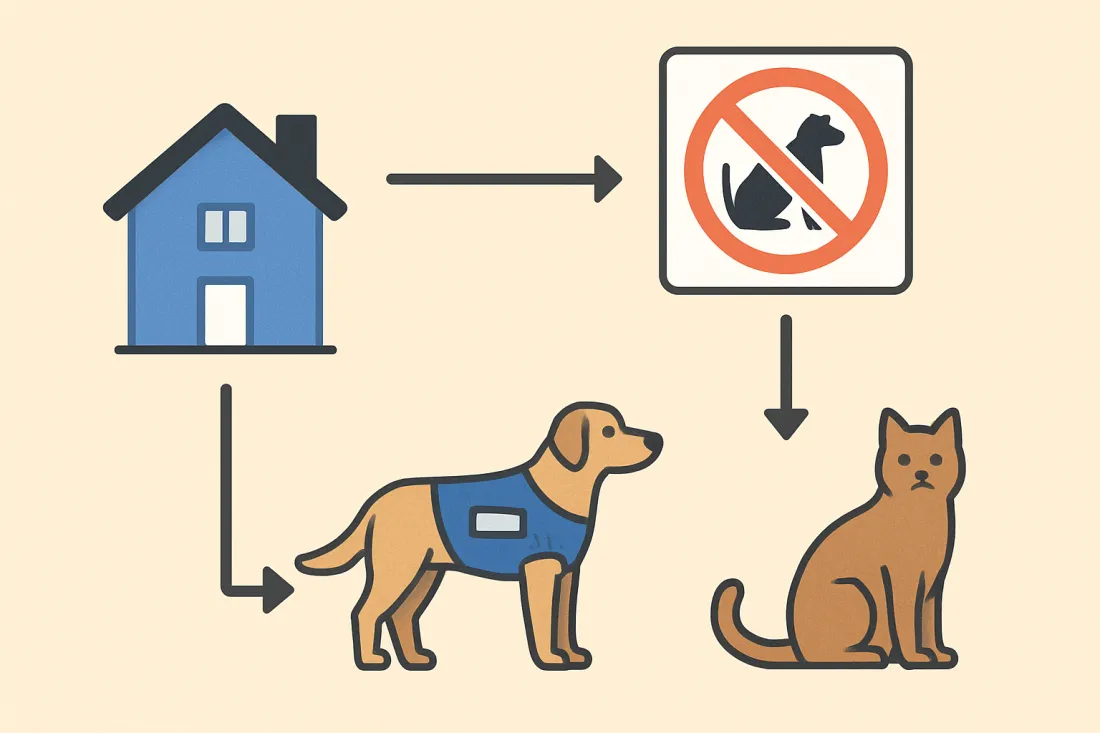
Understanding pets vs. service animals vs. ESAs in US rentals
To understand when “no pets” is legal, separate three categories. This is the single most important decision point for tenants and landlords.
- Ordinary pets
Companion animals with no disability-related role. They may be deeply loved, but they are legally treated as pets. - Service animals
Generally dogs (and in some cases miniature horses) that are individually trained to perform specific tasks directly related to a person’s disability. For example, guiding a person who is blind or alerting someone before a seizure. - Emotional support animals (ESAs)
Animals that help reduce symptoms of a mental or emotional disability (such as anxiety or PTSD) but are not required to have special task training.
In most private rentals:

- Landlords can freely decide whether to allow ordinary pets.
- Landlords usually must consider allowing service animals and, in many cases, ESAs as a reasonable accommodation for a disability.
Think of it this way:

- No-pet policy = usually valid for ordinary pets.
- No-pet policy ≠ automatic ban on assistance animals.
Federal vs. state rules: who actually has to allow animals?
There is no nationwide rule that forces landlords to accept ordinary pets. Instead, two layers of rules matter:
1. Federal disability and housing rules
At the federal level, two main frameworks shape what happens when disability and animals overlap with housing:
- Federal fair housing rules
These generally require many housing providers to make reasonable accommodations for people with disabilities. Allowing an assistance animal in a no-pet building is a common example of such an accommodation. - Federal disability access rules for public places
These define what counts as a service animal and how service animals must be treated in public spaces and some types of housing that operate more like hotels or public accommodations.
Most typical rentals (apartment buildings, multi-unit homes, many single-family rentals) are covered in some way by these federal protections, but there are limited exemptions (for example, some small owner-occupied buildings). Because coverage can be technical, it is wise to:
- Check whether your building is treated as regular housing or more like a hotel/short-stay facility.
- Look up current guidance from federal housing and disability agencies before assuming a rule applies.
2. State and local rules
States and cities can add extra protections or penalties. For example, many states:
- Have specific fines for falsely claiming a pet is a service animal.
- Limit certain pet deposits or fees for ordinary pets.
- Provide additional rights for tenants with assistance animals beyond federal minimums.
Because these details vary widely, always:
- Check your state or city housing agency website for “assistance animal” or “service animal” guidance.
- Confirm whether your rental type is covered by federal fair housing protections.
- Consider speaking with a local tenant or disability rights organization for up-to-date local information.
When landlords can enforce a strict no-pets policy
Outside disability-related situations, landlords in the US usually have broad freedom to decide whether pets are allowed. A no-pet policy is typically legal when:
- The animal is purely a pet
No disability-related need is claimed, and you are not asking for an accommodation. - The housing is standard private rental housing
There is no special program or rule that requires pet acceptance. - The rule is applied consistently
The landlord is not allowing some tenants to have pets while denying others for discriminatory reasons such as race, religion, or family status. - The lease clearly says “no pets”
You signed the lease with that clause and no written exception.
Even in pet-friendly buildings, landlords can often set limits, such as:
- Maximum number of pets per unit (for example, 1–2 animals).
- Reasonable size limits (for example, small or medium dogs only).
- Restrictions on certain species (for example, no large reptiles or farm animals).
- Rules about noise, damage, and cleanliness (quiet hours, waste cleanup, flea control).
However, these limits generally cannot be used to block a legitimate assistance animal that is a reasonable accommodation for a disability. For example, a “no dogs over 25 pounds” rule usually cannot be used to deny a large service dog that behaves appropriately.
How service animals are treated differently from pets
Service animals are not legally treated as pets. Under federal disability access rules, a service animal is generally:
- A dog (or in some limited situations a miniature horse).
- Individually trained to perform specific tasks or work directly related to a person’s disability.
Examples of tasks include:
- Guiding a person who is blind or has low vision.
- Alerting a person who is deaf or hard of hearing to sounds.
- Pulling a wheelchair or providing physical support for balance.
- Alerting to seizures or changes in blood sugar.
- Interrupting self-harming behaviors or grounding someone during a panic attack.
Key housing points:
- Service animals are not “pets” under disability rules. A no-pet policy does not apply to them in the same way.
- Covered housing providers generally must allow a service animal as a reasonable accommodation when it is needed because of a disability and does not pose a direct threat or cause major property damage that cannot be reduced by reasonable steps.
- Landlords usually cannot charge pet fees or pet rent for a service animal, although they may charge for actual damage the animal causes, just as they would for tenant-caused damage.
Behavior still matters. A landlord may be able to exclude a specific service animal if:
- The animal is out of control and the handler does not take effective action.
- The animal has a known history of serious aggression that cannot be managed with reasonable steps.
- The animal causes substantial property damage that cannot be reduced by reasonable measures.
Emotional support animals and fair housing protections
Emotional support animals are treated differently from service animals in public spaces, but they can still be protected in housing.
An emotional support animal (ESA) is typically:
- An animal that provides comfort or reduces symptoms of a mental or emotional disability.
- Not required to have special task training.
In many housing situations covered by federal fair housing rules:
- Landlords may need to allow an ESA as a reasonable accommodation even if they have a no-pet policy.
- Landlords generally cannot charge pet fees or pet rent for an ESA, although they may charge for actual damage.
- Landlords can consider whether the specific animal would be an unreasonable burden (for example, a very large animal in a very small unit, or an animal with a documented history of aggression).
Typical limits on ESAs include:
- The animal may be denied if it poses a direct threat to the health or safety of others that cannot be reduced by reasonable steps.
- The animal may be denied if it would cause substantial physical damage to property that cannot be reduced by reasonable steps.
- The request may be denied if the tenant does not provide reliable disability-related information when lawfully requested.
Because ESAs are often misunderstood, it is important to follow a careful process and avoid relying on generic online letters that may not meet fair housing expectations.
Comparison table: ordinary pet vs. service animal vs. ESA in no-pet housing
| Type of animal | Effect of a no-pet policy | Typical fees and deposits | What documentation or questions are allowed | Key risks or limits for tenants |
|---|---|---|---|---|
| Ordinary pet (no disability claim) | Landlord can usually enforce a full ban or strict limits. | Landlord may charge pet rent or deposits, subject to state/local limits and lease terms. | Standard pet screening (breed, size, vaccination proof, references) is usually allowed. | Very little legal leverage to challenge a no-pet rule unless another type of discrimination is involved. |
| Service animal (trained dog for disability tasks) | No-pet policy generally cannot be used to refuse a legitimate service animal in covered housing. | Pet fees and pet rent are typically not allowed; tenant may pay for actual damage. | When not obvious, landlord is usually limited to asking if it is required because of a disability and what tasks it performs. | Can be excluded if the specific animal is dangerous, out of control, or causes major damage that cannot be reduced by reasonable steps. |
| Emotional support animal (ESA) | No-pet policy often cannot block a legitimate ESA in housing covered by fair housing rules. | Pet fees and pet rent are generally not allowed; tenant may pay for actual damage. | Landlord may request reliable information that the tenant has a disability and that the animal helps with that disability. | Requests can be denied if documentation is weak, the animal poses a direct threat, or the accommodation would be an unreasonable burden. |
What documentation landlords can and cannot ask for
What a landlord may ask depends on whether the animal is a service animal or an ESA/other assistance animal, and whether the disability and need for the animal are obvious.
Questions about service animals
When it is not obvious that a dog is a service animal, housing providers and other covered entities are generally limited to two basic questions:
- Is the dog a service animal required because of a disability?
- What work or task has the dog been trained to perform?
They generally cannot:
- Ask for the specific diagnosis or detailed medical history.
- Require medical records or a list of medications.
- Demand special identification cards, vests, or training certificates as a condition of tenancy.
Documentation for ESAs and other assistance animals in housing
For ESAs and some other assistance animals in housing, landlords often have more room to request documentation, especially when:
- The disability is not obvious.
- The need for the animal is not obvious.
In many cases, housing providers may ask for reliable information that:
- Shows that the person has a disability (without requiring full medical records).
- Explains how the animal helps with at least one major life activity or symptom related to that disability.
Common sources of this information include:
- A letter or form from a licensed health care provider who knows the tenant’s condition.
- Documentation from a disability services provider or case manager.
Landlords generally should not:
- Demand a specific form if the information provided is already clear and reliable.
- Require details about every symptom or treatment.
- Insist on seeing full medical records or therapy notes.
For tenants, a practical approach is:
- Ask your health care provider to write a focused letter stating that you have a disability and that the animal helps with that disability.
- Make sure the letter is reasonably current (for example, written within the last 6–12 months) so it reflects your present situation.
- Keep copies of everything you provide and note the date you shared it.
How to request a reasonable accommodation for a service animal or ESA
If you need an assistance animal in a no-pet building, a clear process helps show that you are acting in good faith and gives your landlord a fair chance to respond.
Step-by-step process to request an accommodation
- Confirm your housing is likely covered
- Check whether your rental is typical residential housing (for example, a year-long lease in an apartment building) rather than a short-stay or hotel-style arrangement.
- If you are unsure, look up your local fair housing agency or tenant rights group for guidance.
- Clarify your animal’s role
- Decide whether your animal is a service animal (trained for tasks) or an ESA (provides emotional support without specific task training).
- Write down, in simple language, how the animal helps you with your disability (for example, “alerts me before I have a panic attack” or “helps me leave the house when my depression is severe”).
- Gather appropriate documentation
- For a service animal, be ready to explain what tasks the dog performs. If your disability and the dog’s role are obvious, you may not need extra paperwork.
- For an ESA, ask a licensed health care provider who knows your condition to write a letter confirming that you have a disability and that the animal helps with that disability.
- Ensure the letter includes the provider’s name, professional role, contact details, and the date it was written.
- Review your lease and building rules
- Look for clauses about pets, assistance animals, or accommodations.
- Check whether the landlord has a written process or form for accommodation requests.
- Prepare a written request
- Write a short, clear letter or email asking for a reasonable accommodation to the no-pet policy.
- State that you have a disability and need an assistance animal (service animal or ESA) to use and enjoy your home.
- Attach or offer to provide supporting documentation from your health care provider, if appropriate.
- Send the request and keep records
- Send your request in a way you can document, such as email, an online portal, or mail with delivery confirmation.
- Save copies of everything you send and any responses you receive, including dates and names.
- Respond to reasonable follow-up questions
- Answer landlord questions that stay within legal limits (for example, clarifying how the animal helps you, or confirming vaccinations and licensing).
- Stay calm and factual, even if the landlord seems skeptical or unfamiliar with the rules.
- Address behavior and safety concerns
- Offer reasonable steps to manage concerns (for example, additional training, using a crate, or agreeing to specific noise rules).
- Follow building rules that do not conflict with your accommodation (leash rules, waste cleanup, quiet hours).
- If denied, ask for the reason in writing
- Request a written explanation if your accommodation is denied or heavily limited.
- Save this explanation; it will be important if you seek help from a housing agency or attorney.
- Consider next steps
- Contact a local fair housing agency, legal aid office, or disability rights group to review your options.
- Decide whether to pursue a complaint, negotiate further, or look for alternative housing that better fits your needs.
Structured checklist: before you challenge a no-pet rule
Use this checklist as a quick self-audit before you push back on a landlord’s no-pet policy.
- I have a disability that substantially affects my daily life, not just occasional stress.
- My animal helps me manage that disability (through trained tasks or emotional support), not just as a hobby or convenience.
- I can explain, in 2–3 sentences, how the animal helps me function or stay stable.
- My animal is generally well-behaved, housebroken, and safe around others, with no recent serious aggression incidents.
- I am willing to provide appropriate documentation from a licensed health care provider, if requested within legal limits.
- I have read my lease and understand the current pet and accommodation rules.
- I am prepared to follow reasonable building rules (leash, waste cleanup, noise control, vaccinations).
- I am ready to communicate in writing and keep records of all conversations and decisions.
- I have looked up, or plan to look up, guidance from federal housing and disability agencies.
- I know where to find local fair housing or legal aid contacts if my request is denied.
Who should challenge a no-pet rule and who should look for pet-friendly housing
Not every “no pets” situation is worth a legal fight. Use the following comparison to decide where you fit.
Good candidates to challenge or negotiate
- You have a documented disability and rely on a service animal or ESA.
- You are willing to provide clear, honest documentation from a licensed health care provider.
- Your animal has a solid behavior history (no recent serious aggression, housebroken, manageable noise).
- You are prepared to follow reasonable rules (leash in common areas, waste cleanup, vaccination requirements).
- You are willing to invest time in a structured process rather than expecting an instant yes.
When it may be better to move on
- You do not have a disability-related need for the animal; it is purely a pet.
- You are not comfortable sharing any health information, even basic confirmation of a disability.
- Your animal has a history of biting, attacking, or serious property damage that you cannot realistically manage.
- The landlord’s no-pet policy is clearly stated, applied consistently, and you have other realistic housing options.
If you fall into the second group, focusing on finding a pet-friendly rental is usually more realistic. For practical strategies, you can read more about what to do if my landlord says no pets.
Cautions about misrepresenting assistance animals
Misrepresenting a pet as a service animal or ESA can create serious problems for you and others.
Potential consequences include:
- State penalties
Many states have laws that allow fines or other penalties for falsely claiming a pet is a service animal. - Damaged credibility
If a landlord or agency discovers misrepresentation, they may doubt any future requests you make, even legitimate ones. - Harm to people with disabilities
Fake service animals that behave poorly can make it harder for people with real service animals to be taken seriously.
Warning signs that you may be crossing a line include:
- Buying a “service dog” vest or ID online for a pet that has no task training.
- Using a generic ESA letter from a website that never connected you with a real provider.
- Claiming an animal is an ESA only after being told “no pets,” without any prior discussion with a health care provider.
If you believe an animal genuinely helps with your disability, talk honestly with a licensed health care provider. Let them decide whether an assistance animal is appropriate and be prepared to follow their guidance.
Decision checklist: push back, negotiate, or move on?
Use these decision criteria to choose your next step:
- If you have a clear disability-related need, reliable documentation, and a well-behaved animal, it often makes sense to request a reasonable accommodation and, if needed, seek help from a fair housing agency or legal aid group.
- If your animal is purely a pet and you do not have a disability-related need, your most realistic options are to negotiate pet terms (if the landlord is open to it) or look for pet-friendly housing.
- If your landlord seems confused but not hostile, focus on education and calm communication. Share official federal guidance links and explain your situation clearly.
- If your landlord is openly hostile or retaliatory, document everything and consider contacting a local housing agency, legal aid group, or tenant organization for support.
- As you decide, remember that responsible pet ownership includes long-term costs such as food, supplies, and unexpected annual vet bills for pets. Make sure you can realistically support your animal before committing to a dispute.
Common mistakes tenants and landlords should avoid
Mistakes tenants should avoid
- Bringing in an animal without asking
Sneaking in a pet or assistance animal can lead to lease violations and possible eviction notices. Request an accommodation first whenever possible. - Relying only on questionable online ESA letters
Some websites sell generic letters after a brief questionnaire. Landlords and agencies may treat these as weak evidence. A letter from a provider who actually treats you is usually stronger. - Mislabeling a pet as a service animal
Calling a pet a service animal when it is not trained for tasks can damage your credibility and may violate state laws. - Ignoring behavior problems
Even assistance animals can be removed if they pose a direct threat or cause serious damage. Take training, socialization, and supervision seriously. - Refusing any communication
You do not have to share every medical detail, but refusing all discussion can make it hard to resolve your request.
Mistakes landlords should avoid
- Assuming “no pets” means no animals at all
Assistance animals are not treated as pets under federal disability rules, and they often require exceptions to no-pet policies. - Demanding full medical records or diagnoses
Asking for complete medical files or detailed diagnoses usually goes beyond what is allowed. - Charging pet fees for assistance animals
Treating service animals or ESAs like ordinary pets for fee purposes can create legal risk. - Relying on stereotypes
Denying an animal based only on breed or size stereotypes, without looking at the individual animal’s behavior, can be problematic. - Ignoring or delaying accommodation requests
Failing to respond or delaying unreasonably can be treated similarly to a denial.
FAQ about no-pet policies, service animals, and ESAs in US rentals
What should I understand about whether a landlord can legally say no pets in the US?
Landlords in the US can usually ban ordinary pets and enforce that rule through lease terms, deposits, and pet rent. However, federal disability and housing rules often require landlords to make exceptions for service animals and, in many housing situations, emotional support animals when they are needed because of a disability. The key questions are whether your housing is covered by fair housing protections, whether your animal is truly an assistance animal, and whether your request is reasonable for the specific property.
Does a no-pet policy apply to my service dog or ESA in a US rental?
A no-pet policy does not automatically apply to a legitimate service dog or, in many cases, a properly documented ESA. In covered housing, landlords generally must treat a service dog as a reasonable accommodation and may also need to allow an ESA if it helps you manage a disability and does not create an unreasonable burden or direct threat. You can still be responsible for damage your animal causes, but routine pet fees and pet rent usually cannot be charged for assistance animals.
What mistakes should I avoid when dealing with a no-pet landlord in the US?
Avoid sneaking in animals without permission, mislabeling a pet as a service animal or ESA, and relying solely on generic online letters that do not reflect a real treatment relationship. Do not ignore behavior issues; even assistance animals can be removed if they are dangerous or destructive. Also avoid refusing all communication with your landlord. Instead, communicate in writing, stay factual, and be prepared to show how your animal helps with your disability if you are requesting an accommodation.
What should I do next after learning about no-pet rules and assistance animals?
Next steps depend on your situation. If you have a disability-related need for an animal, gather documentation from a licensed health care provider and prepare a written reasonable accommodation request. If your animal is purely a pet, focus on negotiating pet terms or searching for pet-friendly rentals. In either case, review your lease, keep written records of all communications, and, if you face a denial that seems unfair, consider contacting a local fair housing agency, legal aid office, or tenant organization for guidance. If you are still deciding what kind of pet fits your lifestyle, you can also explore whether are cats good pets for busy people to choose an animal that matches your schedule and responsibilities.
Summary: when “no pets” really means no animals, and when it does not
In the United States, landlords usually can say “no pets” and enforce that rule for ordinary pets. However, federal disability and housing rules often require landlords to make exceptions for service animals and, in many housing situations, emotional support animals when they are needed because of a disability.
To navigate a no-pet policy effectively:
- Identify whether your animal is a pet, service animal, or ESA.
- Understand that assistance animals are not treated as pets under many housing rules.
- Follow a clear process: gather documentation, make a written accommodation request, and communicate calmly.
- Avoid misrepresentation and focus on honest, well-documented needs.
- Balance your legal rights with responsible pet ownership, including long-term care and cost commitments.
Approaching the issue with accurate information and a structured plan gives you the best chance to protect your housing rights while remaining a considerate neighbor and tenant.