First steps when your landlord says “no pets”
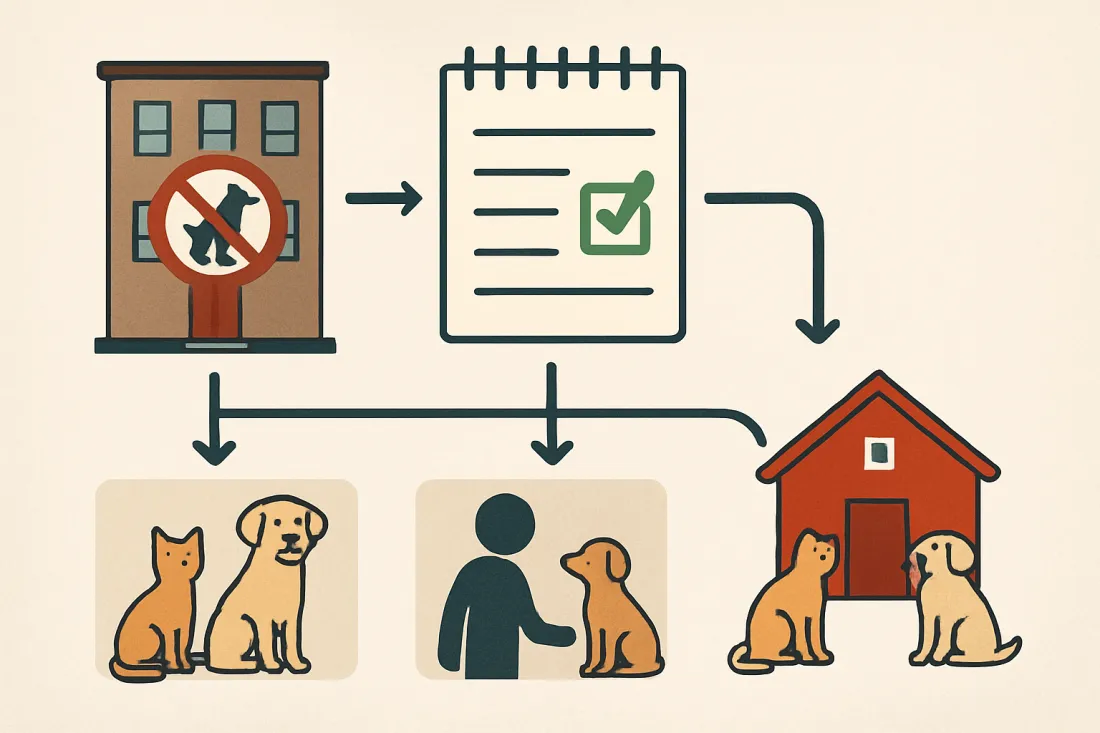
If your landlord says no pets, you usually have three main paths: 1. Confirm what the rule actually is
- Re-read your lease: is it a full no-pet policy or just limits (size, species, number)?
- Check whether the rule is new or has always been there.
- Look for any written exceptions or addendums.
2. Decide which situation you are in
- You want to get a new pet in a no-pet building.
- You already have a pet and the landlord is pushing back or changing rules.
- You have or need a service animal or emotional support animal (ESA).
3. Choose a realistic goal
- Negotiate permission for your pet (with conditions).
- Ask for a reasonable accommodation for a service animal or ESA.
- Plan a move to pet-friendly housing before you are forced to surrender your pet.
The rest of this guide walks through how to do each of these, plus what to avoid so you do not end up evicted or having to give up your animal at the last minute.
How US rental pet policies usually work
Most US rentals fall into a few common categories. Understanding which one you are in helps you see your options.
- Strict no-pet buildings
- Lease says no pets of any kind.
- Often used in small buildings, older properties, or where the owner wants to avoid noise, damage, or allergy issues.
- Landlord may still have to consider service animals and ESAs separately (more on that below).
- Conditional pet-friendly buildings
- Lease allows pets but with rules: weight limits, breed restrictions, number of animals, or species (for example, cats only).
- Often require a pet deposit, pet fee, or monthly pet rent, depending on local rules.
- May require proof of vaccinations and spay/neuter.
- Case-by-case approval
- Lease says pets may be allowed with landlord’s written consent.
- Landlord decides based on your application, references, and the specific animal.
- This is where negotiation, a pet resume, and references can make a big difference.
- Silent leases (no pet language at all)
- Lease does not mention pets.
- In many situations, landlords can still set rules, but it is less clear-cut.
- If you already have a pet and the landlord knew and accepted rent, that can sometimes help you argue that the pet is allowed. You still need local legal advice before relying on this.
Key check: Always rely on what is written in your lease and later written notices, not just what someone said in passing. If the lease and the landlord’s statements conflict, keep copies of everything and consider getting legal advice.
Pets vs ESAs vs service animals: why the difference matters
Landlords often say “no pets,” but US housing rules usually treat three categories differently.
- Pets
- Companion animals you choose to have (dogs, cats, and others) with no disability-related role.
- Landlords generally can allow or prohibit them, or set conditions.
- Service animals
- Typically dogs (and in some cases miniature horses) trained to perform specific tasks for a person with a disability, such as guiding someone who is blind or alerting to seizures.
- Often have stronger protections than pets. Housing providers usually must consider them as a type of assistance animal, not as pets.
- Emotional support animals (ESAs)
- Animals that provide comfort or help relieve symptoms of a mental health disability.
- They are typically not trained to perform specific tasks.
- In many housing situations, ESAs may be treated as assistance animals, not pets, but rules and documentation requirements can vary.
Why this matters for a “no pets” rule In many cases, housing providers must consider reasonable accommodations for assistance animals (service animals and, in some situations, ESAs), even when they have a no-pet policy. However:
- There are limits. For example, if the specific animal poses a direct safety risk or would cause major property damage, the landlord may argue that allowing it is not reasonable.
- Documentation rules can differ between service animals and ESAs.
- State and local rules can add extra protections or conditions.
Practical step: If your animal helps with a disability, do not assume it is “just a pet.” Consider talking with a local tenants’ rights or disability rights organization to understand how assistance animal rules apply where you live.
Decision guide: options when your landlord says no pets
Use this comparison table to see your likely options based on your starting point.
| Your situation | Realistic options | Main risks | Best next step |
|---|---|---|---|
| You want to get a new pet but your lease says no pets | Negotiate an exception; wait until you move; look for a pet-friendly unit in the same area | Landlord refuses and becomes less flexible; possible lease violation if you get the pet anyway | Ask in writing for permission with a pet resume and offer conditions (deposit, training, rules) |
| You already have a pet and the landlord just reminded you of a no-pet rule | Negotiate to keep the pet; request a written addendum; plan a move before any deadline | Lease violation, fees, or non-renewal if you ignore notices | Respond quickly in writing, show you are responsible, and propose clear conditions |
| Your animal is a service animal or ESA related to a disability | Request a reasonable accommodation; provide appropriate documentation; seek legal help if denied | Misunderstandings about what counts as an assistance animal; delays if paperwork is incomplete | Submit a written accommodation request and contact a local fair housing or disability rights group if needed |
| Landlord is changing the building from pet-friendly to no pets | Ask if existing pets are “grandfathered”; negotiate written permission; plan ahead for the next lease term | Non-renewal of lease; pressure to remove the pet at renewal time | Get clarity in writing about how the change affects current tenants and pets |
| You are facing eviction threats over a pet | Seek legal advice immediately; explore emergency pet foster or boarding; look for fast pet-friendly housing | Eviction on your record; having to surrender the pet in a rush | Contact a local tenants’ rights or legal aid group and start backup housing and pet care planning |
How to negotiate with a landlord about a pet
Negotiation works best when you are calm, prepared, and realistic.
Step-by-step negotiation checklist
- Gather your facts
- Lease copy and any building rules.
- Details about your pet: age, breed or mix, size, spay/neuter status, vaccination records.
- Any training certificates (for example, basic obedience) and references from previous landlords or neighbors.
- Decide what you can offer
- Agree to professional cleaning when you move out.
- Agree to keep the pet off certain areas (shared yards, hallways except when entering or exiting).
- Offer to pay a reasonable pet deposit or fee, if allowed in your area.
- Commit to crate training or using baby gates to reduce damage risk.
- Start with a friendly conversation
- In person or by phone if possible, not as a surprise email rant.
- Focus on their concerns (noise, damage, complaints) and how you will prevent them.
- Follow up in writing
- Summarize what you discussed.
- Attach your pet resume and references.
- Propose specific conditions in writing.
- Get any agreement in writing
- Ask for a signed pet addendum or updated lease.
- Do not rely on verbal “it’s fine” promises.
Sample scripts you can adapt
Script 1: Asking for permission for a new pet “Hi [Name], I wanted to ask about the pet policy. I know the lease says no pets, but I’m hoping you might consider an exception for a small, well-behaved [dog/cat]. I’ve attached a short pet resume with details, including vaccinations and training. I’m happy to agree to additional conditions, such as a pet deposit and professional cleaning when I move out. I’ve really enjoyed living here and want to make sure you feel comfortable with any arrangement. Would you be open to discussing this?” Script 2: You already have a pet and received a warning “Hi [Name], I received your notice about the no-pet policy and I understand your concerns. I want to work with you to find a solution that protects your property and allows me to keep [pet’s name], who is an important part of my family. [Pet’s name] is a [age]-year-old [species/breed], spayed/neutered, fully vaccinated, and house-trained. I’ve attached references from my previous landlord and a neighbor confirming there were no noise or damage issues. Would you consider allowing me to keep [pet’s name] under a written pet agreement? I’m willing to accept reasonable conditions, such as a pet deposit and regular inspections with notice. Please let me know if we can discuss options.” Script 3: Requesting a reasonable accommodation for an assistance animal “Dear [Name], I am writing to request a reasonable accommodation for my [service animal/emotional support animal], [animal’s name]. I have a disability, and [animal’s name] helps me manage symptoms related to that disability. I understand the property has a no-pet policy. Because [animal’s name] is an assistance animal, I am requesting an exception to that policy as a reasonable accommodation. I am happy to provide appropriate documentation from a health professional if needed. Please let me know what information you require and the process for reviewing this request.”
Creating a strong pet resume and reference package
A good pet resume can turn a flat “no” into a “maybe.” It shows you are responsible and have thought through potential issues.
What to include in a pet resume
- Basic information
- Name, species, breed or mix, age, weight.
- How long you have had the pet.
- Health and care
- Spay/neuter status.
- Vaccination status and flea or tick prevention.
- Any microchip information.
- Behavior and training
- House-trained or litter-trained.
- Crate trained, if applicable.
- Any obedience classes or certificates.
- How you manage barking, scratching, or other behaviors.
- Daily routine
- How often the pet is walked or exercised.
- Where the pet stays when you are at work (crate, gated area, and so on).
- Emergency plan
- Who cares for the pet if you are away or hospitalized.
- How you will handle evacuation in case of fire or other emergencies.
Reference letters that help
Ask for short, specific letters from people who have seen your pet in a home setting. Good reference sources:
- Previous landlords or property managers.
- Neighbors who shared walls or hallways with you.
- Dog walkers, pet sitters, or trainers.
What a useful reference letter should say:
- How long they have known you and your pet.
- What kind of housing it was (apartment, condo, single-family home).
- Whether there were any noise complaints, damage, or issues.
- How you handled cleaning, waste disposal, and common areas.
- A clear statement like, “I would rent to them again with this pet.”
You can also show you are proactive about safety and damage prevention by learning how to pet proof an apartment for a cat or reviewing general apartment pet rules for dogs before you negotiate.
Legal and fair housing basics for no-pet rules
This is general information, not legal advice. Always check current rules in your city and state or speak with a local attorney or tenants’ rights group.
When a landlord can usually say no to pets
In many situations, landlords can:
- Set a no-pet policy for the building or unit.
- Limit the type, size, or number of pets.
- Charge extra deposits or fees for pets, where allowed by local law.
- Enforce rules about noise, waste, and damage.
They can also take action if:
- You bring in a pet in violation of a clear lease clause.
- The pet is causing serious problems (repeated noise complaints, damage, safety concerns).
- You refuse to follow reasonable pet rules that apply to everyone.
When a “no pets” rule may not be the final word
There are important exceptions and protections in many housing situations:
- Assistance animals
- Service animals and, in many cases, ESAs may be treated differently from pets.
- Housing providers often must consider reasonable accommodations for assistance animals, even in no-pet buildings.
- Reasonable accommodation process
- You usually need to make a clear request and, in some cases, provide documentation from a health professional.
- The landlord can ask limited questions but cannot demand unnecessary personal medical details.
- Limits on extra charges
- In many situations, housing providers cannot charge extra pet fees for assistance animals, though they can still charge for actual damage caused.
Because the details vary by state and by type of housing, a good practical step is to contact a local fair housing organization or legal aid office if your landlord denies an assistance animal request or threatens eviction.
Finding pet-friendly housing quickly if you need to move
If your landlord will not budge, your priority is to avoid a crisis where you have to surrender your pet with no time to plan.
Fast search strategy
- Widen your search filters
- Use rental sites that let you filter for “pet-friendly” or “cats/dogs allowed.”
- Search slightly outside your ideal neighborhood or transit line.
- Consider smaller, independent landlords who may be more flexible than large complexes.
- Prepare a “pet application” packet
- Pet resume and references.
- Photos of your current home showing it is clean and undamaged.
- Proof of renter’s insurance if you have it, especially if it covers pet-related damage or liability.
- Contact listings proactively
- When a listing says “pets considered,” send a message that includes your pet resume right away.
- Be honest about breed and size; surprises later can cost you the unit.
- Use your network
- Ask friends, coworkers, and local pet groups if they know of upcoming rentals.
- Check community boards and local social media groups for smaller, pet-friendly units.
Resource list: tools and places to look
You can usually speed up your search by combining several of these:
- Large rental listing platforms with pet filters.
- Local property management companies that advertise pet-friendly buildings.
- Community groups focused on housing in your city (often on social media or neighborhood apps).
- Local humane societies or animal shelters that maintain lists of pet-friendly landlords or buildings.
- Veterinary clinics and pet supply stores that sometimes post local rental leads on bulletin boards.
As you search, keep responsible pet ownership in mind: choose a home where your animal can live safely and comfortably, not just the first place that technically allows pets.
Backup plans if you must move or face a deadline
Sometimes, even with your best efforts, you cannot stay where you are with your pet. Having a backup plan can prevent last-minute surrender.
Short-term options
- Trusted friends or family
- Ask if someone can foster your pet for a few weeks or months while you secure housing.
- Put agreements in writing: who pays for food, vet care, and what happens if timelines change.
- Temporary foster programs
- Some shelters and rescue groups run short-term foster programs for people in housing transitions or crises.
- These programs may have limited space, so contact them as early as possible.
- Boarding facilities
- Can be an option if you have savings or support to cover costs.
- Better as a very short-term bridge rather than a long-term solution.
Longer-term planning
If you know your lease will not be renewed or you have a move-out date:
- Set a target date at least a few weeks earlier than your actual move-out to have new housing lined up.
- Start viewing pet-friendly units as soon as you receive written notice, not a week before you must leave.
- Keep a list of potential emergency fosters or boarding options in case the move takes longer than expected.
- Review a pet safety checklist for renters in the US so your next place is safer and less likely to lead to complaints or damage.
If you reach a point where you truly cannot keep your pet, contact reputable shelters or rescue groups early. Many are more able to help when they have time to plan, rather than in a same-day emergency.
Common mistakes when dealing with a no-pets rule
Avoiding a few frequent missteps can save you from eviction threats or losing your pet.
- Hiding a pet and hoping no one notices
- Landlords often find out through maintenance visits, neighbors, or social media.
- Being caught after hiding the pet can make negotiation much harder and may lead to faster enforcement.
- Getting a pet first, asking later
- Once you have the pet, you have less leverage. The landlord knows you are emotionally invested.
- It also signals that you are willing to ignore the lease, which makes landlords nervous.
- Relying only on verbal promises
- Staff can change, memories fade, and disputes arise.
- Without a written pet addendum, you may have trouble proving you had permission.
- Misrepresenting a pet as a service animal or ESA
- Falsely claiming an animal is an assistance animal can have legal and ethical consequences.
- It can also make landlords more suspicious of legitimate requests from other tenants.
- Ignoring written notices
- Not responding to violation notices can lead to more serious action, including non-renewal or eviction filings.
- Always respond in writing, even if you are still looking for legal advice.
- Letting your pet’s behavior create complaints
- Frequent barking, damage in common areas, or waste left outside gives the landlord strong reasons to say no.
- Basic training and house rules for your pet can make a big difference. You can use guides on basic house rules for dogs and cats to structure this.
Practical checklist: handling a no-pets rule step by step
Use this checklist to stay organized.
- Clarify the rule
- Re-read your lease and building rules.
- Confirm whether the rule is building-wide or just your unit.
- Note any exceptions or vague language.
- Assess your situation
- Decide if your animal is a pet, service animal, or ESA.
- If it is an assistance animal, gather any documentation from a health professional.
- Prepare your materials
- Create or update your pet resume.
- Request at least one reference letter.
- Collect vet records and proof of vaccinations.
- Open communication
- Schedule a conversation with your landlord or manager.
- Use a calm, solution-focused script.
- Follow up with a written request or summary.
- Plan for both outcomes
- If they say yes: get a written pet addendum and follow all rules carefully.
- If they say no: start searching pet-friendly housing immediately.
- Identify at least one short-term backup option for your pet (friend, foster, boarding).
- Protect your future housing options
- Avoid lease violations that could lead to eviction filings.
- Keep your current place clean and damage-free to earn a good reference.
- Continue training and setting house rules for your pet so future landlords see you as low risk.
FAQ: landlords, no-pet rules, and your options
What can I do if my landlord says no pets?
First, confirm what your lease actually says. Then decide whether your animal is a pet or an assistance animal. For pets, you can try to negotiate an exception using a pet resume, references, and clear conditions (like a deposit and cleaning). If your landlord will not agree, start looking for pet-friendly housing and line up backup care for your pet so you are not forced to surrender them in a rush.
Can a landlord refuse to let you have a pet?
In many situations, yes. Landlords can set no-pet policies or limit the type and number of pets. However, assistance animals such as service animals and, in many cases, ESAs are often treated differently from pets. For those, housing providers may need to consider reasonable accommodations, even in no-pet buildings. Because the details vary, check with a local fair housing or legal aid organization if you are unsure.
How can I get around a no-pet policy?
The safest approach is not to “get around” the policy but to work within it. That means:
- Negotiating respectfully and offering conditions that address the landlord’s concerns.
- Requesting a reasonable accommodation if your animal is an assistance animal.
- Looking for housing that openly allows pets if your current landlord will not change the rule.
Trying to hide a pet or misrepresent it as a service animal can backfire and put both your housing and your pet at risk.
What is the 3-3-3 rule for pets?
The “3-3-3 rule” is a common guideline used by many pet adopters and rescues to describe how long it can take a new dog or cat to adjust:
- About 3 days to start coming out of shock and settle a bit.
- About 3 weeks to learn your routine.
- About 3 months to feel fully at home.
If you are moving or changing housing, this rule is a reminder to give your pet time, structure, and patience while they adjust to a new environment.
Will I be evicted immediately if I have a pet in a no-pet building?
Immediate eviction is not how most situations start. Typically, landlords first send written notices asking you to remove the pet or correct the violation within a set time. If you ignore those notices, they may move toward non-renewal or eviction. As soon as you receive a notice, respond in writing, seek legal advice if you can, and start planning either a negotiation or a move.
How can I show my landlord I am a responsible pet owner?
You can:
- Provide a clear pet resume and references.
- Show proof of vaccinations, spay or neuter, and regular vet care.
- Explain your training routine and how you prevent noise and damage.
- Keep common areas clean and always pick up after your pet.
- Follow building rules consistently so you build trust over time.
Being proactive about training and house rules for your animal helps reassure landlords that your pet will not cause problems.