
If you rent in the US and either have a pet or want to get one, the key rule is simple: your lease and local rules decide what is allowed, and you need written permission for anything that is not clearly covered. Pets, service animals, and emotional support animals are treated differently, and money terms like pet deposits, pet fees, and pet rent all work in different ways.
This guide walks through how pet rules usually work in US rentals, how to read your lease, and what to do before you bring an animal home so you protect both your pet and your housing.
How rental pet rules and disability-related animals fit together
In the US, there is no single nationwide rule that says landlords must allow pets in regular rentals. Instead, three layers of rules interact:
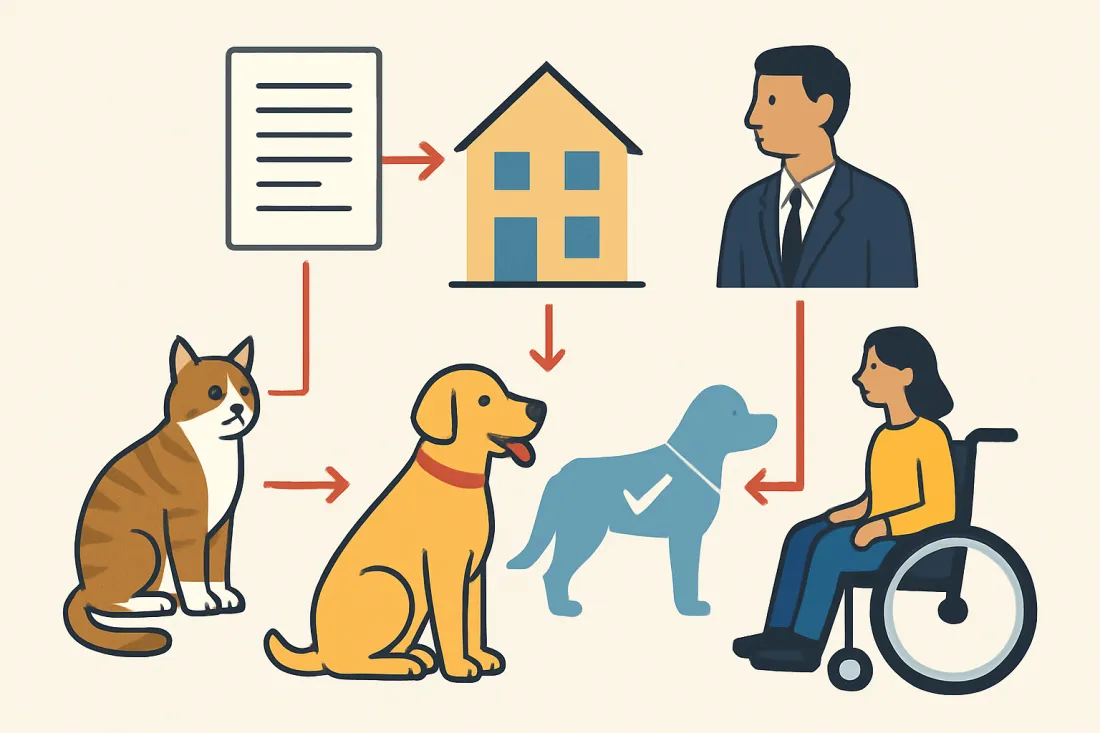
- Federal rules mainly protect people with disabilities who use service animals or have emotional support animals in certain housing situations.
- State rules can add extra protections or limits, such as rules about deposits, fees, or discrimination.
- Local rules (city or county) and building rules can set things like leash requirements, licensing, and breed or number limits.
Because these layers overlap, two renters in different states can face very different pet rules even if their leases look similar. The safest approach is to treat your lease as the starting point, then check whether any higher-level rule changes what the landlord can or cannot do.
What federal rules usually cover for renters with animals
Federal protections focus on disability-related animals, not ordinary pets:

- Service animals are trained to perform tasks for a person with a disability (for example, guiding someone who is blind).
- Emotional support animals (ESAs) provide comfort that helps with a disability but are not trained to perform specific tasks.
In many types of housing, people with qualifying disabilities can request a reasonable accommodation to live with a service animal or ESA even if the building is otherwise “no pets.” Common points:
- Service animals and ESAs are generally not treated as pets for housing purposes.
- They typically cannot be charged standard pet fees or pet deposits, though renters can still be responsible for any actual damage the animal causes.
- Landlords can usually ask for limited documentation for ESAs in housing, but not for service animals in the same way.
Exact rights and procedures depend on the type of housing and current federal guidance, so if you rely on a service animal or ESA, it is important to confirm your specific situation with a local housing counselor or legal aid office.
How state and local rules affect pet policies
States and cities can add their own rules that affect renters with pets. For example, some places:
- Limit how much a landlord can collect as a security deposit (which can affect pet deposits).
- Set rules for how quickly deposits must be returned and how itemized damage must be documented.
- Have local licensing, vaccination, or leash rules for dogs and sometimes cats.
- Limit the number of animals in a unit or building.
Because these details vary widely, always:
- Read your lease and any building rules or community handbook.
- Search your city or county website for “pet license,” “dog leash law,” and “animal control” to see local requirements.
- Check your state’s consumer or housing agency for information on deposits and fees.
Comparing pets, service animals, and emotional support animals in rentals
Understanding the difference between pets, service animals, and ESAs is crucial because it changes what your landlord can ask for and what you must pay.
Ordinary pets
Ordinary pets are animals you keep for companionship that are not covered by disability-related protections. For these animals:
- The landlord can usually allow or forbid pets in the building.
- The landlord can set conditions, such as size limits, species limits, or a maximum number of animals.
- The landlord can usually charge pet deposits, pet fees, and pet rent, as long as those charges follow state and local rules.
Service animals
Service animals are trained to perform specific tasks for a person with a disability. In many housing situations:
- They are not treated as pets.
- Landlords generally cannot charge pet fees or pet rent for them.
- Landlords can still hold the tenant responsible for actual damage caused by the animal.
There are specific rules about what questions housing providers can ask about service animals, so if you use one, consider getting advice from a local disability rights or housing organization before you apply for a rental.
Emotional support animals (ESAs)
ESAs help with a disability by providing emotional support but are not trained to perform tasks. In many housing contexts:
- ESAs can be allowed as a reasonable accommodation even in “no pets” housing.
- They are generally not subject to standard pet fees or pet deposits, though tenants can be charged for actual damage.
- Landlords may be allowed to request documentation from a qualified professional that the tenant has a disability-related need for the ESA.
Because ESA rules are often misunderstood, it is wise to use reputable medical or mental health providers and to avoid online services that promise “instant ESA letters” without a real evaluation.
Comparing pet deposits, pet fees, and pet rent
Many renters see several different pet-related charges in listings or leases. These charges serve different purposes and are treated differently under state law and the lease terms.
Pet deposit
A pet deposit is usually a refundable amount collected to cover potential pet-related damage. Key points:
- It is often held along with or as part of the security deposit.
- If there is no pet damage beyond normal wear and tear, you may be entitled to get it back at the end of the lease, depending on state rules.
- Some states limit the total of all deposits (security + pet), so landlords must stay within those limits.
Always check whether your pet deposit is listed as refundable in the lease and how it interacts with the main security deposit.
Pet fee
A pet fee is usually a one-time, nonrefundable charge for the privilege of having a pet in the unit. For example, a landlord might charge a one-time fee when you move in with a dog. Important details:
- Pet fees are separate from deposits and are typically not returned at move-out.
- Some states or localities may restrict certain nonrefundable fees, so landlords must follow local rules.
- Even with a pet fee, landlords can often still charge for excessive damage at move-out.
Pet rent
Pet rent is an ongoing monthly charge added to your base rent for having a pet. For example, a landlord might add a set amount per month per pet. Consider:
- Pet rent increases your total monthly housing cost for as long as the pet lives there.
- It is not refunded when you move out.
- It can add up over a multi-year lease, so include it in your budget.
Side‑by‑side comparison of common pet charges
| Type of charge | Refundable? | When paid | What it usually covers | Key questions to ask |
|---|---|---|---|---|
| Pet deposit | Usually yes, if no extra damage | Before or at move-in (or when adding a pet) | Potential pet-related damage beyond normal wear | Is it clearly labeled refundable? How is damage documented? How soon is it returned under state rules? |
| Pet fee | Typically no | One-time, often at move-in or when pet is approved | Permission to keep a pet; extra cleaning or admin costs | Is this allowed under local law? Is it separate from the security deposit? Can it be waived or reduced? |
| Pet rent | No | Monthly, along with base rent | Ongoing wear, noise risk, and higher operating costs | How much per month? Per pet or flat rate? Does it change at renewal? |
Lease pet clauses vs disability accommodations
Pet rules often hide in dense lease language. Here are common examples and how to interpret them. These are not legal templates, just typical wording you might see.
“No pets allowed” clause
Example: “No pets of any kind are permitted in the Premises without the prior written consent of Landlord.”
What it means:
- You cannot bring in a pet unless the landlord gives you written permission.
- Verbal promises (“It’s fine, just don’t tell anyone”) are risky; if staff changes, you may be treated as violating the lease.
- Service animals and ESAs may be handled under separate disability accommodation rules, not under this pet clause.
“Pet addendum required” clause
Example: “Tenant may keep one cat or dog in the Premises, subject to execution of a Pet Addendum and payment of applicable pet deposit and pet rent.”
What it means:
- You are allowed a pet, but only after signing a separate pet addendum.
- The addendum will usually list the animal’s name, type, weight, and any rules (such as leash use or noise control).
- Until the addendum is signed and any required payments are made, the pet may still be considered unauthorized.
“Breed, size, or number limits” clause
Example: “Pets are limited to two domesticated cats or dogs, each weighing under 40 pounds. Certain breeds may be prohibited at Landlord’s discretion.”
What it means:
- You must stay within the stated number and size limits.
- Breed restrictions may apply, especially in multi-unit buildings or where insurance rules are strict.
- If your pet grows beyond the weight limit, you may technically be in violation, so clarify how strictly this is enforced.
“Tenant responsible for all pet damage” clause
Example: “Tenant shall be liable for all damage to the Premises or common areas caused by Tenant’s pet(s), including but not limited to flooring, doors, landscaping, and furnishings.”
What it means:
- You can be charged for any damage beyond normal wear that is linked to your pet.
- Pet deposits and security deposits can be used to cover this damage.
- Taking photos at move-in and move-out helps you dispute unfair charges.
Step-by-step checklist before getting a pet in a rental
Before you adopt or bring a pet into your rental, follow this practical checklist to avoid lease violations and surprise costs.
- Re-read your current lease
- Look for words like “pet,” “animal,” “service animal,” “ESA,” or “no pets.”
- Note any size, breed, or number limits and any mention of deposits, fees, or pet rent.
- Check building and community rules
- Ask for the building handbook or house rules if you do not already have them.
- Look for rules about common areas, elevators, yards, and noise.
- If you have a dog, review specific apartment pet rules for dogs so you know what to expect.
- Confirm local requirements
- Search your city or county website for dog or cat licensing, vaccination, and leash rules.
- Check whether your state has limits on deposits or nonrefundable fees.
- Estimate the full cost of pet ownership in a rental
- Add up any pet deposit, one-time fees, and monthly pet rent.
- Include ongoing costs like food, vet care, grooming, and pet insurance if you use it.
- Consider potential costs for training or dog walking if your schedule is tight.
- Choose a pet that fits your housing
- Match the pet’s energy level to your space (for example, high-energy dogs in small apartments can be challenging).
- Check weight and breed against any lease limits.
- Think about neighbors and noise sensitivity.
- Prepare your home
- Protect floors and furniture with rugs, scratch posts, or covers.
- Secure trash, cords, and cleaning supplies.
- Plan where litter boxes, crates, or beds will go.
- Request written permission
- Email your landlord or property manager with details about the pet you want.
- Ask for a pet addendum and a clear list of any charges.
- Sign the pet addendum before bringing the pet home
- Review all terms, including noise rules, supervision, and areas where pets are not allowed.
- Keep a copy of the signed addendum with your lease.
- Set up training and routines
- Plan house training, crate training, and basic obedience.
- Schedule regular walks or play sessions to reduce barking and destructive behavior.
- Document condition and keep records
- Take photos or video of the unit before the pet arrives.
- Save vet records, vaccination proof, and any communication with your landlord about the pet.
How to negotiate pet terms with a landlord
Not every listing is clearly pet-friendly or pet-hostile. Sometimes you can negotiate better terms, especially if you are a strong applicant.
Know what you can offer
- Show you are responsible: Provide references from previous landlords or neighbors who can confirm your pet’s behavior.
- Highlight training: Mention obedience classes, crate training, or that your cat reliably uses a scratching post.
- Offer extra assurance: Some renters offer to pay for professional cleaning at move-out or to carry renters insurance that covers pet-related liability, if available.
Decide what you are willing to accept
- Think through your maximum monthly budget including pet rent.
- Decide whether you can afford a higher refundable deposit but want to avoid nonrefundable fees.
- Consider whether you are open to restrictions like keeping the pet off certain furniture or using a crate when you are away.
Practical negotiation tips
- Ask early: Bring up your pet when you first apply, not after you sign.
- Be specific: Share the pet’s age, size, breed (if applicable), and temperament.
- Suggest concrete terms: For example, propose a slightly higher refundable deposit instead of a large nonrefundable fee.
- Get everything in writing: If the landlord agrees to waive or reduce a fee, make sure the lease or addendum reflects that.
Who should choose strict vs flexible pet rules
Different renters and landlords have different risk levels and priorities. The table below compares when strict rules or more flexible rules might make sense from a renter’s perspective.
| Scenario | Stricter pet rules (few or no pets) | More flexible pet rules (broadly pet-friendly) |
|---|---|---|
| Noise-sensitive building or thin walls | May reduce barking and hallway noise, but can still have unauthorized pets if rules are not enforced. | More pets in the building, but clear rules and expectations can help manage noise. |
| Renter with a calm, older pet | Harder to find housing, but once approved you may stand out as a low-risk tenant. | Easier to find options that accept your pet, but you may pay higher pet rent or fees. |
| Renter planning to move often | Frequent negotiations and re-approvals can be stressful. | Pet-friendly buildings can make moves smoother, but long-term pet rent adds up. |
| Renter on a tight budget | Strict “no pet” buildings may be cheaper but do not allow a pet at all. | Pet-friendly units may cost more upfront and monthly; careful budgeting is essential. |
Template email to request pet permission
Use this template to request permission for a pet if your lease requires approval or is unclear. Adjust details to fit your situation.
Subject: Request to add a pet to [Apartment Address / Unit Number]
Dear [Landlord/Property Manager Name],
I hope you are well. I am writing to request written permission to keep a [type of animal, e.g., “2-year-old neutered indoor cat” or “5-year-old spayed mixed-breed dog”] in my unit at [address and unit number].
The pet’s details are:
- Name: [Pet’s name]
- Species/Breed: [e.g., Domestic short hair cat / Mixed-breed dog]
- Age: [Age]
- Weight: [Approximate weight, if relevant]
- Vaccinations: [Up to date on core vaccinations; records available upon request]
I understand and respect the building’s rules regarding pets and am committed to being a responsible pet owner. I will ensure that:
- The pet does not disturb neighbors with noise.
- All waste is cleaned up promptly and disposed of properly.
- The pet does not cause damage to the unit or common areas.
I am happy to sign a pet addendum and to review any applicable pet deposit, pet fee, or pet rent. If helpful, I can also provide references from previous landlords or neighbors regarding my history as a responsible pet owner.
Please let me know what additional information you need and whether you are willing to approve this request. I would appreciate having any approval in writing so I can keep it with my lease documents.
Thank you for your consideration.
Sincerely,
[Your Name]
[Phone Number]
Common mistakes renters make with pets
Many pet-related conflicts in rentals come from a few predictable mistakes. Avoid these to protect your housing and your pet.
- Bringing in a pet without written permission
- Even if a staff member says “it’s fine,” you can still be in violation if the lease says otherwise.
- Unauthorized pets can lead to fees, demands to remove the animal, or even eviction in serious cases.
- Assuming all animals are treated like ESAs or service animals
- Ordinary pets do not have the same protections as service animals or ESAs.
- Mislabeling a pet can damage trust with your landlord and may cause legal problems.
- Ignoring size, breed, or number limits
- Adding a second pet or adopting a larger animal than allowed can violate the lease.
- Always get updated written approval when your pet situation changes.
- Skipping training and supervision
- Untrained dogs that bark excessively or cats that scratch doors can lead to complaints and damage charges.
- Basic training and clear house rules protect both your pet and your deposit.
- Not documenting the unit’s condition
- Without move-in photos, it is harder to prove that scratches or stains were there before your pet.
- Take dated photos or video of floors, doors, and walls before and after your pet lives there.
- Underestimating total costs
- Pet rent, deposits, and vet bills can strain a tight budget.
- Before adopting, run a realistic monthly and yearly cost estimate so you do not have to choose between your pet and your housing later.
Decision checklist: Are you ready for a pet in your rental
Use this quick checklist to decide whether now is the right time to have a pet in your rental.
- Lease and rules
- My lease clearly allows pets, or I have written permission.
- I understand any size, breed, or number limits.
- I know the building’s rules for common areas, noise, and waste.
- Money and deposits
- I know the pet deposit, pet fee, and pet rent amounts that would apply.
- I can afford these costs plus regular pet care without risking late rent.
- I understand which charges are refundable and which are not.
- Time and lifestyle
- I have enough time each day for walks, play, and training.
- My work or school schedule allows for regular feeding and bathroom breaks.
- I have a backup plan (friend, sitter, or service) for travel or emergencies.
- Space and neighbors
- My unit has enough space for the type and size of pet I want.
- I have thought about noise and smells and how they might affect neighbors.
- I am ready to manage shedding, litter boxes, or outdoor cleanup.
- Long-term commitment
- I have considered how long the pet might live and how that fits my plans.
- I am prepared to look for pet-friendly housing again if I move.
- I understand that rehoming a pet is stressful for the animal and want to avoid that if possible.
FAQ on pet rules, landlord limits, and renter responsibilities
Can a landlord refuse to let you have a pet
In many private rentals, yes. Unless a federal, state, or local rule says otherwise, landlords can usually decide whether to allow pets and can set reasonable conditions. However, people with qualifying disabilities who use service animals or ESAs may have additional rights to request accommodations, even in “no pet” housing. If you are unsure, check with a local housing counselor or legal aid office.
What is the 3-3-3 rule for pets
The “3-3-3 rule” is a common guideline used by many trainers and shelters to describe how pets, especially adopted dogs, adjust to a new home:
- First 3 days: The pet may feel overwhelmed, shut down, or overly excited.
- First 3 weeks: The pet starts to learn routines and show more of its true personality.
- First 3 months: The pet usually feels more secure and fully settled into the household.
This is not a strict scientific rule, but it is a helpful reminder to be patient and consistent, especially in a rental where noise and damage can quickly become issues.
Why do many rentals not allow pets
Common reasons include concerns about property damage, noise complaints, allergies among residents, and insurance limits. Some landlords also worry about extra cleaning costs between tenants. Because of these risks, they may charge higher deposits or pet rent, or they may decide not to allow pets at all.
What happens if a tenant has a pet without permission
If your lease bans pets or requires written approval and you bring in a pet anyway, the landlord may treat it as a lease violation. Possible outcomes include written warnings, extra fees, demands to remove the pet, or, in serious or repeated cases, eviction proceedings. If you already have an unauthorized pet, it is usually better to talk to your landlord and try to work out a written agreement than to hope it goes unnoticed.
Can landlords charge pet fees or deposits for service animals or ESAs
In many housing situations, service animals and ESAs are not treated as pets, and landlords generally cannot charge standard pet fees or pet deposits for them. However, tenants can still be held responsible for actual damage caused by the animal. Because rules can be complex and depend on the type of housing, it is wise to confirm your rights with a local housing or disability rights organization.
How can I protect my deposit when I have a pet
Protecting your deposit starts with prevention and documentation. Pet-proof your space, keep nails trimmed, use scratching posts or chew toys, and clean up accidents quickly. Take photos at move-in and move-out, keep receipts for any repairs you handle yourself, and follow building rules about noise and common areas.
By understanding how pet rules work in US rentals and planning ahead, you can enjoy life with your animal companion while staying on good terms with your landlord and neighbors.