
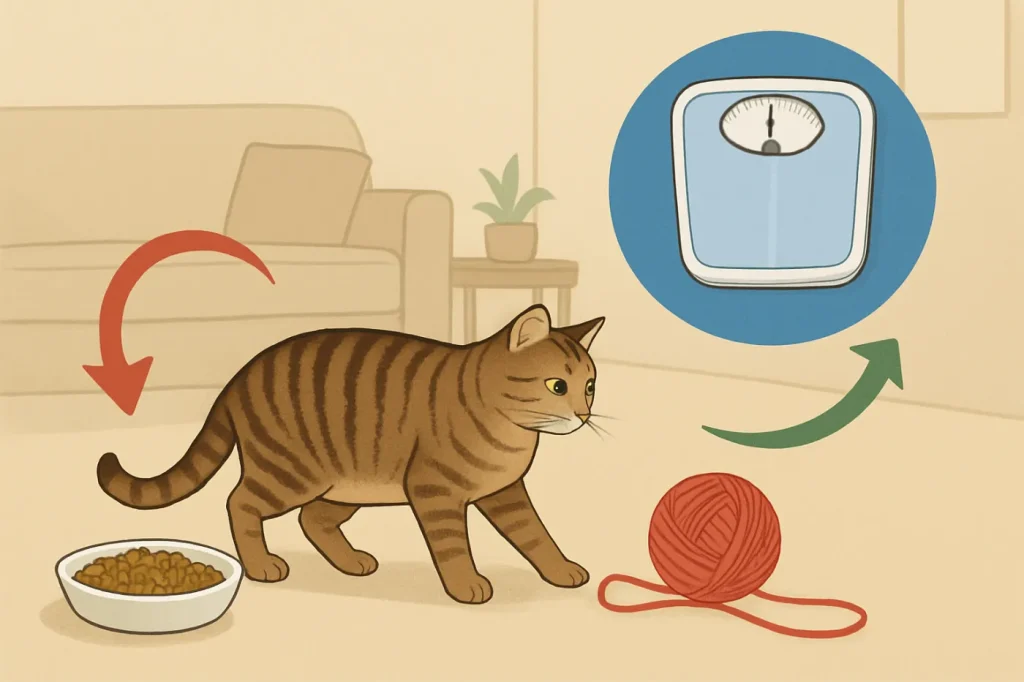
To avoid obesity in an indoor cat, combine three things every single day: measured food portions, built-in play and movement, and simple weight monitoring. When these are set up as a routine, most healthy indoor cats can stay at a stable, healthy weight.
What a healthy-weight indoor cat looks like
Before changing anything, you need a clear picture of what “healthy weight” means for your cat.
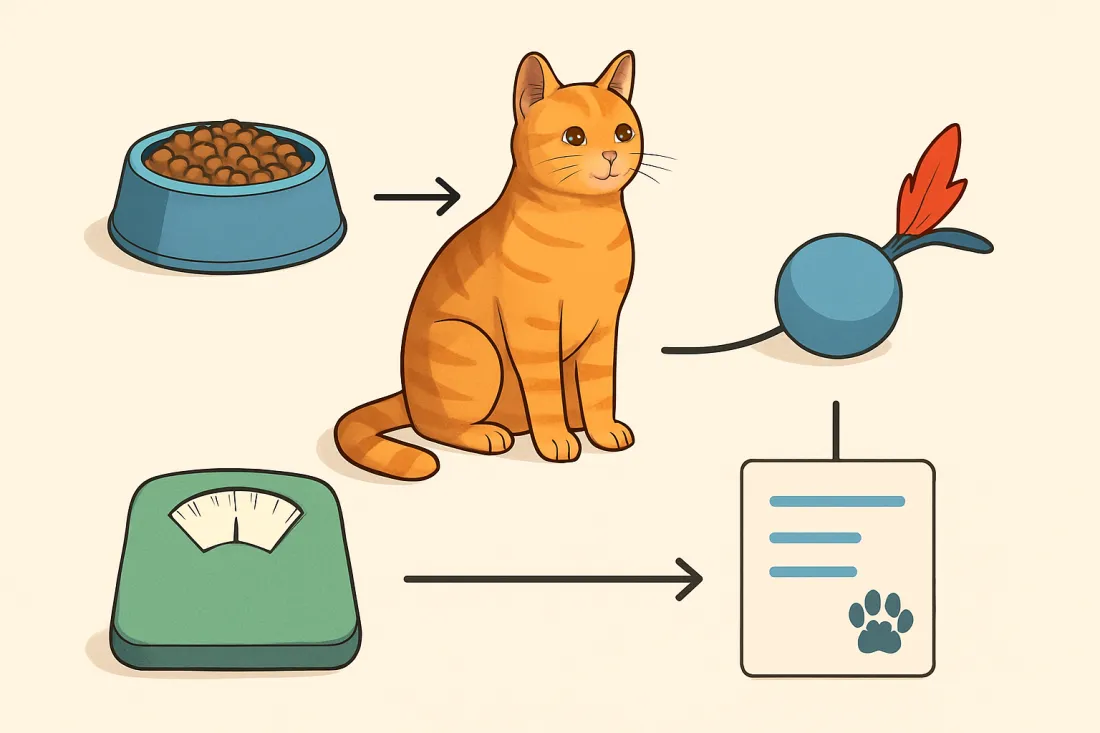
- Ribs: You can feel the ribs easily under a thin layer of fat, but you cannot see them sharply from a distance.
- Waist from above: When you look down, there is a visible “hourglass” shape behind the ribs.
- Tuck from the side: When you look from the side, the belly tucks up slightly toward the back legs instead of hanging down.
- Energy: The cat moves comfortably, jumps to usual spots, and plays at least in short bursts.
Veterinarians often use a body condition score (BCS) scale from “too thin” to “obese.” Ask your vet where your cat sits on that scale and what a realistic target is. That target is your reference point for every decision about food and exercise.
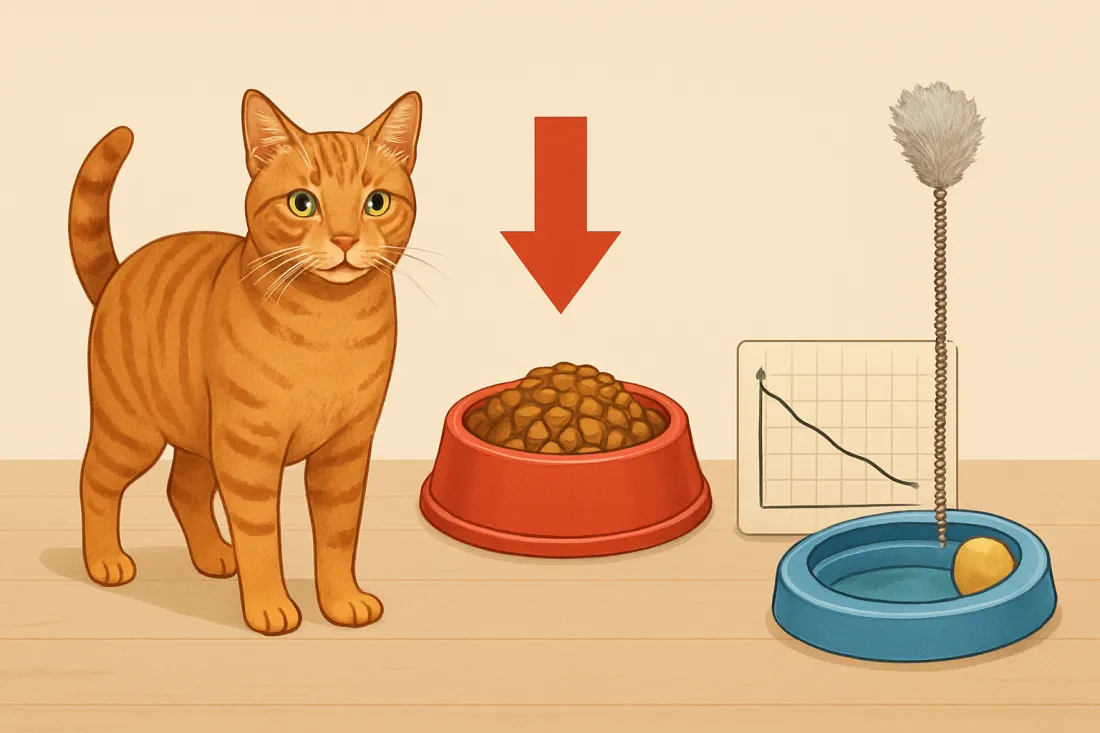
Early signs your indoor cat is getting overweight
Catching weight gain early is much easier than reversing full obesity. Watch for:
- Ribs harder to feel: You have to press firmly to feel ribs through fat.
- Waist disappearing: From above, your cat looks more like an oval or rectangle than an hourglass.
- Soft belly pad: A small belly pouch is normal, but if it becomes thick and swings noticeably, that can be extra fat.
- Less jumping: The cat hesitates before jumping to usual perches or avoids higher spots.
- Shorter play sessions: The cat tires quickly and lies down after brief play.
- Tight harness or collar: Gear that once fit now needs loosening.
If you notice two or more of these changes over a few weeks, it is time to adjust food and activity and schedule a weight check with your vet.
Why indoor cats are at higher risk of obesity
Indoor life is safer in many ways, but it also creates conditions that make weight gain more likely:
- Less natural movement: No hunting, patrolling territory, or climbing trees means fewer calories burned.
- Free access to food: Bowls left full all day encourage constant snacking.
- Boredom eating: Some cats learn that meowing brings food or treats, so they eat for entertainment, not hunger.
- High-calorie extras: Treats, table scraps, and sharing human food can quietly double daily calories.
- Neutering/spaying: Many cats need fewer calories after surgery, but their appetite may stay the same or increase.
- Small living space: Apartments without vertical space or play setups limit running and climbing.
Understanding these risk factors helps you design a routine that compensates for them with controlled feeding and built-in activity.
Daily routine to prevent obesity in indoor cats
Use this as a practical framework you can adapt to your cat’s age, health, and personality.
1. Switch from free-feeding to measured meals
- Check the food label and ask your vet for a starting range. Use the feeding guide on the bag or can as a rough starting point, then confirm with your vet based on your cat’s current weight and target weight.
- Weigh or measure every portion. Use a kitchen scale or a dedicated measuring cup. “Scoops” by eye are almost always larger than you think.
- Split daily food into 2–4 small meals. For most indoor cats, two main meals plus one or two small snack-sized meals works well and reduces begging.
- Feed in a quiet, consistent spot. Routine reduces stress and food guarding, which can affect how much your cat eats.
2. Choose food that supports a healthy weight
There is no single perfect food for every cat, but you can use these decision points:
- Life stage: Kittens, adults, and seniors have different needs. Use food labeled for your cat’s life stage unless your vet recommends otherwise.
- Indoor or weight-control formulas: These often have adjusted calories and fiber to help manage weight for indoor cats.
- Wet vs. dry: Wet food can help some cats feel fuller with fewer calories per volume, while dry food is easier to use in puzzle feeders. Many owners use a mix.
- Vet guidance for special conditions: If your cat has kidney disease, diabetes, or other health issues, always follow your vet’s specific diet advice.
3. Build movement into every day
Most indoor cats will not exercise on their own enough to offset overfeeding. Plan for short, frequent play sessions:
- Schedule 2–3 play blocks daily. Even 5–10 minutes at a time can make a difference when done consistently.
- Use “prey-style” toys. Wand toys, feather teasers, and small balls that mimic chasing and pouncing tap into natural hunting instincts.
- Rotate toys weekly. Put some toys away and bring them back later so they feel new and interesting.
- Add vertical space. Cat trees, shelves, and window perches encourage climbing and jumping.
- Use food puzzles. Puzzle feeders and treat balls make your cat “work” for part of their food, adding both movement and mental stimulation. For more ideas, see the guide on how to avoid boredom in indoor cats.
4. Monitor weight and adjust slowly
- Weigh your cat regularly. Many owners use a home scale by weighing themselves with and without the cat, or ask their vet clinic if they allow quick weight checks.
- Track changes over time. Keep a simple log of weight, body shape notes, and any diet changes.
- Adjust food in small steps. If your cat is slowly gaining, ask your vet how much to reduce daily calories. Changes are usually made in small percentages, not drastic cuts.
- Watch behavior. If your cat seems constantly frantic for food after a change, talk with your vet about whether the plan is appropriate.
Age-specific considerations for preventing obesity
Indoor cats have different needs at different life stages. Adjust your routine as your cat ages.
Kittens (up to about 12 months)
- High energy, high needs: Kittens burn a lot of calories for growth and play, so they usually need more food per pound than adults.
- Use kitten-specific food: It is formulated for growth. Do not switch to adult or weight-control food early without vet advice.
- Multiple small meals: 3–4 meals a day help keep energy steady and prevent overeating at one sitting.
- Encourage safe play: Provide tunnels, soft toys, and climbing options to build muscle and coordination.
- Watch for rapid weight gain after spay/neuter: Appetite may stay high while calorie needs drop. Ask your vet how to adjust portions after surgery.
Young and middle-aged adults (about 1–7 years)
- Switch to adult food at the right time: Your vet can guide you on when to move from kitten to adult food, usually around the first birthday.
- Set a stable routine: This is the best time to lock in measured meals and daily play habits.
- Watch for lifestyle changes: Moving to a smaller home, adding another pet, or changes in your schedule can reduce activity and increase stress eating.
- Recheck weight yearly at minimum: Use annual vet visits to confirm that your cat’s body condition is still healthy.
Seniors (around 7+ years)
- Metabolism slows: Older cats may need fewer calories, even if their appetite seems the same.
- Joint comfort matters: Arthritis or stiffness can reduce movement, leading to weight gain. Gentle play and easy-to-climb furniture help.
- Regular vet checks: Weight gain or loss in seniors can signal health issues. Do not assume changes are “just age.”
- Adjust food texture and type: Some seniors do better with more wet food or smaller, more frequent meals.
Comparison table: feeding and activity strategies for indoor cats
Use this table to compare common approaches and choose what fits your cat and household.
| Strategy | When it fits best | Benefits for weight control | Risks or downsides | How to make it safer |
|---|---|---|---|---|
| Free-feeding dry food | Very few cats; usually not recommended for indoor-only cats | Convenient for owners with irregular schedules | Easy to overeat; hard to track intake; high obesity risk | Switch to measured meals or use a timed feeder with pre-portioned amounts |
| Measured dry food meals | Most healthy adult indoor cats | Easy to measure; works well with puzzle feeders; predictable calories | Some cats may eat too fast or beg between meals | Use slow-feeder bowls, split daily amount into more small meals, add play before meals |
| Wet food meals (with or without some dry) | Cats that need more water or feel hungry on dry food alone | Often lower calories per volume; can help cats feel fuller; supports hydration | Less convenient to leave out; can be more expensive; spoils if left long | Serve smaller portions more often; refrigerate leftovers; still measure total daily calories |
| Food puzzle / foraging feeders | Cats that eat too fast or need more mental stimulation | Slows eating; adds activity; mimics hunting behavior | Some cats get frustrated or give up; owners may add extra food | Start with easy puzzles; use part of the normal daily ration, not extra; supervise at first |
| High-treat lifestyle | Owners who use treats heavily for bonding or training | Can help with training and positive experiences | Treat calories add up quickly; cat may refuse regular food | Limit treats to a small fraction of daily calories; use play and affection as rewards instead |
Step-by-step checklist to keep your indoor cat at a healthy weight
Use this structured checklist as a practical routine. Review it monthly and adjust with your vet as needed.
Step 1 – Get a baseline
- Ask your vet for your cat’s current weight and body condition score.
- Confirm a realistic target weight or body condition range.
- Note any medical issues (e.g., joint pain, past urinary problems) that affect diet or activity.
Step 2 – Set up feeding correctly
- Choose a life-stage-appropriate food (kitten, adult, senior, or vet-recommended diet).
- Use the food label and vet guidance to set a starting daily amount.
- Buy a measuring cup or kitchen scale dedicated to cat food.
- Divide the daily amount into 2–4 meals and schedule times you can stick to.
- Decide on a daily treat limit and what counts as a “treat” (commercial treats, bits of cooked meat, etc.).
Step 3 – Build an activity plan
- List 3–5 toys your cat actually uses (wand toys, balls, tunnels, etc.).
- Schedule at least two 5–10 minute play sessions into your day.
- Set up at least one vertical space (cat tree, shelf, or window perch).
- Introduce one simple food puzzle or foraging game using part of the daily ration.
Step 4 – Monitor and adjust
- Weigh your cat about once a month (or as your vet recommends).
- Record weight, body shape notes, and any changes in food or activity.
- If weight creeps up, contact your vet before making big changes.
- If your cat seems constantly hungry or stressed, ask your vet about adjusting the plan.
Step 5 – Keep the environment engaging
- Rotate toys weekly to keep them interesting.
- Offer safe window views or perches for “cat TV.”
- Spend daily quiet time with your cat (grooming, petting, talking) that does not involve food.
- Review your broader daily care routine for indoor cats so weight control fits into overall well-being.
Common mistakes that lead to obesity in indoor cats
Avoiding a few typical errors can make weight control much easier.
Overfeeding without realizing it
- “Topping up” the bowl: Adding a little food whenever the bowl looks low quickly adds extra calories.
- Using large scoops: A heaping scoop can be far more than the intended portion.
- Not counting treats: Treats, table scraps, and “just a bite” snacks all count as calories.
Better approach: Measure all food, including treats, and keep track of how many times you refill bowls.
Using food as the main way to show love
- Offering treats whenever the cat meows or follows you.
- Giving extra food because the cat “looks hungry” even after a full meal.
- Sharing human food as a bonding habit.
Better approach: Replace some food-based affection with play, grooming, talking, and lap time.
Ignoring slow, steady weight gain
- Not weighing the cat for years and relying only on appearance.
- Assuming a bigger body is just “fluffy” or “normal for the breed.”
- Buying larger harnesses or collars without asking why they are needed.
Better approach: Weigh regularly and ask your vet to review body condition at every visit.
Drastic, unsupervised dieting
- Suddenly cutting food in half without vet input.
- Skipping meals to “make up” for treats.
- Switching foods frequently in search of a quick fix.
Better approach: Any weight-loss plan should be gradual and guided by your vet, especially for overweight cats.
Assuming laziness instead of looking for causes
- Calling the cat “lazy” when it may be bored, in pain, or unchallenged.
- Not providing toys, climbing options, or interactive play.
- Expecting the cat to exercise alone without any setup.
Better approach: Make it easy and fun for your cat to move. If your cat still avoids activity, ask your vet to check for pain or illness.
When to call the vet about your indoor cat’s weight
Your veterinarian is your main partner in preventing obesity. Contact the clinic when:
- You notice rapid weight gain. If your cat seems noticeably heavier over a short period, do not wait for the next annual visit.
- Your cat is already overweight or obese. Do not start a strict diet on your own. Cats need gradual, supervised weight loss.
- There are behavior or health changes. Lethargy, breathing changes, limping, or difficulty grooming can be related to weight or other conditions.
- Your cat is a senior with weight changes. Any sudden gain or loss in older cats deserves a checkup.
- You are unsure how much to feed. Bring the food bag or can and your measuring cup to the appointment so your vet can give specific guidance.
After your vet visit, update your home routine and continue monitoring. If your vet suggests a preventive care plan, such as a regular weigh-in schedule, you can pair it with a structured preventive care schedule for indoor cats to stay on track.
FAQ about avoiding obesity in indoor cats
What is the most important thing to understand about preventing obesity in indoor cats?
The key idea is that weight control is about routine, not one-time fixes. Indoor cats usually gain weight when daily calories quietly exceed what they burn, often by a small amount over a long time. Measured portions, consistent play, and regular weight checks work together. If you build these into your normal day, your cat’s weight is much more likely to stay stable.
What common mistakes should I avoid when trying to keep my indoor cat slim?
Avoid free-feeding without measuring, giving frequent treats without counting them, and using food as the main way to respond to meowing or attention-seeking. Do not ignore gradual weight gain or assume your cat is just “big-boned.” Also avoid sudden, severe food cuts without vet guidance, because cats need careful, gradual changes to stay healthy.
How much should I play with my indoor cat to help prevent obesity?
Most indoor cats benefit from at least two short play sessions a day, around 5–10 minutes each, using toys that encourage chasing and pouncing. Some cats enjoy more frequent, shorter bursts. The goal is regular movement that raises their activity above what they would do just lounging around the home.
What should I do next after learning how to avoid obesity in indoor cats?
Start by setting a baseline: confirm your cat’s current weight and body condition with your vet. Then choose a measuring method for food, decide on a daily treat limit, and schedule two play sessions you can realistically keep. Over the next month, track your cat’s weight and behavior and adjust with your vet’s help if you see changes. Turning these steps into habits is what protects your cat’s health long term.