
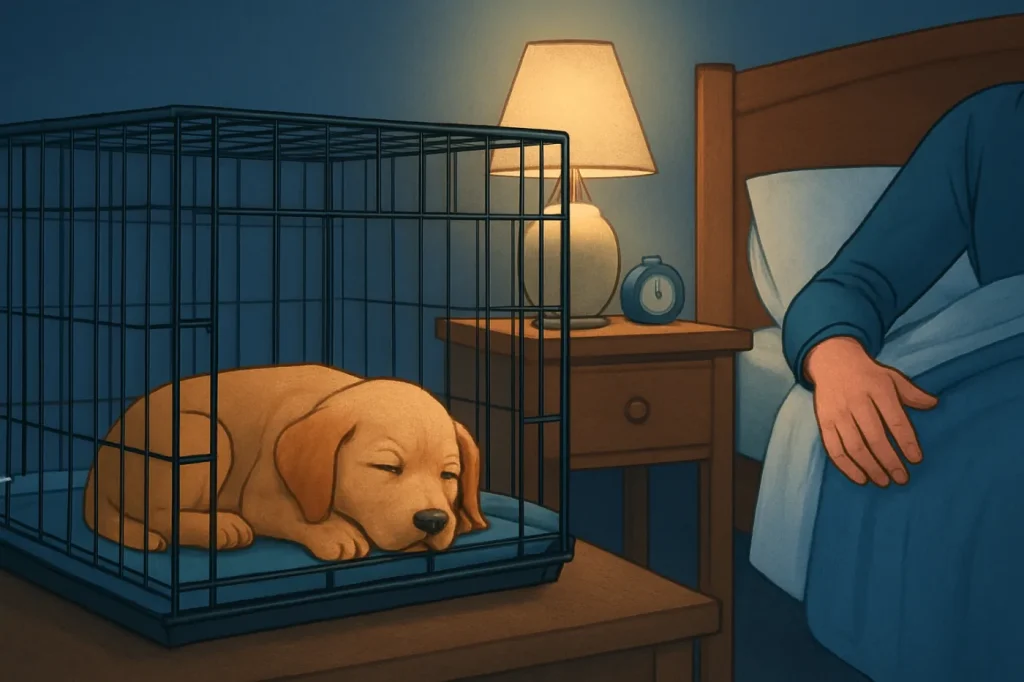
Most new owners find the first night with a puppy at home exhausting and emotional. Your puppy may cry, have accidents, and seem completely unsettled. That is normal. Your job is not to create a perfect night; it is to get through it safely while starting good habits.
Here is the practical bottom line for night one:
- Let your puppy sleep in your bedroom (or just outside it) in a crate or small pen, not loose in the house.
- Expect crying on and off for the first few nights, especially the first one.
- Plan 1–3 overnight potty trips depending on age and size, and keep them boring.
- Comfort your puppy calmly without turning it into playtime or teaching them that screaming always brings you running.
Why the first night with a puppy feels so hard
Understanding what your puppy is going through makes it easier to stay calm and consistent when you are tired.
What has changed for your puppy
- They just left their litter and mom. Until now, your puppy likely slept in a pile of warm siblings. Suddenly they are alone in a strange place with new smells and sounds.
- They do not know you yet. You know you love them; they do not yet know you are safe and reliable. That trust builds over days and weeks, not hours.
- Their bladder is tiny. Young puppies cannot hold it for long. Nighttime is when that becomes very obvious.
- They do not know the house rules. Where to sleep, where to potty, what is safe to chew—everything is brand new.
What this means for the first night
- Crying is normal. Most puppies will whine, bark, or howl at some point the first night. It is distress, not defiance.
- Sleep will be broken. Expect to be up at least once or twice. Treat it like having a newborn baby for a short time.
- Your reactions teach habits. How you respond to crying, accidents, and restlessness on night one sets patterns for the next few weeks.
Crate vs pen vs bed on the first night
The biggest decision is where and how your puppy sleeps. There is no single right answer, but some setups make house training and safety much easier.
Option 1: Crate in your bedroom
This is the most common and practical setup for many U.S. households.
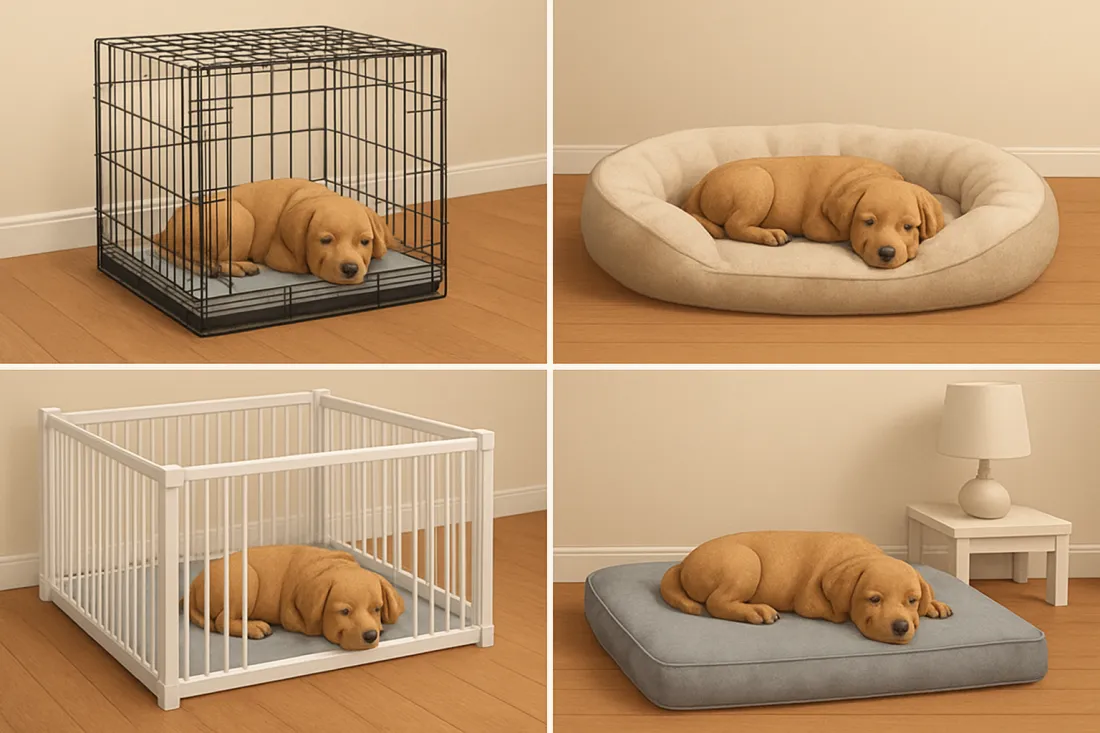
- Pros: Helps with house training, keeps the puppy safe, reduces crying because they can see and hear you, and makes it easier to hear when they need a potty break.
- Cons: Some puppies protest the crate at first; you will need to introduce it gently.
- Best for: Owners who want a well crate-trained dog, apartments or homes where accidents on carpet are a big problem, and people who want clear nighttime structure.
Option 2: Puppy pen or gated area near your bed
A small exercise pen with a bed, water, and a potty area can work if you are not ready to commit to crate training yet.
- Pros: Gives a bit more space, can include a puppy pad area, less intense for puppies who panic in a closed crate.
- Cons: Slower house training if they learn to potty in the pen, more room to chew or get into mischief.
- Best for: Very young or sensitive puppies, or owners who plan to transition to a crate later.
Option 3: Crate in another room
Some people place the crate in a living room or kitchen because the bedroom is small or they are light sleepers.
- Pros: Still supports house training and keeps the puppy safe; may let a very light sleeper rest a bit more.
- Cons: Often more crying because the puppy feels isolated; harder to tell if crying is for potty or protest.
- Best for: Owners who cannot fit a crate in the bedroom but are still willing to get up for scheduled potty breaks.
Option 4: In your bed (co-sleeping)
Many people are tempted to let the puppy sleep in their bed on night one. It can help everyone sleep more, but it has trade-offs.
- Pros: Maximum comfort and bonding, may reduce crying, easy to notice when they stir for a potty break.
- Cons: Risk of rolling on a tiny puppy, harder to transition to a crate later, more accidents in bed, can create a strong expectation of bed access.
- Best for: Owners who are comfortable with a dog in their bed long term and can manage accidents and safety.
Comparison table: first-night sleeping setups
| Sleeping setup | Best fit scenario | House training impact | Crying & comfort level | Main risks or downsides |
|---|---|---|---|---|
| Crate beside your bed | Most new owners; puppies of any size | Usually fastest progress because puppies avoid soiling their sleeping area and you can respond quickly to potty cues | Moderate crying at first, but your presence and voice can soothe without opening the crate | Requires patient crate introduction; some initial protest barking or whining is likely |
| Puppy pen or gated area in bedroom | Very young, nervous, or crate-averse puppies | Mixed: easier for you (less rushing outside), but puppy may learn to potty in the pen | Often less intense crying because they have more space and can see you | More room to chew unsafe items; slower transition to sleeping through the night without a potty area |
| Crate in another room | Owners with tiny bedrooms or very light sleepers | Still good for house training if you set alarms for potty breaks | Often more crying because puppy feels isolated; harder to tell if crying is potty or protest | Temptation to ignore all crying, which can lead to soiling the crate or extreme distress |
| In your bed (no crate) | Owners who want long-term co-sleeping and can supervise closely | Can work but accidents in bed are likely; harder to teach independence later | Usually least crying because puppy is pressed against you | Safety concerns for very small puppies, difficult to change later, may reinforce separation-related anxiety |
How to set up the puppy’s bedtime space
Once you choose crate or pen, make it feel safe and cozy, not like a punishment.
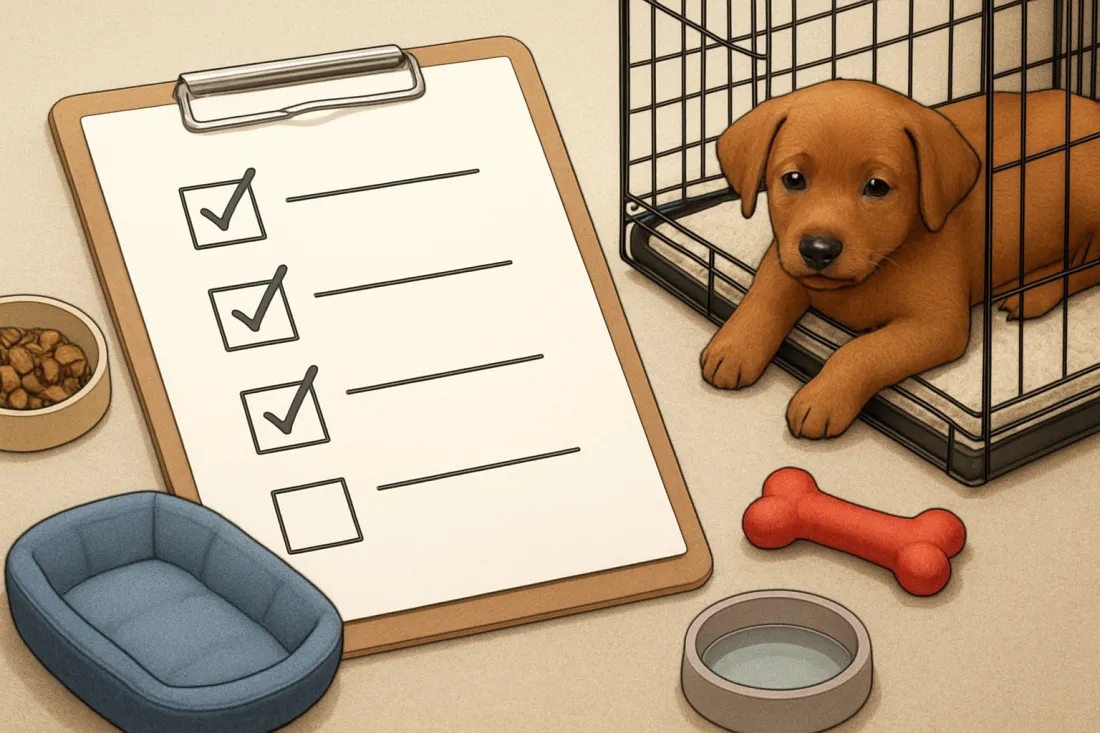
Crate or pen setup checklist
- Right size: Big enough for your puppy to stand up, turn around, and lie down comfortably, but not so big that they can potty in one corner and sleep in another.
- Location: Near your bed or where you sleep, at least for the first few nights. Being close reduces panic and lets you hear potty cues.
- Bedding: A washable blanket or crate pad. For very young puppies or heavy chewers, use something simple and safe that you do not mind washing.
- Temperature: Room should be comfortably warm, not hot. Puppies are used to body heat from littermates, so avoid drafts.
- Noise and light: Dim the room and keep noise low. A white noise machine or fan can help mask outside sounds that might startle them.
- Safety check: Remove cords, small objects, and anything chewable within reach of the crate or pen. A room-by-room guide to pet proofing a home for a new puppy can help you catch hazards.
Safe comfort options
These can make the first night less scary without creating bad habits:
- Soft toy or plush: Choose one designed for puppies, without small parts they can chew off.
- Heartbeat toy: Some products mimic a mother’s heartbeat and gentle warmth. Many owners find these reduce crying, especially for very young pups.
- Your worn T-shirt: A T-shirt you have worn (no loose buttons, zippers, or strings) can be placed in the crate so your scent is nearby.
- Chew-safe comfort item: A puppy-safe chew or teething toy can help them settle, but remove anything that could be shredded and swallowed unsupervised.
Evening routine before lights out
A predictable, calm routine makes the first night smoother and sets the pattern for future nights.
Sample pre-bed routine (adjust times to your schedule)
- Late afternoon/early evening play: Give your puppy a good play session and mental stimulation earlier in the evening so they are pleasantly tired, not wired, at bedtime.
- Early evening meal: Feed the last meal a few hours before bedtime so they have time to digest and potty before sleeping. Check your vet’s advice for meal frequency based on age.
- Calm bonding time: Gentle petting, short training sessions with treats, or quiet time on a mat help them relax and feel safe with you.
- Limit water close to bedtime: Do not remove water all evening, but you can pick up the water bowl about 1–2 hours before bed for healthy puppies, unless your vet says otherwise.
- Final potty trip: Right before you go to bed, take your puppy outside to the same potty spot on a leash. Wait quietly until they go, then calmly praise and bring them straight back in.
- Settle into sleeping spot: Place them in the crate or pen with their comfort items, say a simple cue like “bedtime,” and keep your voice low and relaxed.
Overnight potty break schedule by age
Very young puppies cannot hold their bladder all night. Planning breaks prevents accidents and teaches them that outside is the bathroom.
A common rule of thumb is that a puppy can hold their bladder for roughly their age in months plus one hour, but this is only a rough guide and often too optimistic at night. Small breeds and very young puppies usually need more frequent breaks.
Typical overnight potty needs
- 8–10 weeks old: Expect to take them out roughly every 2–3 hours at night. That might mean 2–3 trips outside.
- 10–12 weeks old: Many can manage around 3–4 hours at night, so 1–2 trips.
- 3–4 months old: Some can start to make it 4–6 hours, often just one middle-of-the-night trip.
These are general patterns, not guarantees. Always adjust based on your puppy’s size, health, and how the night is going. If your puppy wakes and cries after sleeping quietly for a while, assume they may need a potty break.
How to handle nighttime potty trips
- Keep it boring: No play, no training, no long cuddles. Quietly carry or walk them on a leash to the potty spot, wait, praise briefly when they go, and return them straight to bed.
- Use a consistent cue: A simple phrase like “go potty” can help them understand the purpose of the trip.
- Low light only: Use a nightlight or small flashlight, not full bright lights that wake everyone up.
- Back to bed immediately: If they do not go within a few minutes, calmly return them to the crate and try again later if they wake.
Handling crying without creating bad habits
Crying is the hardest part emotionally. You want to comfort your puppy, but you also do not want to teach them that screaming is the only way to get your attention.
Why puppies cry at night
- Loneliness and fear: They are not used to sleeping alone.
- Need to potty: A full bladder or bowel is uncomfortable.
- Frustration: They want to be out of the crate or pen to explore or be with you.
Step-by-step response to nighttime crying
- Pause and listen for a moment. If the crying just started and they recently had a potty break, wait a minute or two to see if they settle.
- Check the time since last potty. If it has been a couple of hours (or whatever interval you are using), assume they may need to go out.
- Use your voice first. Calmly reassure them without opening the crate: a soft “You’re okay, bedtime” in a low, steady tone.
- If it continues and potty is likely, take them out. Quietly leash or carry them, go straight to the potty spot, no play. If they go, praise and return to bed.
- If they do not potty, keep it brief. After a few minutes, go back inside and settle them again. Do not extend the trip into a fun outing.
- Once you know they are empty, avoid opening the crate for every whimper. Use your voice, a gentle tap on the crate, or place your hand near the crate for reassurance without turning it into a game.
Over a few nights, your puppy learns that:
- Crying sometimes leads to a quick, boring potty trip.
- Crying does not lead to long play sessions or sleeping in your bed if that is not your long-term plan.
- They are safe and you are nearby.
What not to do on the first night
Some reactions feel natural in the moment but make things harder in the long run.
- Do not punish crying or accidents. Yelling, banging on the crate, or scolding for a puddle only makes your puppy more anxious and confused. They are not being “bad”; they are learning.
- Do not let them free-roam the house at night. A loose puppy can chew cords, swallow objects, fall down stairs, or potty everywhere. Use a crate or small pen.
- Do not turn nighttime into playtime. If every potty trip includes toys, cuddles, and excitement, your puppy will wake you up just to have fun.
- Do not keep changing the rules mid-night. If you decide on crate beside the bed, try to stick with it for the night instead of moving them from room to room in desperation.
- Do not over-soothe every tiny whimper. Constantly rushing to them at the first sound can teach them to escalate their crying to get more attention.
Normal first-night fussing vs signs of illness
Most first-night crying is normal adjustment. Still, you should know when it might be more than that.
Normal first-night behavior
- Whining, barking, or howling when first placed in the crate or when you leave the room.
- Settling for a while, then crying again when they wake up.
- One or two soft stools or a single accident if they are stressed.
- Eating and drinking normally earlier in the day, with typical puppy energy when awake.
Warning signs that need a vet’s advice
Contact a vet or emergency clinic if you notice any of the following, especially in a very young puppy:
- Repeated vomiting or diarrhea, especially with blood or mucus.
- Refusing food and water entirely, or extreme lethargy (too weak to stand or walk normally).
- Labored breathing, persistent coughing, or wheezing.
- Bloated, painful belly, or crying when touched.
- Shivering that does not stop when they are warm and dry.
If you adopted from a shelter or breeder, check any paperwork for after-hours contact information and ask in advance what to do if you are worried on the first night.
Who should choose which first-night setup
Your home, schedule, and long-term goals should guide your decision.
If you live in an apartment
- A crate or pen in your bedroom helps you respond quickly to potty needs and keeps barking lower because your puppy can see you.
- Plan how you will get outside quickly for potty breaks (elevator, stairs, safe nighttime route).
- Consider a temporary indoor potty option if outdoor access is difficult at night, but use it consistently to avoid confusion.
If you have a house with a yard
- You can often carry your puppy straight to a fenced area for quick potty trips.
- Still keep them on a leash at night at first so they do not wander or eat things in the dark.
- A crate near your bed is still helpful for house training and safety.
If you have children in the home
- Explain that the puppy needs quiet sleep time and that nighttime is not for play.
- Keep the crate or pen in an area where adults can supervise, not in a child’s room on night one.
- Use daytime to teach kids how to interact gently and safely.
Structured first-night checklist: step-by-step plan
Use this checklist as a simple first-night plan you can follow when you are tired.
1. Before your puppy comes home
- Decide: crate, pen, or bed? Agree as a household where the puppy will sleep and what the long-term plan is.
- Set up the sleeping area near where you will sleep: crate or pen, bedding, water (if recommended), and safe comfort items.
- Puppy-proof the area and nearby rooms so there are no cords, plants, or small objects within reach.
- Confirm vet contact details and emergency clinic information and keep them in your phone.
2. Afternoon and evening of day one
- Let your puppy explore a small, safe part of the house with supervision.
- Offer meals and water according to your vet’s or breeder’s schedule.
- Take them outside frequently (about every 1–2 hours) to start the potty routine.
- Introduce the crate or pen positively during the day with treats and short, calm sessions.
3. One hour before bedtime
- Pick up the water bowl if your vet agrees, especially for very young puppies, to reduce overnight accidents.
- Have a calm play session or short walk (if fully vaccinated and your vet approves) to help them relax.
- Take them outside for a potty break and calmly praise when they go.
4. Right before you go to sleep
- Take a final potty trip to the same outdoor spot.
- Place them in the crate or pen with their comfort items.
- Use a simple bedtime cue and keep the room dim and quiet.
- Set an alarm for the first planned potty break based on their age (for example, around 2–3 hours for an 8–10 week old).
5. During the night
- When the alarm goes off, or if they wake and cry after a decent stretch of sleep, take them out for a quick, boring potty trip.
- Return them straight to bed after they go.
- If they cry again soon after a potty trip, use your voice to soothe and wait a bit before deciding whether to go back in.
- Watch for any signs of illness and be ready to call a vet if something seems wrong.
6. Morning after the first night
- Take them out for a potty break as soon as you wake up.
- Give breakfast and water, then another potty trip shortly after eating.
- Expect them to be tired and a bit clingy; keep the day calm and predictable.
- Review what worked and what did not, and adjust your plan for night two.
Common first-night mistakes to avoid
Many owners only realize these are mistakes after a few rough nights. You can skip that learning curve.
- Changing the sleeping spot every night. Consistency helps your puppy feel secure. Pick a plan and stick with it for several nights before deciding it “doesn’t work.”
- Letting them cry for hours with no breaks. Ignoring all crying can lead to soiling the crate and extreme distress. Balance comfort with structure.
- Expecting them to sleep 8 hours without a break. Very few young puppies can do this. Plan for interruptions so you are less frustrated.
- Skipping daytime structure. If the puppy naps all day with no routine, they will be wide awake at midnight. Start gentle structure from day one.
- Not planning for the long term. If you never want a dog in your bed, avoid “just this once” on night one, because puppies do not understand exceptions.
- Forgetting the bigger picture of costs and time. The first night is only the beginning; it helps to think ahead about the first year cost of a puppy and the time you will invest in training and care.
FAQ about the first night with a puppy at home
Where should a puppy sleep the first night at home?
For most families, the best place for a puppy to sleep the first night is in a crate or small pen near your bed. Being close to you reduces fear and lets you hear when they need a potty break, while the crate or pen keeps them safe and helps with house training. If your bedroom is too small, set up the crate just outside the door and keep the door open so they can still hear and smell you.
Is the first night with a puppy the hardest?
The first night is often the most emotional and chaotic because everything is new for both you and the puppy. Many owners find that nights two and three can still be rough, but usually the pattern improves as the puppy learns the routine and starts to trust that you will come back. If each night gets dramatically worse instead of slightly better, review your routine and talk with a vet or trainer to rule out health or anxiety issues.
Will a puppy cry all night the first night?
Most puppies do not cry nonstop all night, but many will have several crying episodes, especially when first put in the crate and when they wake up needing to potty. If you respond with calm, brief potty trips and quiet reassurance, they usually settle for stretches of sleep between those episodes. If your puppy truly cries for hours without a break, check that they are not hungry, cold, or ill, and consider moving their crate closer to you for extra comfort.
Should you let your puppy sleep with you the first night?
Letting a puppy sleep in your bed the first night can reduce crying and help you both rest, but it also sets a strong expectation that can be hard to change later. There are also safety concerns for very small puppies that could be rolled on or fall off the bed. If your long-term plan is for the dog to sleep elsewhere, it is usually better to start with a crate or pen beside your bed so they are close but not under the covers with you.
How long until a puppy sleeps through the night?
Many puppies start sleeping longer stretches by around three to four months of age, but it varies widely by size, health, and routine. Smaller breeds often need more frequent nighttime potty breaks for longer. Consistent daytime schedules, regular potty trips, and a calm bedtime routine all help your puppy reach full-night sleep sooner.
The first night with a puppy at home is rarely perfect, but it is the start of your life together. With a clear plan, realistic expectations, and patience, you can get through it safely and set your puppy up for better nights ahead. As you look beyond the first night, it can also help to think about your wider routine, such as a structured first 30 days with a rescue dog routine adapted for puppies, so your new family member settles in smoothly.