
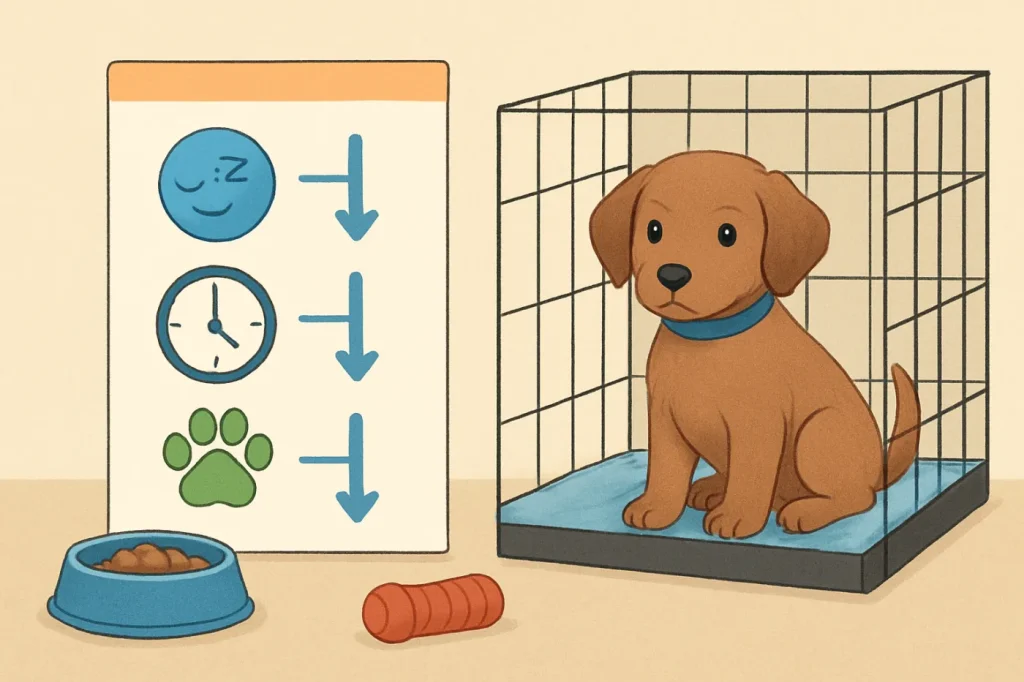
For the first week with a new puppy, think in terms of a simple rhythm, not a rigid clock: sleep → potty → short play or training → potty → sleep again. If you keep that cycle going and time potty breaks to your puppy’s age and size, you will be ahead of most new owners.
What you should understand about a first week puppy schedule
Before you start building a timetable, it helps to know what is realistic for a young puppy so you do not expect adult-dog behavior from a baby animal.
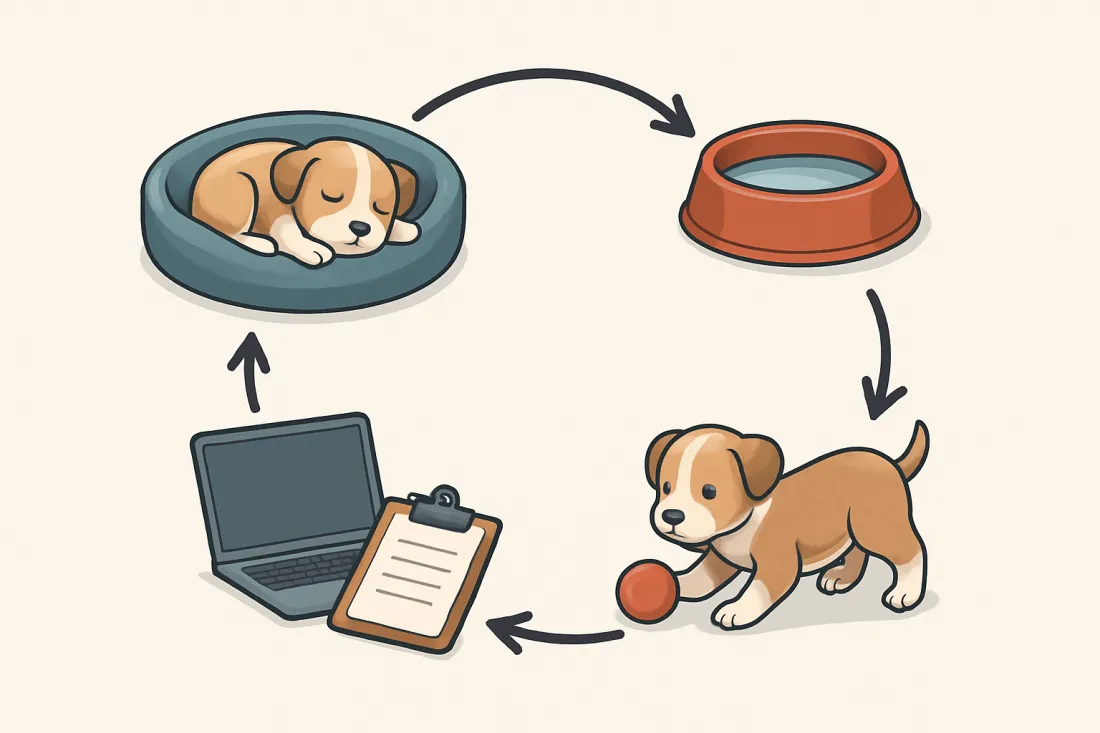
- Puppies sleep a lot: It is normal for a young puppy to sleep most of the day. Many puppies will nap or sleep for around 18–20 hours out of 24 when you add up night sleep and daytime naps.
- Bladders are tiny: A common rule trainers use is that a puppy can often hold their bladder for about their age in months, plus one hour under calm conditions. In the first week, that usually means potty breaks at least every 2–3 hours during the day, and more often for very small breeds.
- Activity comes in short bursts: Young puppies do best with 5–10 minute play or training bursts followed by rest. Long, intense sessions usually end in overtired, bitey, zoomy puppies.
- Consistency beats perfection: Your schedule does not need to be exact to the minute. What matters is a predictable order of events: wake → outside → breakfast → play → nap, and so on.
- Night waking is normal: In the first week, many puppies cannot sleep through the night without at least one potty break, especially small breeds.
Keep these points in mind as you read the sample schedules below and adapt them to your own life.
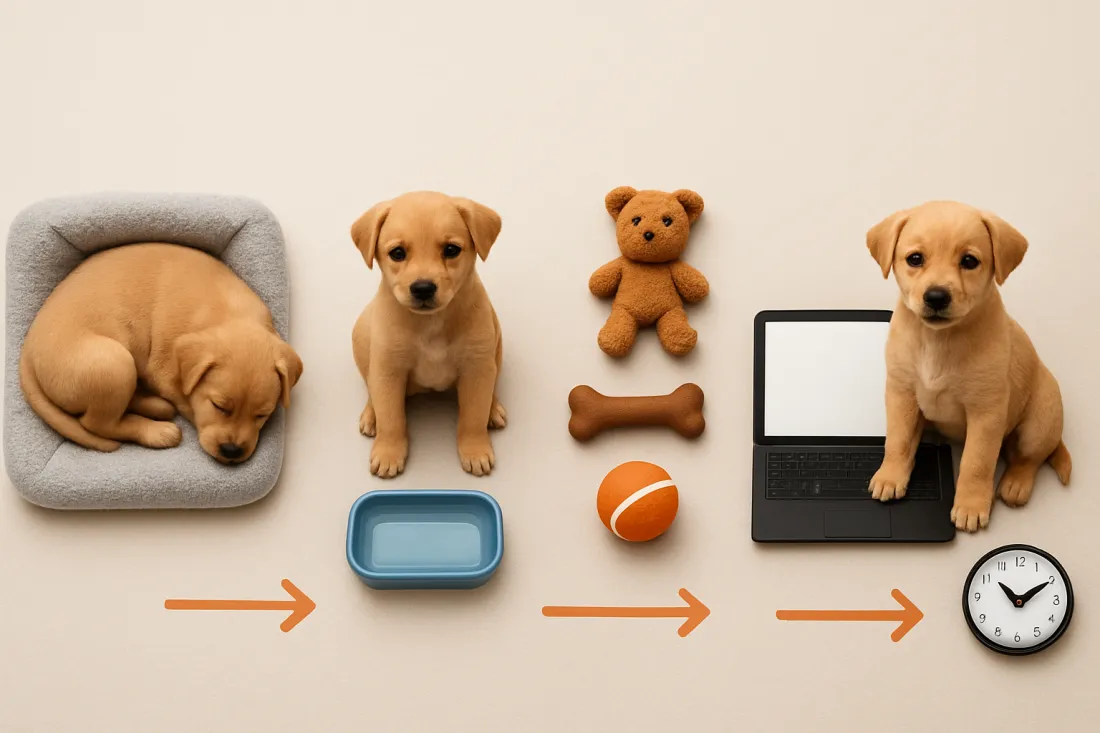
How much sleep and activity puppies actually need in week one
New owners often worry that their puppy is either too sleepy or too wild. Understanding the normal range helps you avoid over-exercising or under-stimulating your puppy.
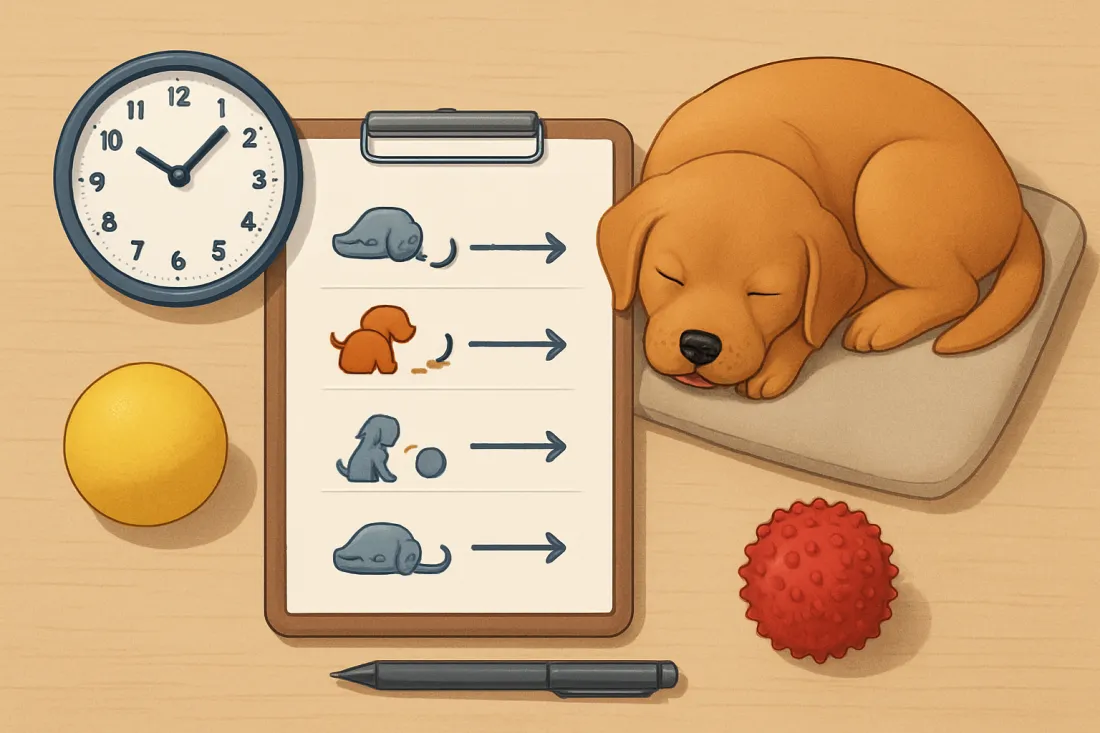
Typical sleep needs in the first week
- Total daily sleep: Many young puppies will sleep most of the day. Long naps after short play sessions are normal and healthy.
- Nap pattern: Expect your puppy to be awake for 30–90 minutes at a time, then crash for a nap. Very young or small puppies may only manage 20–30 minutes of awake time before they need rest again.
- Night sleep: Aim for a quiet, dark sleep space and a consistent bedtime routine. Your puppy may still wake once or twice to potty in the first week.
Activity and mental stimulation in week one
- Short, gentle play: Several 5–10 minute play sessions spread through the day are usually enough in week one. Focus on gentle tug, soft toys, and exploring the home, not long walks.
- Very short walks: Until vaccinations are complete, keep outdoor time focused on potty breaks and very short, safe exploration. Do not plan long walks as a main exercise source in week one.
- Brain work: Sniffing, simple training, and food puzzles are tiring in a healthy way. A few minutes of training can tire a puppy more than a long game of fetch.
If your puppy is constantly wild and cannot settle, they may be overtired. Add more naps and use the crate or pen for quiet time. If they seem unusually lethargic, check with your vet.
Potty break timing by age and size
Potty timing is the backbone of your first week schedule. Use these general guidelines and adjust for your puppy’s breed, size, and what you observe.
Key moments for potty breaks
- Immediately after waking (night or nap)
- Immediately after eating or drinking
- After play or training
- Before and after any time in the crate or pen
Beyond those key moments, use age and size to guide how often you take your puppy out.
| Puppy type | Approx. age in week one | Daytime potty break frequency | Nighttime expectation | Notes |
|---|---|---|---|---|
| Toy/small breeds | 8–10 weeks | Every 45–90 minutes while awake | Likely 1–2 potty trips overnight | Very small bladders; err on the side of more frequent breaks. |
| Medium breeds | 8–12 weeks | Every 1–2 hours while awake | Often 1 overnight potty trip | May stretch slightly longer as they settle, but do not rush it. |
| Large/giant breeds | 8–12 weeks | Every 1.5–2 hours while awake | Possibly 0–1 overnight potty trip | Bladders can be a bit larger, but young pups still need frequent breaks. |
These are starting points, not strict rules. If your puppy has accidents between scheduled breaks, shorten the gap. If they consistently stay dry, you can gradually lengthen the time.
Sample weekday schedule for working owners
This sample schedule assumes:
- You work roughly 9 a.m. to 5 p.m.
- You can come home at lunch or have a helper or dog walker.
- Your puppy is around 8–12 weeks old.
Adjust times to your own workday; keep the order of events similar.
Morning before work
- 6:00 a.m. – Wake up, go straight outside for a potty break.
- 6:15 a.m. – Breakfast, then back outside for potty.
- 6:30–7:00 a.m. – Calm play and a 5–10 minute training session (name, sit, coming to you, handling paws).
- 7:00–7:30 a.m. – Supervised free time in a puppy-safe area, then another potty trip.
- 7:30–8:30 a.m. – Nap in crate or pen while you get ready for work.
- 8:30 a.m. – Quick potty break right before you leave.
Midday support while you are at work
- 11:30 a.m.–12:30 p.m. – Someone (you, a family member, or a sitter) comes by for:
- Immediate potty break.
- Lunch (if your feeding plan includes a midday meal), then potty again.
- Short play and a 3–5 minute training session.
- Back to crate or pen with a safe chew for a nap.
If your puppy is very young or very small, they may need two visits during the workday (for example, late morning and mid-afternoon) to avoid accidents and long stretches alone.
Evening after work
- 5:00 p.m. – Arrive home, go straight outside for potty.
- 5:15–5:45 p.m. – Supervised play, gentle exploration, and a short training session.
- 5:45–6:30 p.m. – Nap in crate or pen while you prepare dinner.
- 6:30 p.m. – Dinner, then potty.
- 7:00–8:30 p.m. – Family time: puppy hangs out with you in a puppy-proofed area, with a couple of short play or training bursts and at least one more potty break.
- 8:30–9:30 p.m. – Wind-down: calm chewing, cuddles, limited excitement, final potty trip right before bed.
Overnight for working owners
- Expect to set an alarm or respond if your puppy fusses to go out once during the night.
- Keep overnight potty trips very boring: outside, potty, praise, back to bed.
If your work schedule is longer or you cannot come home midday, plan for reliable help (family, neighbor, or professional sitter). Leaving a young puppy alone all day without potty breaks is not realistic or fair.
Sample first week schedule for stay-at-home owners
If you are home most of the day, you have more flexibility, but your puppy still needs structure. The goal is to balance together time with short, planned alone time so your puppy does not become overly dependent.
Morning for stay-at-home owners
- 7:00 a.m. – Wake and potty.
- 7:15 a.m. – Breakfast, then potty again.
- 7:30–8:00 a.m. – Play and a 5–10 minute training session.
- 8:00–9:30 a.m. – Nap in crate or pen while you do quiet tasks.
Late morning to afternoon
- 9:30 a.m. – Potty, then short play or sniffy exploration.
- 10:00–11:00 a.m. – Supervised free time near you; offer a chew or simple food puzzle.
- 11:00 a.m. – Potty, then nap in crate or pen.
- 12:30 p.m. – Lunch (if using three meals), potty, then a short training session.
- 1:00–2:30 p.m. – Quiet afternoon nap.
Late afternoon and evening
- 2:30 p.m. – Potty and gentle play.
- 3:00–4:00 p.m. – Supervised time with the family, then another potty break.
- 4:00–5:30 p.m. – Nap in crate or pen (this is a good time to practice being in another room from you).
- 5:30 p.m. – Dinner, then potty.
- 6:00–8:00 p.m. – Family time, a couple of short training or play bursts, and at least one more potty trip.
- 8:30–9:30 p.m. – Calm wind-down, last potty, then bedtime.
Even if you are home, build in short, planned alone periods in the crate or pen so your puppy learns that being alone is safe and normal.
Comparison table: working owner vs stay-at-home puppy schedule
Use this table to see how the same puppy needs can be met in different lifestyles and to choose what to prioritize in your own routine.
| Schedule element | Working owner (out of home 9–5) | Stay-at-home owner | Key decision point |
|---|---|---|---|
| Morning routine | Earlier start, condensed play and training before work. | More relaxed morning with extra short sessions. | Choose earlier wake-up vs. shifting some activity to evening. |
| Midday potty breaks | Requires helper or sitter for 1–2 visits. | Owner can provide frequent short breaks. | Decide who can reliably cover daytime potty needs. |
| Alone time | Longer stretches alone; crate or pen and enrichment are essential. | Must be scheduled on purpose so puppy does not become clingy. | Balance social time with planned independence. |
| Training sessions | Short sessions before work, at lunch visit, and in the evening. | More, smaller sessions spread throughout the day. | Fit 3–5 mini sessions into natural daily transitions. |
| Owner rest time | Evening can feel busy; use crate naps to recharge. | More flexibility, but easy to overdo interaction. | Protect your own rest so you can stay consistent. |
Short training sessions to start in the first week
Training in week one should be light and fun. Think of it as teaching your puppy how to live in your home, not drilling obedience.
Core skills to introduce
- Name recognition: Say the puppy’s name once, reward when they look at you.
- Coming to you: Call in a happy voice from a few feet away, reward generously when they arrive.
- Sit: Lure their nose up with a treat so their bottom goes down, then reward.
- Handling: Briefly touch paws, ears, collar, and reward so vet care and grooming are easier later.
- Crate or pen is safe: Toss treats inside, feed meals there, and let the puppy go in and out freely at first.
How to structure training in your schedule
- Do 3–5 minute sessions, 3–5 times per day.
- Attach them to existing events: after breakfast, after lunch, early evening, and before bed.
- End while your puppy is still engaged; do not wait until they are frustrated or distracted.
Safe socialization in the first week
Socialization is about gentle exposure to the world, not overwhelming your puppy. In the first week, focus on safe, low-pressure experiences.
What to include in early socialization
- Household sounds: TV, vacuum at a distance, doorbell, dishwasher. Pair with treats and calm behavior.
- Surfaces: Carpet, tile, grass, concrete, a low step. Let your puppy explore at their own pace.
- People: A few calm visitors or family members, one or two at a time. Let the puppy choose to approach.
- Car rides: Very short, positive trips where nothing scary happens.
What to avoid in week one
- Crowded places where many unknown dogs gather.
- Dog parks or pet store floors where vaccination status is unknown.
- Long, exhausting outings that disrupt naps and potty timing.
Ask your vet what is safe based on your puppy’s vaccination status and local disease risks, and adjust your socialization plan accordingly.
Managing alone time to prevent separation issues
Even in the first week, it is important that your puppy learns that being alone is temporary and safe. This is easier to build from day one than to fix later.
How to build alone time into the schedule
- Start with your puppy in a crate or pen while you are still in the room, then gradually move farther away.
- Practice short absences: step out of the room for 30 seconds, then a minute, then a few minutes.
- Pair alone time with something pleasant, like a safe chew or a stuffed food toy.
- Use normal departures and arrivals: no long, emotional goodbyes or excited greetings.
Signs to slow down your alone-time training
- Continuous, intense distress (screaming, frantic escape attempts) that does not settle after a few minutes.
- Refusal to eat or play with chews when alone.
- Accidents only when left alone, despite good potty habits otherwise.
If you see these signs, shorten the alone-time duration and build up more gradually. If distress is severe or does not improve, consider working with a qualified trainer or behavior professional.
Structured checklist: build-your-own first week puppy schedule
Use this checklist to design a schedule that fits your life and your puppy’s needs. Go through it step by step and adjust as you learn your puppy’s patterns.
- Map your fixed human commitments
- Write down work hours and commute.
- Add school runs, appointments, and regular activities.
- Mark any times when no adult is home.
- Mark non-negotiable puppy potty needs
- Potty on waking and before bed.
- Potty after every meal and nap.
- Extra breaks every 45–120 minutes while the puppy is awake, depending on age and size.
- Place meals across the day
- Decide on 3 or 4 meals per day based on your vet’s guidance.
- Space meals evenly during your waking hours.
- Avoid feeding right before long crate times when possible.
- Insert short training sessions
- Add 3–5 minute sessions after breakfast, midday, and early evening.
- Focus on name, coming when called, sit, and handling.
- Keep sessions upbeat and end on a success.
- Block off nap times
- Plan for your puppy to nap after each play or training burst.
- Use the crate or pen for at least some naps to build comfort.
- Protect nap time from visitors and noisy activities when you can.
- Schedule safe socialization moments
- Plan one or two brief exposures per day (new sound, surface, person, or car ride).
- Keep them short and positive; stop before your puppy is overwhelmed.
- Check with your vet about what is safe outside your home.
- Plan alone-time practice
- Schedule at least 1–2 short crate or pen sessions daily while you are home.
- Start with a few minutes and slowly increase as your puppy stays relaxed.
- Pair alone time with a safe chew or food toy.
- Review and adjust after a few days
- Notice when accidents happen and add a potty break before those times.
- If your puppy is wild in the evening, add an extra nap earlier in the afternoon.
- If you are exhausted, simplify: fewer visitors, shorter training, more rest for everyone.
Common mistakes with first week puppy schedules
Knowing what to avoid can save you a lot of stress and cleanup.
- Expecting a full night’s sleep immediately: Most young puppies cannot hold it all night in week one. Plan for at least one quick potty trip.
- Too much freedom too soon: Allowing a puppy to roam the whole house makes potty training and supervision much harder. Use gates, pens, and a crate.
- Over-exercising: Long walks or hours of rough play can stress growing joints and lead to overtired behavior problems.
- Underestimating potty needs: Waiting “to see if they ask” often leads to accidents. Take them out on a schedule, especially after sleep, food, and play.
- No planned alone time: Keeping the puppy with you every second can feel loving but makes later separations harder.
- Inconsistent rules: Allowing couch access one day and forbidding it the next confuses your puppy. Decide house rules early and stick to them.
- Skipping rest for social visits: Back-to-back visitors and outings can overwhelm a puppy and disrupt their rhythm.
What to do next after setting your first week puppy schedule
Once you have a draft schedule, treat it as a living plan that you adjust as you learn more about your puppy.
- Watch your puppy’s signals: Adjust potty timing, nap length, and play intensity based on what you see.
- Track patterns for a few days: Note when accidents happen, when your puppy gets wild, and when they naturally nap. Tweak the schedule to match.
- Prepare your home: Puppy-proof key areas so you can relax during supervised free time. If you live in an apartment, guidance on how to pet proof an apartment for a new puppy can help you set up safe zones.
- Plan for costs and support: Food, vet care, training help, and pet sitters are part of responsible pet ownership. To budget beyond week one, you can look at the first year cost of a puppy or even compare it with a kitten using a first year cost of owning a puppy or kitten guide.
- Be kind to yourself: The first week is tiring. Imperfect days happen. Consistency over time matters more than any single rough night.
FAQ about first week puppy schedules
What is the most important thing to prioritize in a first week puppy schedule?
The top priority is potty timing tied to your puppy’s natural rhythms: after waking, after eating or drinking, after play, and before and after crate time. If you consistently get your puppy outside at those moments and offer frequent additional breaks based on age and size, house training usually progresses much faster. Training, socialization, and play can be built around that potty framework.
How often should I play with my puppy during the first week?
Think in terms of many short play bursts instead of a few long sessions. For most young puppies, several 5–10 minute play or training sessions spread through the day are enough, with naps in between. If your puppy starts biting harder, zooming nonstop, or ignoring you, that often means they are overtired and need a rest more than more play.
What mistakes should I avoid when following a first week puppy schedule?
Avoid treating the schedule like a rigid checklist that ignores your puppy’s signals. Common mistakes include waiting too long between potty breaks, skipping naps because visitors want to play, and never practicing alone time. Use the schedule as a guide, but adjust if your puppy seems consistently overtired, frantic, or is having frequent accidents.
What if my work schedule does not match the sample first week puppy schedule?
If your hours are very early, very late, or longer than a typical workday, use the structured checklist above to build a custom routine. Start by blocking your fixed work times, then layer in potty breaks, meals, naps, and short training sessions wherever you or a helper can reliably provide them. The exact clock times matter less than meeting the basic needs: frequent potty trips, plenty of sleep, gentle activity, and some planned alone time.
What should I focus on after the first week with my puppy?
After the first week, keep the same basic rhythm but gradually stretch potty intervals as your puppy stays dry, add slightly longer training sessions, and expand safe socialization experiences. You can also start thinking about puppy classes, long-term budgeting, and how your routine will change as your puppy grows. The habits you build in the first week—consistent potty timing, gentle training, and calm alone time—will make the next stages much easier.