
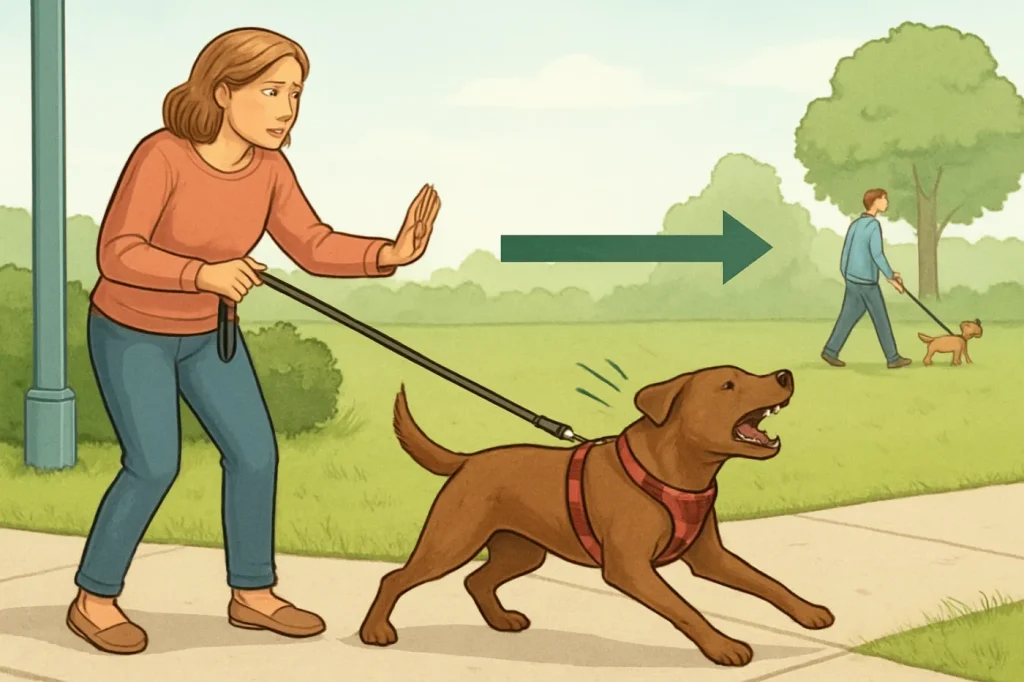
To avoid leash reactivity in dogs, combine three things on every walk: enough distance from triggers, calm and consistent handling, and reward-based training that changes how your dog feels about what they see. Most dogs can improve when owners manage the environment, use the right equipment, and follow a simple step-by-step plan.
What leash reactivity is and why it happens
Leash reactivity is when a dog barks, lunges, growls, or whines intensely at triggers (usually other dogs, people, bikes, or cars) while on leash. Off leash, the same dog may be friendly or neutral, which can be confusing for owners.
Leash reactivity is usually driven by one or more of these emotions:
- Fear or insecurity – the dog feels unsafe and tries to drive the trigger away.
- Frustration – the dog wants to greet or chase but the leash prevents it, so energy explodes outward.
- Learned habit – the dog has discovered that barking and lunging make things happen (the other dog leaves, the owner crosses the street, or the dog gets to move forward).
The leash itself changes how dogs behave:
- It removes choice – the dog cannot move away or approach freely.
- It can add tension – a tight leash changes body language and can make dogs feel trapped.
- It often transmits owner stress – if you tense up, your dog may read that as “danger.”
Understanding that reactivity is emotional, not “stubbornness” or “dominance,” is key. The goal is to change how your dog feels, not just suppress the behavior.
Risk factors: which dogs are more likely to become leash reactive
Any dog can become leash reactive, but some situations raise the risk. Use these as early warning signs, not labels.
Common risk factors
- Age
- Adolescents (roughly 6–24 months) often show a spike in reactivity as hormones, energy, and confidence change.
- Under-socialized adults may react strongly because they lack positive experiences with the world.
- Past experiences
- History of being charged, attacked, or scared by another dog or person.
- Repeated exposure to triggers at too close a distance with no way to escape.
- Frequent yelling, leash jerks, or punishment around triggers, which can make them feel even more unsafe.
- Genetics and temperament
- Dogs bred for guarding, herding, or protection may be more sensitive to movement and strangers.
- Very high-energy or intense dogs can tip into frustration quickly when restrained.
- Environment and routine
- Living in a busy urban area with constant close encounters and little space to move away.
- Always walking on tight, short leashes with no chance to sniff or decompress.
- Inconsistent rules – sometimes allowed to pull toward dogs, sometimes punished for it.
Risk factors are not destiny. They simply mean you should be more proactive with prevention and management.
Prevention strategies for puppies and new dogs
Preventing leash reactivity is much easier than fixing it later. With puppies and newly adopted dogs, focus on calm, positive experiences and clear communication.
1. Start with decompression, not crowded walks
- For the first days or weeks with a new dog, prioritize quiet, low-pressure walks over busy sidewalks or dog parks.
- Let your dog sniff, explore, and move at a relaxed pace instead of marching in a straight line.
- Avoid overwhelming them with lots of dogs, kids, or traffic until they seem comfortable with basics.
2. Teach leash skills before big challenges
Before asking your dog to handle crowded environments, build these foundations in calm areas:
- Name response – say their name, reward eye contact.
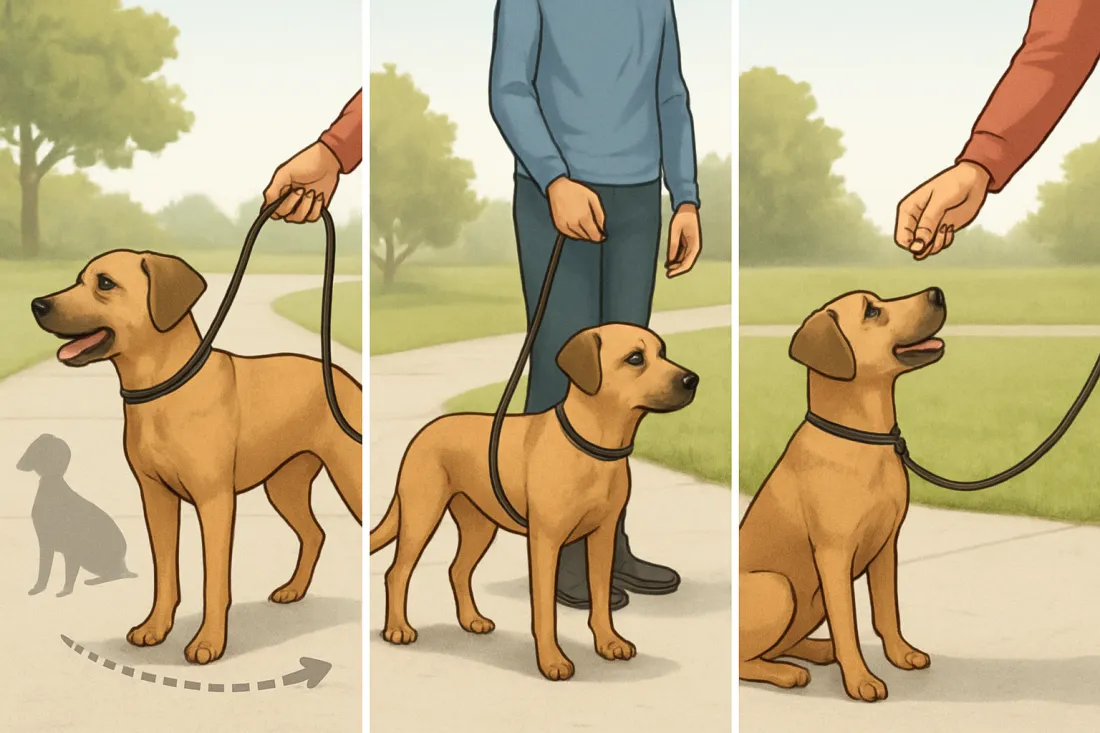
- Hand target – teach your dog to touch your hand with their nose; this becomes a way to guide them past triggers.
- Loose-leash walking – reward your dog for walking near you with a slack leash, even if it is just a few steps at first.
3. Create positive associations with the world
- When your puppy or new dog notices a dog, person, bike, or stroller at a comfortable distance, calmly say “yes” or use a marker word and feed a treat.
- Do not lure them closer; just pair the sight of the trigger with something good.
- Keep sessions short and end while your dog is still relaxed.
4. Protect them from bad experiences
- Politely decline off-leash greetings with unknown dogs, especially if the other dog is rushing or the owner cannot recall them.
- Avoid letting children run up and hug your dog; instead, coach calm, gentle interactions or skip them entirely.
- If your dog seems unsure, increase distance rather than forcing them to “face their fears.”
Choosing and using equipment: harnesses, head collars, and what to avoid
The right gear will not fix emotions by itself, but it can make walks safer and give you more control while you work on training.
| Equipment type | Best for | Benefits | Risks / what to watch | How it fits into a reactivity plan |
|---|---|---|---|---|
| Front-clip harness | Most pet dogs, especially pullers | Reduces pulling leverage, protects neck, gives better steering | Can rub if poorly fitted; some dogs dislike putting it over the head | Good default choice; combine with reward-based loose-leash training |
| Back-clip harness | Calmer walkers, small dogs, or as a secondary attachment | Comfortable, simple to use, less likely to tangle | Can encourage pulling in strong dogs | Fine for dogs with minimal pulling; not ideal if you struggle with control |
| Head collar | Strong, powerful dogs with owners needing extra control | Gives precise control of head direction, can reduce lunging impact | Requires careful introduction; sudden jerks can strain neck if misused | Use with professional guidance; pair with calm, slow handling and training |
| Flat collar | Dogs with good leash manners | Simple, familiar, holds ID tags | Pressure on neck if dog pulls or lunges | Can be used with a harness (ID on collar, leash on harness) |
| Harsh aversive tools (prong, choke, shock) | Often marketed for “stopping pulling” | May suppress behavior quickly | Can increase fear, pain, and association of triggers with discomfort | Generally best avoided for reactive dogs; focus on behavior change, not pain |
Whatever you choose, check local rules about leashes and control. For broader context on legal responsibilities, see guidance on US leash laws and dog owner responsibilities.
Step-by-step management and training plan
This plan combines management (preventing outbursts) with counterconditioning (changing emotions) and desensitization (gradually increasing difficulty). Adjust the pace to your dog.
Step 1: Identify triggers and thresholds
- List what your dog reacts to: other dogs, men with hats, kids on scooters, cars, etc.
- Observe the distance at which your dog can notice the trigger but still:
- Can eat treats.
- Can respond to their name.
- Has a mostly loose body and soft eyes.
This is your dog’s working distance.
- If your dog is already barking or lunging, you are too close. Increase distance immediately.
Step 2: Change the picture of walks
- Choose quieter routes and times of day with fewer triggers.
- Give your dog more sniffing opportunities; sniffing helps lower arousal.
- Keep the leash loose whenever possible. Avoid constant tension.
- Carry high-value treats your dog loves and a treat pouch for easy access.
Step 3: Start distance-based counterconditioning
- Begin in a location where you can control distance (large park, parking lot edge, wide sidewalk).
- When your dog notices a trigger at a safe distance, calmly say your marker word (for example, “yes”) and feed several small treats one after another.
- When the trigger disappears or you turn away, stop feeding.
- Your dog learns: “When that thing appears, good stuff happens.”
Repeat many short sessions. You are not asking for obedience yet; you are changing the emotional association.
Step 4: Add simple behaviors for structure
Once your dog can see triggers at a distance without exploding, add easy behaviors that give them a job:
- Look at me – say their name, reward eye contact.
- Hand target – ask for a nose touch to your hand as you pass a trigger.
- Let’s go – a cue that means “turn with me and move away.”
Practice these away from triggers first, then use them when a trigger appears at a manageable distance.
Step 5: Gradually decrease distance and increase difficulty
- When your dog consistently stays calm at one distance, take one small step closer in later sessions.
- Change only one variable at a time – distance, number of triggers, or movement. Do not suddenly add all three.
- If your dog reacts, you have gone too far. Next time, increase distance again and progress more slowly.
Step 6: Plan for setbacks
- Expect ups and downs. Weather, health, and random surprises can affect your dog.
- After a bad walk, give your dog a day or two of easier routes and more decompression.
- Keep notes (see checklist below) so you can see overall progress, not just one bad day.
Structured checklist for safe walks and tracking progress
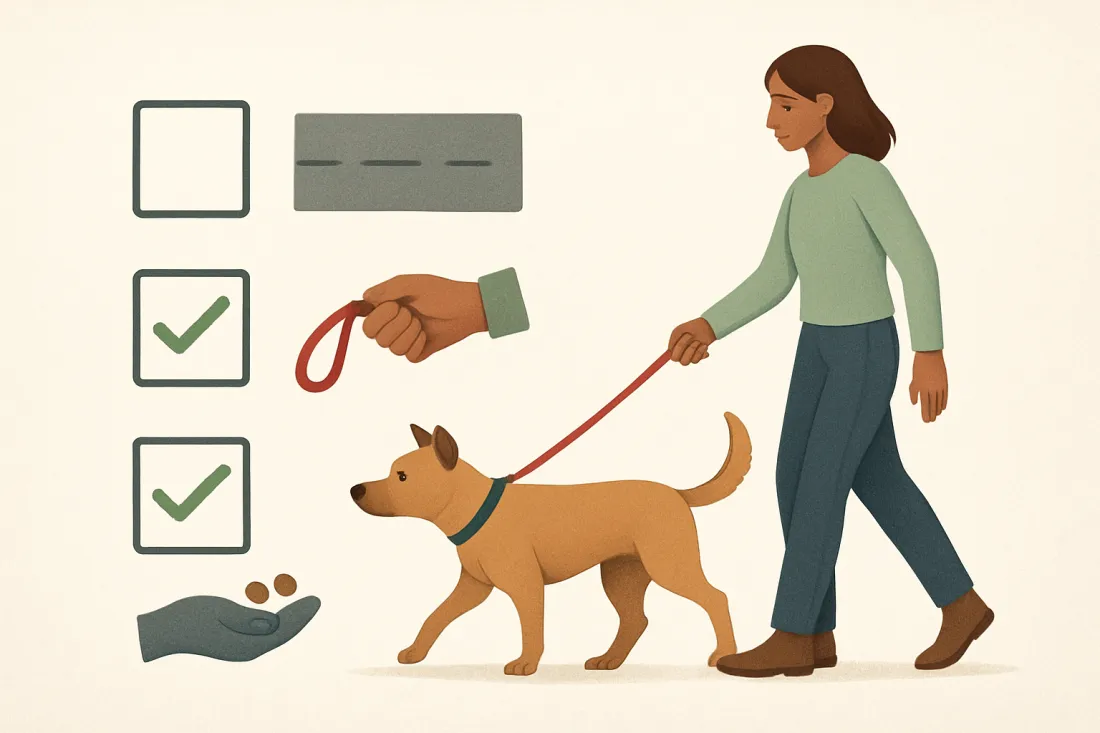
Use this checklist before, during, and after walks to stay consistent and notice improvement.
Before the walk
- My dog has had a chance to toilet and drink recently.
- I chose a route that matches today’s energy and stress level (quieter if my dog is already amped up).
- Harness and collar are fitted correctly (no rubbing, not too loose).
- I have high-value treats and a pouch ready.
- I feel reasonably calm and have a plan for what to do if we see triggers.
During the walk
- I keep the leash mostly loose, avoiding constant tension.
- When my dog notices a trigger at a safe distance, I mark and treat calmly.
- If a trigger appears too close, I turn away early using “let’s go” instead of waiting for an explosion.
- I allow sniff breaks to help my dog decompress.
- I avoid scolding or yanking; I focus on creating distance and then rewarding calm.
After the walk
- I rate my dog’s overall reactivity from 1 (very calm) to 5 (very reactive).
- I note the closest distance where my dog stayed calm.
- I record any surprises (loose dogs, loud noises) that may have affected behavior.
- I plan one small adjustment for the next walk (different route, more distance, better timing of treats).
Over time, you should see the average rating go down and the comfortable distance get shorter. If things are not improving after several weeks of consistent work, it is a good time to involve a professional.
Safety tips for encounters with other dogs and people
Even with a solid plan, surprises happen. Your priority is safety for your dog, other dogs, and people.
1. Learn and use “U-turn” and “hide-and-seek” moves
- U-turn: Before your dog explodes, cheerfully say “let’s go!” and turn 180 degrees, feeding treats as you move away.
- Hide-and-seek: Step behind a parked car, hedge, or driveway entrance to break line of sight while feeding treats.
2. Advocate for your dog with other owners
- If you see an off-leash dog or an owner letting their dog drag them toward you, call out calmly: “Please call your dog, mine needs space.”
- Do not feel obligated to allow greetings, even if the other dog is “friendly.” Your dog’s emotional safety comes first.
3. Manage greetings with people
- If your dog is nervous around strangers, ask people to ignore your dog at first – no eye contact, no reaching over the head.
- Let your dog approach and retreat at their own pace, or skip greetings entirely if they are too stressed.
- For dogs that get overexcited, practice sit for greetings with familiar people before trying it with strangers.
4. Know when to leave
- If your dog has already had one big outburst, consider shortening the walk and heading home via a quieter route.
- Multiple explosions in one walk can keep arousal high and slow progress.
Common mistakes that make leash reactivity worse
Avoiding these pitfalls can speed up progress and protect your dog’s trust.
- Getting too close, too fast
- Flooding your dog with triggers at close range (“they’ll get used to it”) often backfires and increases fear.
- Punishing the outburst
- Yelling, jerking the leash, or using pain-based tools may stop the behavior in the moment but can make your dog associate triggers with pain, worsening the underlying emotion.
- Letting your dog practice lunging
- Repeatedly walking the same busy route without a plan allows the behavior to become a habit.
- Inconsistent rules about greetings
- Sometimes allowing your dog to drag you to other dogs and sometimes not can create frustration and confusion.
- Ignoring early warning signs
- Staring, stiff body, closed mouth, or slow tail wag can come before barking. Intervene early by increasing distance.
- Expecting overnight change
- Leash reactivity usually builds over time and takes weeks or months of consistent practice to improve.
Decision criteria: when you can DIY and when to seek professional help
Many owners can make good progress on their own, but some situations call for a certified trainer or behavior professional.
DIY is usually reasonable when
- Your dog’s reactivity is mild to moderate – barking or lunging but able to recover quickly once distance is increased.
- There is no history of bites to people or other dogs.
- You can control the environment enough to practice at safe distances.
- You are able to carry treats, watch your dog’s body language, and stay reasonably calm.
Seek help from a certified trainer or behaviorist when
- Your dog has bitten or made serious attempts to bite a person or another dog.
- Reactivity is severe – your dog cannot eat, cannot respond to you, or stays agitated long after triggers are gone.
- You feel afraid of your dog’s behavior or of losing physical control.
- There are multiple behavior issues (for example, reactivity plus separation distress or aggression at home).
- You have worked consistently for several weeks with no improvement or things are getting worse.
When looking for help, prioritize professionals who use reward-based, force-free methods and who are experienced with fear and reactivity, not just basic obedience.
FAQ: avoiding leash reactivity in dogs
How can I tell if my dog is starting to become leash reactive, not just excited?
Early signs of leash reactivity often show up before full barking and lunging. Watch for your dog freezing and staring at triggers, a suddenly stiff body, closed mouth after previously panting, or a tail that goes from loose to tight and high. You might also notice whining, pacing, or pulling straight toward other dogs or people. If you see these signs, increase distance, turn away, and start pairing the sight of triggers with treats at a safer distance instead of waiting for a full outburst.
What is the first thing I should change on walks to reduce leash reactivity?
The most impactful first change is usually to increase distance from triggers and choose quieter routes. Many dogs react simply because they are repeatedly forced into close encounters they cannot handle. By walking at times and in places where you can keep a comfortable buffer, you give your dog a chance to stay under threshold and learn new patterns. Combine this with carrying high-value treats and rewarding your dog whenever they notice a trigger and remain calm.
Should I let my reactive dog greet other dogs to “get it out of their system”?
For most leash-reactive dogs, forcing greetings does not help and can make things worse. If your dog is reacting from fear, being pushed into close contact can increase that fear. If they are reacting from frustration, occasional greetings can make them pull and bark harder next time because they expect to reach the other dog. It is usually safer to skip greetings with unfamiliar dogs and focus on calm walking at a distance. Controlled, positive interactions with carefully chosen dogs can be helpful later, ideally with guidance from a professional.
What should I do next after learning about how to avoid leash reactivity?
Pick one or two changes to start with instead of trying to fix everything at once. For example, switch to a well-fitted front-clip harness, choose a quieter walking route, and begin pairing the sight of other dogs with treats at a safe distance. Use the checklist above to track each walk for at least two weeks. If you do not see any gradual improvement or you feel overwhelmed, reach out to a certified trainer or behaviorist who uses reward-based methods to build a tailored plan for you and your dog.