
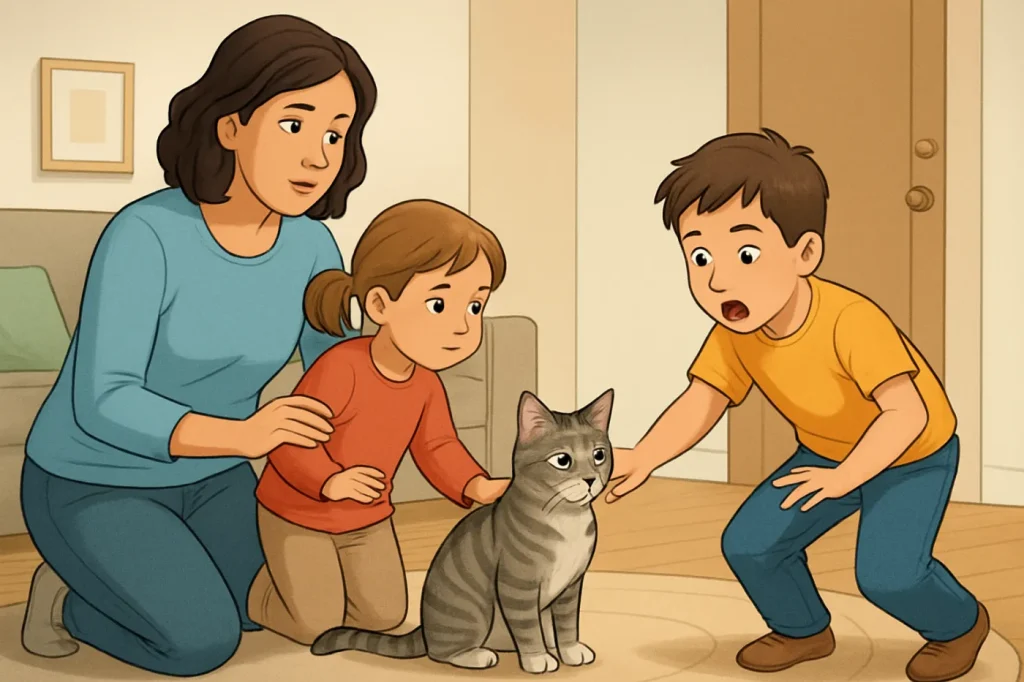
To safely introduce a cat to a family with young children, give the cat its own quiet room at first, teach kids clear “cat rules,” and let all contact be cat-led and supervised. Go slowly over the first week, watch for stress or aggression from either side, and pause if anyone seems overwhelmed.
Why bringing a cat into a home with kids can be wonderful – and risky
A well-managed introduction can give your children a gentle, loving companion and teach them empathy and responsibility. But rushed or chaotic introductions can lead to bites, scratches, fear of animals, and a stressed or even unsafe cat.
Key things to understand before you start:
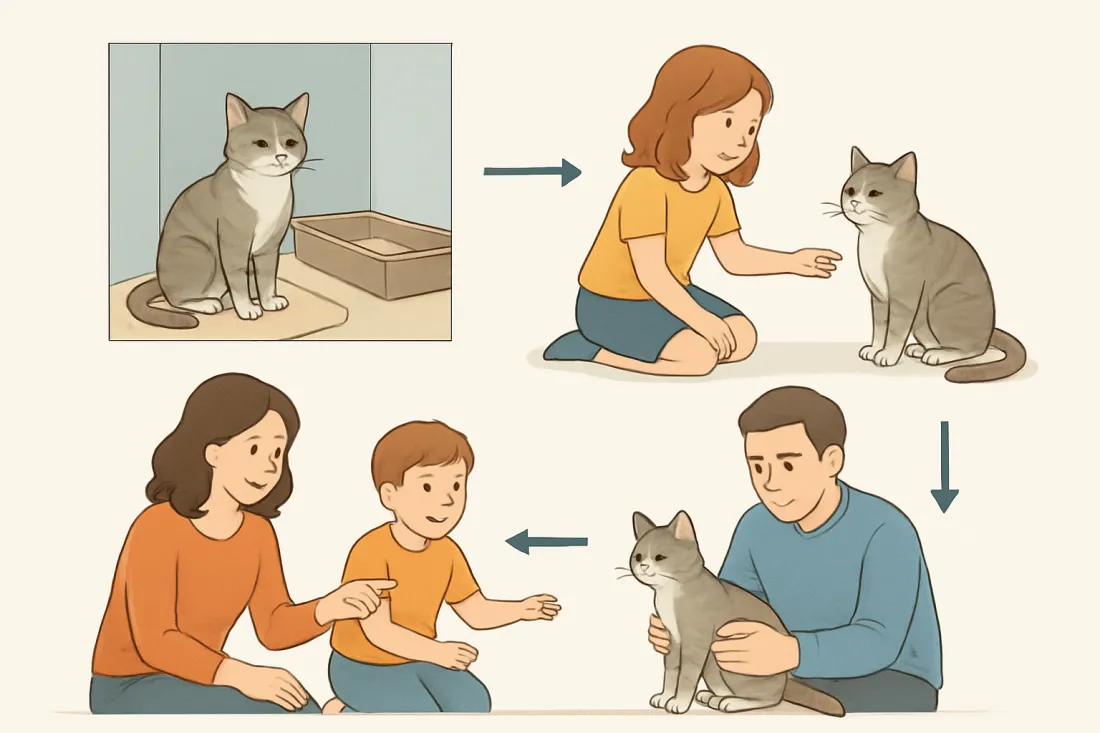
- Cats are prey and predators. Sudden movements, loud noises, and grabbing can trigger fear or defensive scratching.
- Young children (especially under 6) often move fast, shout, and grab – exactly what many cats find scary.
- Most problems come from going too fast: forcing the cat to be held, letting kids chase, or giving the cat no safe space.
- A calm, step-by-step plan usually prevents injuries and helps the cat settle faster.
Pre-adoption checklist for families with young children
Before you choose a cat, check that your family, home, and expectations are ready. Use this as a decision tool, not just a wish list.
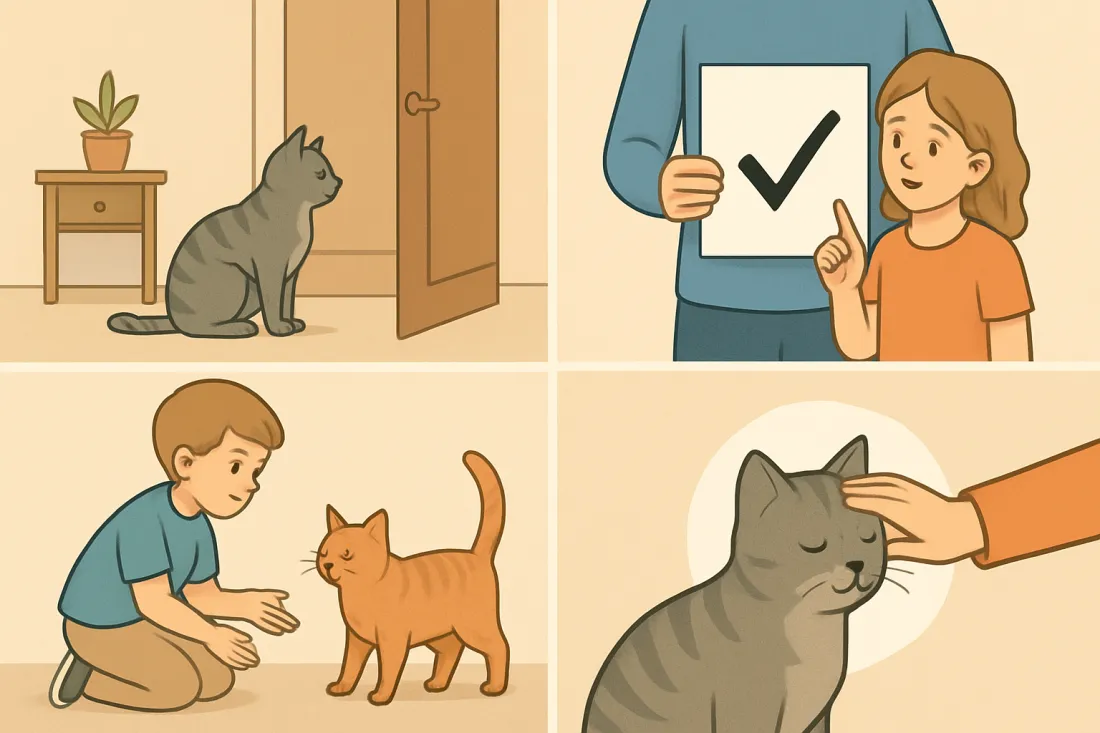
1. Kids’ ages and behavior
- Under 3 years: Children this age cannot reliably follow rules. Plan for constant adult supervision during any cat contact and expect to keep the cat’s safe room off-limits much of the time.
- 3–6 years: Many kids can learn simple rules (“gentle hands,” “no chasing”) but still need close supervision and reminders.
- 7+ years: Older kids can help with care and usually follow more detailed safety rules, but they still need guidance at first.
Ask yourself:
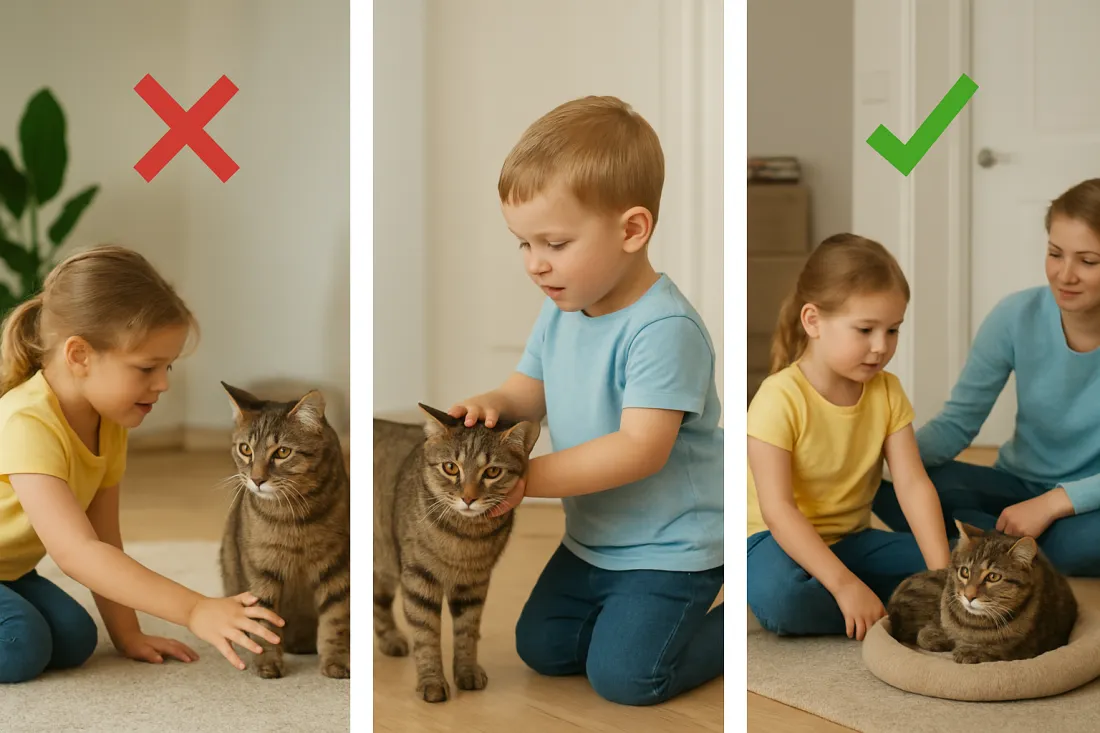
- Can my child stop immediately when I say “hands off the cat”?
- Does my child understand that animals feel pain and fear?
- Is anyone in the home rough with toys or prone to hitting when frustrated?
If the honest answer is “not yet,” you may still adopt, but you must commit to tighter supervision and slower introductions.
2. Choosing the right cat temperament
For families with young children, temperament matters more than looks or age. When you talk to a shelter, rescue, or breeder, describe your kids and ask specifically about:
- History with children: Has the cat lived with or been fostered around kids before? How did it react?
- Handling tolerance: Does the cat accept gentle petting? Does it nip or swat when touched on paws, tail, or belly?
- Energy level: High-energy cats may enjoy active play but can also get overstimulated. Very shy cats may hide for weeks in a busy home.
- Health status: Ask whether the cat is up to date on core vaccinations and has been seen by a vet recently.
Many families do best with an adult cat that has a known personality, rather than a kitten that is still learning boundaries and may scratch more during play.
3. Home setup and safe spaces
Before the cat arrives, plan where it can feel safe and where kids will be allowed to interact.
- Safe room: A quiet room with a door that closes (bedroom, office, or large bathroom). This is the cat’s base camp for the first days.
- Vertical escape routes: Cat tree, shelves, or sturdy furniture the cat can jump onto to get away from kids.
- Kid-free zones: Decide which areas are off-limits to children so the cat always has a retreat.
- Litter box privacy: Place the box where kids are unlikely to play. Children should not handle litter.
4. Time, budget, and long-term commitment
Adding a cat means ongoing costs (food, litter, vet care) and time for play, cleaning, and training kids. If you are still weighing the financial side, you may find it helpful to read about realistic pet costs for families with children so you are not surprised later.
Comparison table: Which type of cat fits a home with young kids
Use this table to compare broad options. Individual cats vary, so always ask about the specific animal.
| Cat type | When it can work well with young kids | Main risks or challenges | What to ask the shelter or current owner |
|---|---|---|---|
| Adult cat (2–8 years) | Best when you want a known temperament and calmer energy; good for most families with kids who can follow basic rules. | May have habits you need to learn; can be stressed by loud homes if previously quiet. | Has this cat lived with children? How did it react to noise and handling? Any history of biting or scratching? |
| Senior cat (8+ years) | Often very calm and cuddly; good for gentle, quieter children and families who can manage vet care. | May have health issues and less tolerance for rough play or being chased. | What health conditions does this cat have? Does it hide when stressed? How does it react to sudden movement? |
| Kitten (under 1 year) | Can grow up used to kids if you supervise carefully and teach gentle play from day one. | Sharp claws, high energy, more likely to scratch during play; kids may treat it like a toy. | Has the kitten been handled by people daily? How does it react to being picked up? Any signs of fear or aggression? |
| Very shy or fearful cat | Sometimes works in very calm homes with older, patient kids. | May hide for long periods; can scratch or bite if cornered; busy homes can overwhelm it. | What situations make this cat hide or hiss? Has it ever scratched or bitten when scared? How long does it take to warm up? |
| High-energy, playful cat | Good for active families who will provide daily play with toys instead of hands. | Can become overstimulated and swat; kids may misread play as “meanness” or scare the cat. | How does this cat play? Does it use teeth or claws on hands? How does it calm down after play? |
Step-by-step plan for the first week with kids and a new cat
This is a practical timeline you can adapt to your home. The key is to move at the cat’s pace, not the children’s excitement level.
Before arrival: Set up and prepare the family
- Prepare the safe room:
- Cozy bed or box with a blanket.
- Litter box on the opposite side of the room from food and water.
- Food and water bowls in a quiet corner.
- Hiding options: cardboard box on its side, covered bed, or space under furniture.
- Scratching post and a few toys (wand toy, soft balls).
- Child-proof the rest of the home:
- Secure cords, small toys, and breakables the cat might knock over.
- Decide where food and litter will go so kids are not stepping in or playing with them.
- Explain that doors to the outside must be closed quickly so the cat does not escape.
- Practice cat rules with kids before the cat comes:
- Role-play gentle petting on a stuffed animal.
- Practice “freeze like a statue” when an adult says “stop for the cat.”
- Explain that the cat’s room is like a bedroom where someone is sleeping – you knock and wait.
Arrival day: Calm, quiet, and no chasing
On day 1, the goal is simply to get the cat safely into the home and let it settle in the safe room.
- Bring the cat into the safe room only: Carry the carrier straight there. Close the door before opening the carrier.
- Keep the room quiet: Only one or two calm adults in the room at first. Let the cat come out on its own.
- Kids meet the cat from a distance:
- Have children sit on the floor near the door or across the room.
- Explain that they can look and talk softly, but not touch yet.
- If the cat hides, tell kids that hiding is how cats feel safe and that this is a good sign the cat is using its safe place.
- Short, supervised visits only: A few minutes at a time, then let the cat rest alone.
Days 2–3: Gentle, cat-led contact
Once the cat is eating, using the litter box, and exploring the safe room, you can allow more interaction – still in that room.
- Invite the cat to approach:
- Have kids sit on the floor, hands in their lap.
- Adults can hold a wand toy or toss a soft toy gently away from the cat.
- If the cat comes closer, let it sniff shoes or hands. No grabbing.
- First petting attempts:
- Only if the cat approaches and seems relaxed (tail not puffed, body not stiff).
- Show kids to offer one finger and gently stroke the cat’s shoulder or cheek, not the belly or tail.
- Limit to a few seconds, then stop and see if the cat leans in or walks away.
- Keep sessions short: Several 5–10 minute visits spaced through the day are better than one long, intense session.
Days 4–5: Exploring the home with rules
If the cat is using the litter box reliably and seems curious rather than terrified, you can let it explore more of the home.
- Supervised exploration:
- Close outside doors and windows.
- Let the cat walk out of the safe room on its own. Do not carry it.
- Kids can follow at a distance but must not run or chase.
- Structured play:
- Use wand toys so hands stay far from claws.
- Teach kids to end play by letting the cat “win” the toy, then calmly walking away.
- Return to safe room breaks: After 20–30 minutes (or sooner if the cat seems stressed), guide the cat back to its room for quiet time.
Days 6–7: Building routine and responsibility
By the end of the first week, many cats will be more comfortable, though some may still be shy. Focus on predictable routines.
- Set feeding routines: Feed at the same times daily. Older children can help measure food under adult supervision.
- Assign simple kid tasks:
- Refilling water bowls.
- Placing toys back in a basket.
- Helping close doors and gates to keep the cat safe.
- Review rules daily: Ask kids to repeat the main rules before playtime.
- Watch for stress: If the cat hides more, hisses, or swats, slow things down and give more quiet time.
House rules for kids around cats: structured checklist
Use this checklist to set clear, simple rules. You can print it, put it on the fridge, and review it with your children.
- Rule 1 – Let the cat choose:
- We never chase the cat.
- We sit and wait for the cat to come to us.
- Rule 2 – Gentle hands only:
- We use one hand to pet, with soft fingers.
- We pet on the back, head, or shoulders – not tail, ears, or belly.
- We stop petting after a few seconds to see if the cat wants more.
- Rule 3 – No picking up without an adult:
- Kids do not pick up the cat unless an adult says it is okay and helps.
- If the cat struggles, we gently put it down right away.
- Rule 4 – Respect the safe places:
- We do not go into the cat’s room without asking an adult.
- We never pull the cat out from under furniture or from a hiding spot.
- Rule 5 – Quiet bodies, quiet voices:
- We walk, we do not run, near the cat.
- We use indoor voices when the cat is in the room.
- Rule 6 – No sharing food:
- We do not give the cat our snacks or candy.
- We do not touch the cat’s food or litter box.
- Rule 7 – Tell an adult right away:
- If the cat scratches, bites, or hisses, we step back and tell an adult.
- If we see the cat stuck somewhere or chewing something dangerous, we tell an adult.
Sample scripts for parents to explain cat rules to kids
Simple, repeated phrases help children remember what to do. Adjust the wording to your child’s age.
Explaining why the cat needs space
For toddlers (around 2–3 years):
“Kitty is small and can feel scared. When kitty goes to her room, that means ‘no touch, just look.’ We can wave and say, ‘Goodnight, kitty!’”
For preschoolers (3–5 years):
“Cats do not use words like we do. They use their body to say ‘yes’ or ‘no.’ When kitty walks away or hides, that means ‘no thank you.’ Our job is to listen with our eyes and let kitty go.”
Teaching gentle touch
For young kids:
“We use feather fingers with the cat. Show me your feather fingers. Good! We pet from kitty’s head to her back, one time, then stop and see if she asks for more.”
Stopping chasing behavior
When a child starts to run after the cat:
“Freeze like a statue! Remember, we do not chase kitty. Chasing makes her scared. If we want to play, we sit down and use the toy so kitty can choose to come.”
Responding to a scratch or nip
After a minor scratch:
“Let us wash your hand. The cat was telling us, ‘I am scared’ or ‘That is too much.’ Next time we will use gentle hands and stop sooner. The cat is not bad; we just have to learn her language.”
Red-flag behaviors and when to pause introductions
Some tension is normal, but certain patterns mean you should slow down or change your approach.
Red flags from the cat
- Frequent hissing or growling at kids: The cat is feeling threatened. Reduce contact, increase distance, and let the cat stay in its safe room more.
- Swatting with claws out or repeated nipping: The cat is using stronger signals to say “stop.” Check whether kids are ignoring earlier signs like tail flicking or ears flattening.
- Hiding almost all the time: If the cat rarely eats, uses the litter box, or comes out when the house is quiet, it may be too stressed.
- Guarding behavior: If the cat blocks hallways, stares intensely, or lunges at passing feet, it may be overwhelmed or in pain.
What to do: Pause introductions, limit kid access, and give the cat more quiet time. Consider talking with a veterinarian or a qualified behavior professional if the behavior continues.
Red flags from children
- Ignoring rules on purpose: Repeated chasing, grabbing, or cornering the cat after clear instructions.
- Laughing at the cat’s fear: Treating hissing or hiding as a game.
- Roughness when frustrated: Hitting, kicking, or throwing things near the cat.
What to do: Immediately stop all contact between that child and the cat for the moment. Re-teach the rules and consider whether the child is ready for direct interaction. The cat’s safety and your child’s safety both matter.
When to seek professional help
- If the cat has bitten hard enough to break skin more than once.
- If a child seems fearful of the cat and refuses to be in the same room.
- If the cat is not eating, drinking, or using the litter box normally.
- If you feel you are constantly on edge about a possible bite or scratch.
In these situations, contact your veterinarian first to rule out pain or illness, and ask for a referral to a behavior professional if needed.
US-specific safety and liability notes for families with cats
In the United States, families should think about health, legal, and housing responsibilities when bringing a cat into a home with children.
Health and vaccination basics
- Routine vet care: Work with a veterinarian to keep your cat current on core vaccinations and parasite prevention as recommended for your area.
- Handwashing: Teach kids to wash hands with soap and water after playing with the cat, before eating, and after helping with any pet-related chores.
- Litter box hygiene: Adults should handle litter. Pregnant adults and people with weakened immune systems should be especially careful and follow their doctor’s advice.
- Wound care: If a cat bite or deep scratch breaks the skin, clean it right away with soap and water and contact a healthcare provider for guidance.
Liability and bites
Rules about pet-related injuries can vary by state and by situation. In general:
- You are responsible for supervising your children around the cat and for managing the cat so it does not injure others.
- If your cat bites someone outside your household, you may be asked to provide proof of rabies vaccination and to follow local animal control instructions.
- For any serious bite, contact your doctor or an urgent care clinic, and follow any instructions about reporting the bite to local authorities.
Because local requirements differ, check with your veterinarian or local animal control office about what is expected in your area.
Renters, leases, and pet rules
If you rent your home in the US:
- Review your lease for pet policies before adopting a cat. Some leases limit the number or type of pets or require written permission.
- Ask about pet deposits or monthly pet fees so you can budget accurately.
- Understand any rules about damage, noise, or complaints from neighbors related to pets.
If you are unsure about adoption requirements in your area, you can also look at general pet adoption requirements for families with children to know what shelters may ask.
Common mistakes when introducing a cat to young children
Avoiding a few frequent errors can make the first weeks much smoother.
- Letting kids treat the cat like a toy: Pulling tails, dressing the cat up, or putting it in strollers can lead to fear and scratching.
- Skipping the safe room: Turning the cat loose in the whole house on day one can be overwhelming and make it hard for the cat to feel secure.
- Forcing interaction: Picking up or cornering a cat that is hiding or trying to leave often leads to bites or scratches.
- Using hands as toys: Wrestling with the cat using bare hands teaches it that fingers are for biting.
- Ignoring early warning signs: Tail flicking, ears back, and skin twitching are signals the cat is uncomfortable. Waiting until a swat happens is too late.
- Leaving kids and cat unsupervised too soon: Even if things seem fine, early unsupervised time can go wrong quickly if a child trips, yells, or grabs.
What to do next: turning the plan into action
After reading, you can move forward in three practical steps:
- Decide if now is the right time: Review the pre-adoption checklist. If your children are not ready to follow rules or your housing situation is uncertain, consider waiting or planning more preparation time.
- Prepare your home and family: Set up a safe room, create kid-friendly rules, and practice scripts with your children before the cat arrives.
- Follow the first-week plan and adjust: Use the day-by-day guide, but slow down if the cat seems stressed or the kids struggle with rules. It is better to go too slow than too fast.
If you later consider adding a dog as well, you may want to learn how to safely adopt a shelter dog with young children so all pets and kids stay safe together.
FAQ: Introducing a cat to a family with young children
How long does it usually take for a cat to adjust to a home with young kids?
Adjustment time varies widely. Some confident cats may relax within a few days, while shy cats can take several weeks or longer to feel comfortable in a busy home. A good rule is to measure progress in small steps: Is the cat eating and using the litter box normally? Does it explore more of the room or house over time? Does it choose to approach family members more often? If progress stalls or the cat seems more fearful after the first week, slow down interactions and give more quiet time.
What should I do if my child is afraid of the new cat?
Fear is common, especially if a child has been scratched before or is not used to animals. Start with distance: let your child watch the cat from across the room or through a baby gate, with no pressure to touch. Read simple books about cats together and model calm behavior yourself. You can have your child toss treats gently toward the cat without getting close. Over time, move closer as your child feels ready, but never force contact. If fear persists or worsens, talk with your pediatrician or a child therapist for additional support.
Is it better to adopt a kitten or an adult cat when I have young children?
Both can work, but many families with young children do better with a calm adult cat whose personality is already known. Kittens are cute but have sharp claws, high energy, and less impulse control, which can lead to more scratches during play. An adult cat that has lived with kids before and enjoys gentle handling is often easier to integrate. Whatever you choose, supervision and clear rules are still essential.
What if the cat keeps hiding and will not come out around my kids?
Hiding is a normal coping strategy, especially in the first days. If the cat eats, drinks, and uses the litter box when the house is quiet, it is probably just adjusting. Keep the safe room calm, limit kid visits to brief, quiet sessions, and avoid trying to pull the cat out. Offer hiding spots that still let the cat see the room, like a covered bed. If the cat continues to hide most of the time for more than a couple of weeks, or stops eating or using the litter box, contact your veterinarian for advice.
How can I tell if play between my child and the cat is getting too rough?
Watch the cat’s body language. Signs that play is becoming too much include tail lashing, ears flattening, skin twitching, sudden freezing, or the cat turning to grab the toy or hand more roughly. If you see these, calmly end the game by removing the toy and letting the cat walk away. Teach your child that when the cat’s body looks “tight” or “wiggly,” it is time for a break. Keeping play sessions short and using toys that keep hands away from claws helps prevent things from escalating.