
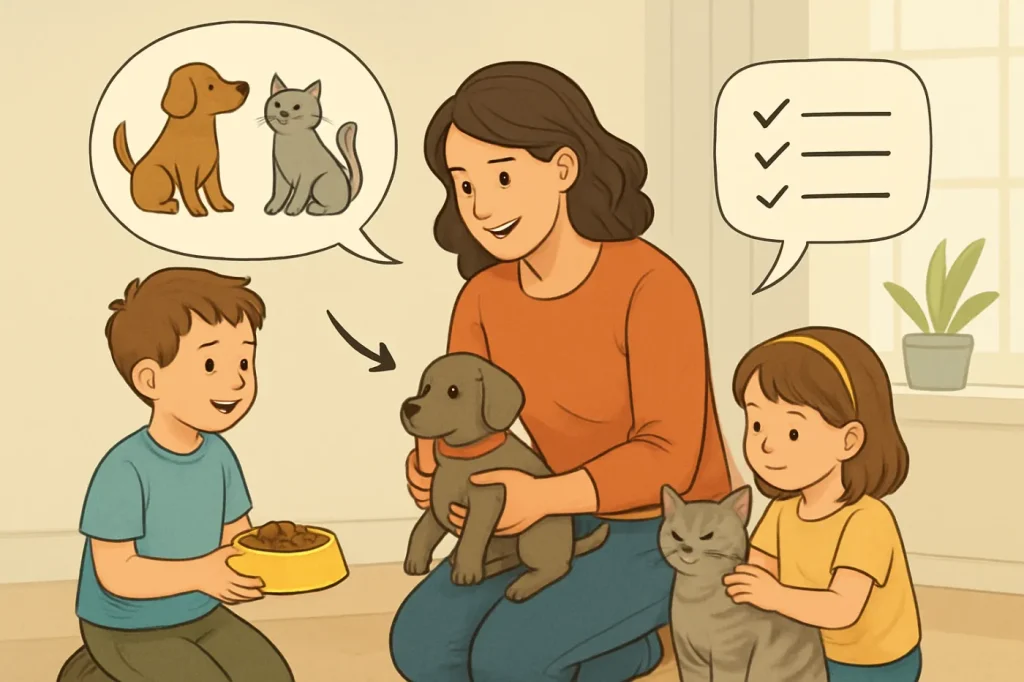
Preparing kids for a new dog or cat means doing three things before adoption day:
- Explaining that pets are a long-term family member, not a toy
- Matching responsibilities to each child’s age and personality
- Practicing specific routines (feeding, gentle touch, quiet time) before the pet arrives
When you treat the new pet as a shared family project instead of a surprise gift, kids are more likely to bond safely, help with care, and handle the hard parts like messes, training, and eventual vet visits.
How to match pet responsibilities to your child’s age
Kids can absolutely help with a new pet, but only if the jobs fit their age and maturity. Adults stay 100% responsible for safety, training, and health, no matter how old the child is.
Age-based responsibility guide for kids
Use this as a starting point and adjust for your child’s personality, attention span, and comfort level with animals.
Toddlers and preschoolers (around 2–4 years)
- Main goal: Learn to be gentle and calm around the pet.
- Can help with:
- Handing you the food bowl while you fill it
- Helping scatter a few treats you’ve measured out
- Joining you to say “goodnight” to the pet at bedtime
- What they should not do:
- Pick up or carry the pet
- Approach the pet without an adult
- Be alone with the pet, even for a short time
- Key rule to teach: “We use soft hands and quiet voices with pets.” Practice on a stuffed animal first.
Early elementary (around 5–7 years)
- Main goal: Build simple daily habits with supervision.
- Can help with:
- Adding food to the bowl while you watch and measure
- Helping brush the dog or cat for a few minutes
- Filling water bowls with you standing nearby
- Helping pick up toys at the end of the day
- What they should not do alone:
- Walk the dog outside without an adult
- Correct or punish the pet
- Clean litter boxes or handle waste
- Key rule to teach: “If you feel annoyed or mad, walk away and tell an adult. Do not grab, hit, or yell at the pet.”
Older elementary (around 8–11 years)
- Main goal: Take on regular chores with adult backup.
- Can help with:
- Feeding at set times using a pre-measured scoop
- Helping with short, supervised dog walks
- Helping clean the litter box or yard with gloves and adult nearby
- Practicing simple training cues you’ve already taught the pet (sit, stay, come)
- What still needs adult oversight:
- Any handling of a nervous, new, or reactive animal
- Decisions about food changes, training methods, or discipline
- Monitoring that chores are actually done and done safely
- Key rule to teach: “You are a helper, not the boss. Adults decide training and rules.”
Preteens and teens (around 12+ years)
- Main goal: Share real responsibility while adults stay in charge of health and safety.
- Can help with:
- Regular feeding and water checks
- Daily walks, following your safety rules and local leash requirements
- Basic grooming (brushing, wiping paws, helping with nail trims if the pet is calm)
- Joining vet visits to hear about health and long-term care
- What adults still own:
- Vet decisions and payment
- Final say on training, equipment, and where the pet is allowed
- Backup when school, sports, or social life get busy
- Key rule to teach: “Pets are a long-term commitment. If your schedule changes, we adjust together; the pet does not become ‘less important.’”
Talking to kids about lifelong commitment vs. “fun for now”
Before you bring home a dog or cat, have a clear, age-appropriate talk about what “forever home” means. Kids need to understand that pets stay even when life changes.
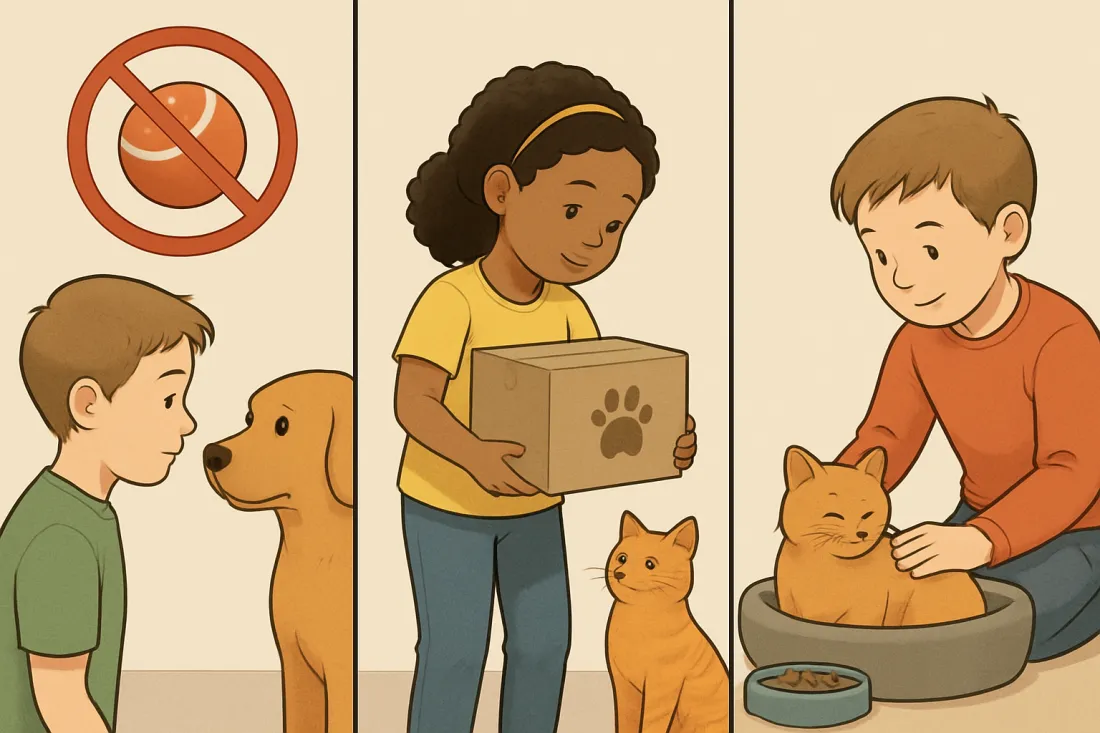
How to explain lifelong commitment to younger kids
- Use simple comparisons: “Our cat will probably live longer than your stuffed animals and some of your toys. She will live with us for many years, like you will.”
- Connect to routines they know: “Just like we brush your teeth every day, we will feed and care for the dog every day.”
- Talk about feelings: “Sometimes the dog will be fun, and sometimes he will be annoying. We still keep him and take care of him, like we do with each other.”
How to explain commitment to older kids and teens
- Talk about time: “Dogs and cats often live for many years. That means this pet will still be with us when you are in middle school, high school, maybe even after that.”
- Talk about trade-offs: “If we adopt this pet, we may say no to some trips or activities because we need someone to care for them.”
- Talk about hard days: “There will be vet visits, accidents, and times when you are tired of walking the dog. Commitment means we still show up.”
Questions to ask your kids before adopting
Use these questions to start a real conversation, not a quiz they have to pass:
- “What do you think will be the most fun part of having a pet?”
- “What do you think will be the hardest part?”
- “How do you think our mornings and evenings might change?”
- “What should we do if the dog or cat does something we do not like?”
- “What could we do to help the pet feel safe when they are scared?”
Listen carefully for unrealistic expectations (“I will walk the dog every single day forever,” “The cat will always sleep with me”). Gently bring those back to reality and explain that adults will help and that some days will not go as planned.
TV, social media, and what pets are really like
Many kids expect pets to act like cartoon characters or viral videos: always funny, always cuddly, instantly trained. That gap between fantasy and reality is where disappointment and unsafe behavior often start.
How to reset expectations about dogs and cats
- Explain that pets are not toys: “Our dog is not here to entertain us all the time. He has feelings, gets tired, and needs quiet.”
- Talk about training: “Dogs in movies do tricks because people trained them for a long time. Our dog will need time and practice to learn.”
- Talk about consent: “Just like you do not always want a hug, our cat does not always want to be held. We watch her body language.”
- Talk about mess: “Sometimes there will be fur on clothes, accidents on the floor, or scratched furniture. That is part of living with an animal.”
Simple reality checks to do together
- Watch a calm, educational video about dog or cat body language and pause to ask, “What do you think this pet is feeling?”
- Visit a local shelter or adoption event and quietly observe how different pets behave: shy, playful, nervous, sleepy.
- Talk about one “cute” video they like and ask, “Is the animal really happy here? How can we tell?”
If you plan to adopt from a shelter, reading about how does adopting from an animal shelter work can also help older kids understand why some pets might be shy or overwhelmed at first.
Dog vs. cat with kids: which fits your family better
Both dogs and cats can be wonderful with children, but they usually fit different lifestyles and personalities. Instead of asking “Which is better?”, ask “Which fits our home, schedule, and kids right now?”
Comparison table: dog vs. cat for families with kids
| Factor | Dog with kids | Cat with kids | Best fit for families who… |
|---|---|---|---|
| Daily time commitment | Multiple walks, training, play, and supervision; more structured time outside | Play and interaction daily, but usually less scheduled outdoor time | Choose a dog if you want built-in outdoor time; choose a cat if your schedule is tighter |
| Noise and energy level | Often louder and more energetic; barking and zoomies are common | Usually quieter; may have short bursts of play, then long naps | Choose a dog if your home tolerates noise; choose a cat if you need a calmer environment |
| Physical interaction | Many dogs enjoy active play, fetch, and walks with kids | Many cats prefer short, gentle petting and play with toys, not rough handling | Choose a dog for kids who want active games; choose a cat for kids who can respect more limited touch |
| Training needs | Training is essential for safety and manners; requires consistency | Training is still helpful (litter, scratching posts, handling) but often less formal | Choose a dog if adults can commit to training; choose a cat if you want simpler basics |
| Space needs | More impact in small spaces; needs room to move and a safe outdoor plan | Often adapt well to apartments with vertical space and hiding spots | Choose a dog if you have access to safe outdoor areas; choose a cat if you live in a smaller home |
| Kids’ involvement | Kids can help with walks, training games, and play under adult guidance | Kids can help with play sessions, feeding, and gentle grooming | Either can work; think about whether your kids prefer active outdoor time or calmer indoor time |
If you are leaning toward a dog and want a more detailed preparation plan, you can also review how to prepare to adopt a rescue dog and adapt the steps for your kids’ ages.
Creating a realistic family pet-care plan
Before adoption day, treat pet care like a family project. Decide who does what, when, and what happens if someone forgets.
Key decisions to make together
- Where the pet will sleep: Crate, bed, or specific room. Explain to kids that this is the pet’s safe space, not a play zone.
- Where food, water, and litter box will go: Choose spots that are easy for adults to reach and safe from toddlers.
- House rules: Couch or no couch? Bedroom or no bedroom? Table scraps or no people food? Agree before the pet arrives.
- Quiet times: Decide when the pet should not be disturbed (during meals, when sleeping, when hiding).
- Emergency plan: Who is in charge if the pet gets sick, escapes, or shows worrying behavior? Kids should know which adult to tell immediately.
Structured checklist: responsibilities by child and parent
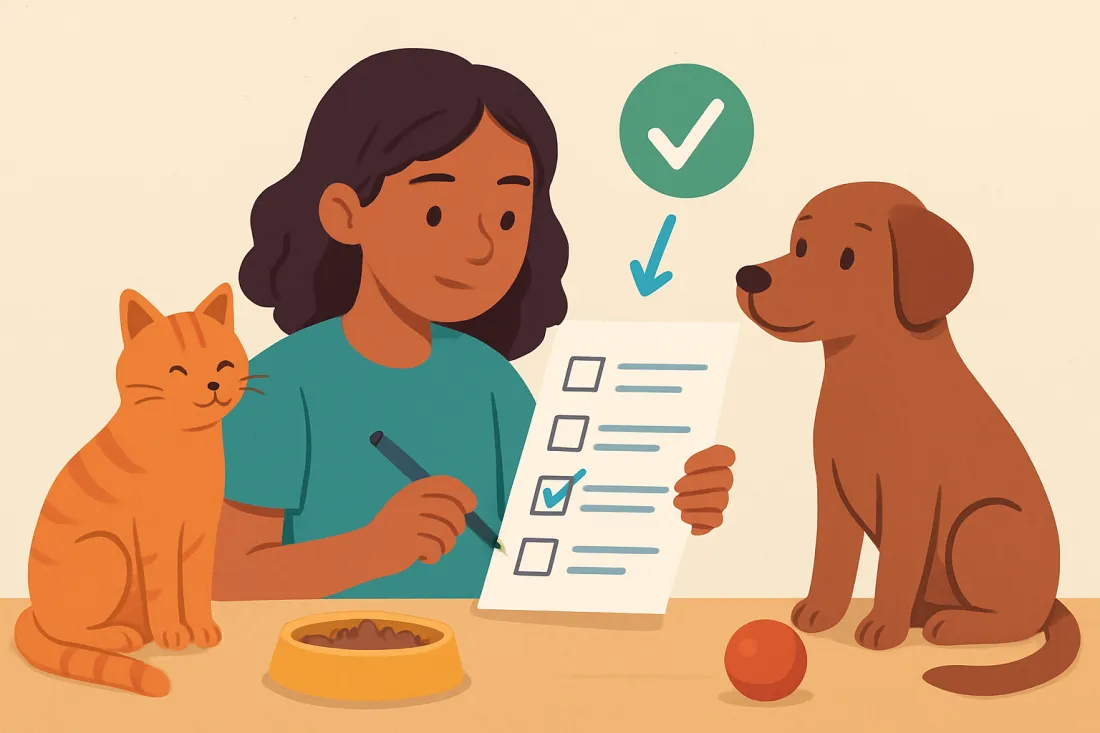
Use this checklist to assign tasks. For each item, decide: parent only, parent + younger child, or parent + older child/teen.
- Daily basics
- Morning feeding (measure food, refresh water)
- Evening feeding
- Water check mid-day (if someone is home)
- Dog walks or cat play sessions (who, when, how long)
- Quick daily check for any injuries, limping, or changes in behavior
- Weekly and regular chores
- Brushing fur (who holds, who brushes, how long)
- Cleaning litter box or yard (older kids can help with adult supervision)
- Washing food and water bowls
- Washing bedding or blankets
- Toy check (throw away broken toys, rotate others)
- Training and enrichment
- Short training sessions (who leads, who helps with treats)
- Teaching kids how to ask the pet to sit before petting (for dogs)
- Planning new games or puzzle feeders for mental stimulation
- Health and safety
- Scheduling and attending vet visits (adult task; kids can join)
- Checking that doors, gates, and windows are secure
- Making sure harmful foods and chemicals are out of reach
- Reviewing safety rules with kids every few weeks
Write your plan down and keep it where kids can see it, like on the fridge. Expect to adjust it after the first week as you learn what works.
First week with the new pet: what kids should and should not do
The first week sets the tone for your pet’s relationship with your children. Think “slow, calm, and predictable.”
What kids should do in the first week
- Let the pet come to them: Teach kids to sit on the floor sideways, hold out a hand, and wait. If the pet approaches, they can gently pet the shoulders or chest, not the face or tail.
- Use quiet voices: Practice “indoor voices” and slow movements around the pet, especially for younger children.
- Follow a simple greeting rule: “Ask an adult, ask the pet, then pet.” Ask the adult if it is a good time, then watch the pet’s body language. If the pet moves away, that means “no.”
- Help with one small daily job: For example, adding water to the bowl, helping with a short play session, or joining you for a walk.
- Tell an adult about any problem: If the pet growls, hisses, hides, or jumps too hard, kids should step away and call an adult.
What kids should not do in the first week
- No hugging, squeezing, or picking up without permission: Many pets find tight hugs scary, especially when they are new.
- No chasing or cornering: If the pet walks away or hides, kids must not follow. That hiding spot is off-limits.
- No disturbing while eating or sleeping: Teach kids to give the pet space during meals and naps.
- No rough play: No tugging ears or tail, no riding, no wrestling. Show kids how to use toys instead of hands.
- No solo time with the pet: An adult should always be present when kids and the new pet are together, especially in the first weeks.
Signs your pet needs more space
Teach kids a few simple body-language signs that mean “I need a break”:
- Dog: tail tucked, ears back, licking lips, yawning when not tired, turning head away, moving behind furniture or an adult
- Cat: tail flicking, ears back or sideways, dilated pupils, low growl, hissing, hiding under furniture
Make a rule: “If you see any of these signs, stop, step back, and tell an adult.”
Common mistakes when preparing kids for a new pet
Avoiding a few typical mistakes can prevent stress for both kids and animals.
1. Presenting the pet as a surprise gift
Big surprise reveals look cute in videos, but they skip the most important part: preparation. When kids do not expect a pet, they have not had time to learn rules, talk about fears, or think about responsibilities. Instead, involve them in the decision and preparation process.
2. Saying “You are getting a pet” instead of “We are getting a pet”
When adults tell kids, “This is your dog,” kids may feel pressure to do everything or feel like they failed if they forget a chore. Frame it as a family pet: adults are responsible, kids are helpers.
3. Overpromising what the pet will be like
Statements like “She will sleep in your bed every night” or “He will never scratch” set kids up for disappointment and can lead to unsafe pushing of boundaries. Use “maybe” and “we will see what the pet likes” instead of guarantees.
4. Expecting kids to manage behavior problems
Kids should never be in charge of correcting growling, hissing, jumping, or guarding behavior. That is an adult job, often with help from a trainer or behavior professional if needed. Kids’ only job is to step away and tell an adult.
5. Dropping all rules when the pet is “cute”
Letting the dog jump on kids “just this once” or letting the cat play with hands instead of toys may feel harmless at first, but it teaches habits that are hard to change. Stick to your rules from day one, even when everyone is excited.
Decision checklist: are your kids ready for a new dog or cat?
Use this checklist to decide whether to move forward now, wait, or adjust your plan. Be honest with yourself and your kids.
- Understanding and attitude
- Have you explained that pets are a long-term commitment, not a temporary toy?
- Can your child describe at least one fun part and one hard part of having a pet?
- Does your child show empathy for animals (gentle touch, respect for space)?
- Safety and supervision
- Can an adult be present whenever kids and the new pet interact, especially at first?
- Do you have a safe space where the pet can retreat and kids know not to follow?
- Have you removed or secured items that could harm a curious pet (cleaners, small toys, cords)?
- Time and routine
- Have you mapped out who will handle morning, afternoon, and evening pet care?
- Does your current schedule realistically allow for walks or playtime every day?
- Are you prepared for extra time in the first weeks for training and adjustment?
- Adult responsibility
- Are you, as an adult, ready to stay responsible even if kids lose interest?
- Are you prepared to handle vet visits, training decisions, and long-term care?
- Do you have a plan for the pet during vacations, moves, or schedule changes?
If you answered “not yet” to several points, consider waiting a bit, choosing a different type of pet, or adjusting your expectations. You can still build your child’s skills by visiting friends’ pets, volunteering with animals as a family, or learning more about responsible pet ownership together.
Summary: turning kids into responsible pet helpers
Preparing kids for a new pet is less about perfect behavior and more about clear expectations, practice, and adult backup. When you:
- Match chores to your child’s age and maturity
- Explain that pets are long-term family members, not toys
- Reset expectations from TV and social media to real life
- Create a simple, written family pet-care plan
- Guide the first week with calm, supervised interactions
you give both your kids and your new dog or cat a safer, calmer start. After reading, your next step is to sit down with your children, talk through the commitment, and draft your family’s pet-care plan together. If you are still deciding on timing, you might also reflect on whether to adopt now or later, especially if you are balancing other big life changes.
FAQ about preparing kids for a new pet
What should parents understand first about preparing kids for a new pet?
Parents need to understand that preparation is about more than buying supplies. Kids need time to adjust their expectations, learn safety rules, and practice gentle behavior before the pet arrives. Adults remain fully responsible for the animal’s welfare; kids are helpers whose tasks must match their age. A calm, planned introduction and clear family rules do more for safety and bonding than any toy or accessory.
What common mistakes should families avoid when introducing a dog or cat to children?
Some of the biggest mistakes are surprising kids with a pet without any preparation, calling it “your dog” or “your cat” instead of a family pet, and expecting children to manage behavior issues on their own. Other pitfalls include allowing rough play “because the pet is young,” ignoring early signs of stress like hiding or growling, and dropping rules whenever the pet does something cute. Avoiding these mistakes helps protect both kids and the animal.
How can I tell if my child is ready to help care for a new pet?
Look at how your child handles smaller responsibilities now: do they remember simple daily tasks with reminders, respond to feedback, and show care for living things like plants or existing pets? A ready child can follow safety rules, accept that adults make final decisions, and talk honestly about both fun and hard parts of pet care. If they struggle with impulse control or gentle touch, focus on practicing those skills before bringing a pet home.
What should families do next once they decide to adopt a dog or cat?
Once you decide to adopt, sit down together and create a written pet-care plan that lists daily tasks, house rules, and safety guidelines. Walk through your home to remove hazards, set up the pet’s safe space, and practice gentle handling with a stuffed animal. Then, talk with your kids about what the first week will look like, including what they should and should not do. If you are adopting from a shelter, review how the process works so older kids know what to expect on adoption day.