

Caring for a chronically ill dog or cat means living with two hard truths at once: you love your pet deeply, and you have limited time, money, and emotional energy. Balancing quality of life and cost is not about choosing between love and money. It is about using your limited resources to give your pet the kindest life possible, for as long as that life still feels like “themselves.”
The core idea: a “good” decision is one that keeps your pet’s comfort and joy at the center, is financially realistic for your household, and is made with clear information from your veterinarian—not guilt, pressure, or panic.
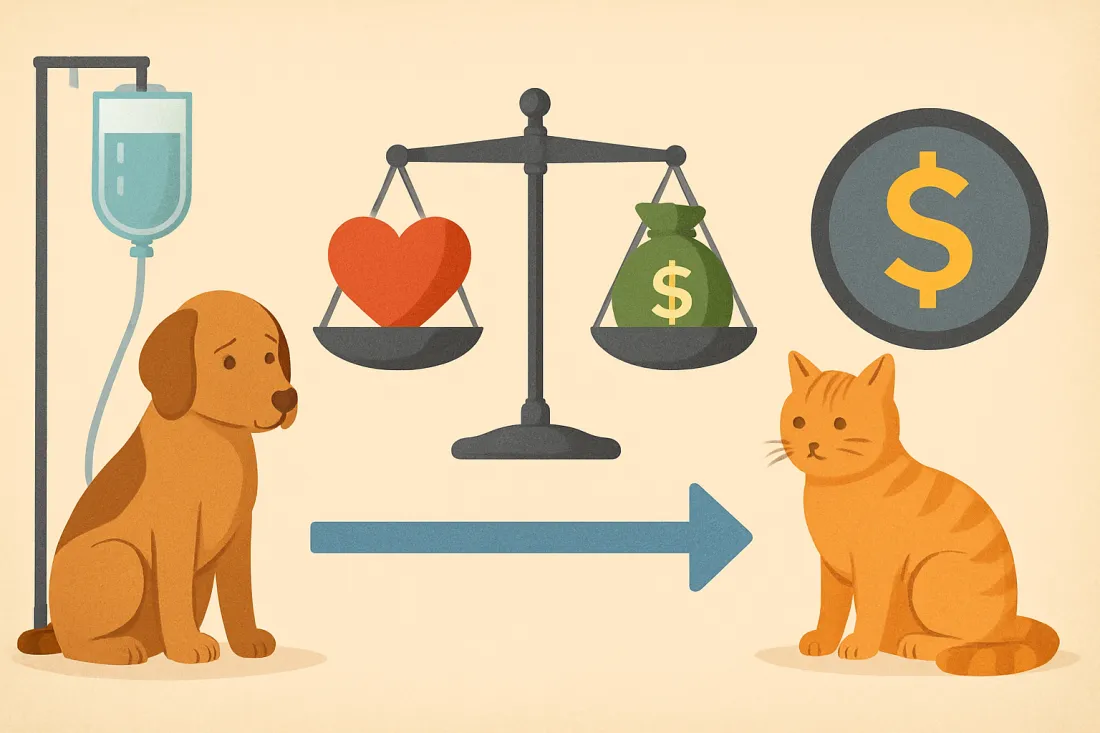
How to think about quality of life vs cost for a chronically ill pet
When a pet is diagnosed with a chronic condition (kidney disease, diabetes, heart disease, cancer, severe arthritis, etc.), you are usually facing three ongoing realities at once:

- Medical reality: Your pet’s disease will likely need lifelong management, not a quick cure.
- Financial reality: There will be recurring costs (medications, tests, rechecks, special diets), plus possible emergencies.
- Emotional reality: You are grieving the loss of the “healthy future” you imagined, while trying to stay strong for your pet.
Balancing these means shifting from “How do I fix this?” to “How do I give my pet the best life possible with the time and money we realistically have?” That usually involves:
- Understanding your pet’s current quality of life in a structured way.
- Choosing a treatment tier that fits your budget and your pet’s temperament.
- Revisiting the plan regularly as the disease and your finances change.
- Knowing in advance when you will consider palliative care or euthanasia so you are not forced to decide in a crisis.
Key decision criteria: what “quality of life” really means for your pet
“Quality of life” is often used as a vague phrase, which makes decisions harder. Breaking it into specific areas helps you see patterns and talk clearly with your vet. Common quality-of-life domains include:
- Pain and comfort
- Is your pet in obvious pain (crying, limping, panting at rest, hiding, flinching when touched)?
- Does pain medication clearly help, or are they uncomfortable most of the day?
- Mobility and independence
- Can your dog or cat get up, walk to food and water, and use the litter box or go outside with reasonable help?
- Are they falling, getting stuck, or so weak they cannot move without you?
- Appetite and hydration
- Are they eating and drinking enough on most days without extreme coaxing?
- Are they losing weight, vomiting frequently, or refusing food for more than a day?
- Enjoyment and engagement
- Do they still show interest in favorite things—walks, toys, treats, sunny spots, your company?
- Or do they mostly sleep, stare, or seem withdrawn and disinterested?
- Breathing and anxiety
- Is their breathing easy and quiet at rest?
- Are they restless, pacing, panting, or unable to settle, especially at night?
- Good days vs bad days
- Over the past 1–2 weeks, are there clearly more good days than bad days?
- Or are bad days becoming the norm, with only rare bright moments?
None of these alone decides anything. But together, they show whether your pet is mostly living, or mostly enduring.

Structured checklist: tracking your pet’s quality of life over time
Use this checklist weekly (or more often during a crisis) to track trends. You can keep a simple notebook or notes app and bring it to vet visits.
- Rate each area from 1–5 (1 = very poor, 5 = excellent):
- Pain control (seems comfortable most of the time)
- Mobility (can move around and toilet with manageable help)
- Appetite (eats enough most days without extreme coaxing)
- Hydration (drinks or accepts fluids, no constant vomiting/diarrhea)
- Enjoyment (still has clear moments of joy or interest)
- Breathing (easy, not labored at rest)
- Good days vs bad days (more good than bad this week)
- Add up the scores.
- Higher total = better overall quality of life.
- Watch for downward trends over several weeks, not just one bad day.
- Note specific examples.
- “Monday: refused food all day.”
- “Wednesday: wagged tail on walk, ate dinner well.”
- “Friday night: restless, panting, could not settle.”
- Share this log with your vet.
- Ask: “Based on this pattern, what does this tell you about where we are in the disease?”
- Ask: “Are there adjustments that might improve comfort without adding too much cost or stress?”
This checklist does not give you a “right answer,” but it replaces vague impressions (“I think they’re okay?”) with concrete observations you can act on.
Comparing treatment tiers: gold standard vs modified plans vs comfort-focused care
When your pet is diagnosed, you will often be presented with a “gold standard” treatment plan. This might include advanced imaging, frequent lab work, brand-name medications, specialty referrals, or intensive hospital stays. For many families, that plan is simply not affordable or not realistic for their pet’s temperament. That does not mean you are failing your pet.
Most conditions can be managed at different “tiers” of care. The best tier is the one that your family can sustain and that your pet can tolerate.
| Treatment tier | What it typically looks like | When it may fit | Main trade-offs and risks | Questions to ask your vet |
|---|---|---|---|---|
| Gold standard / aggressive care | Specialist consults, advanced imaging, frequent lab monitoring, newer or brand-name drugs, possible surgery or hospital stays, strict diet and home routines. | Families with strong financial reserves or pet insurance; pets who tolerate vet visits and handling well; conditions where aggressive care can significantly extend good-quality life. | High ongoing cost and time commitment; more vet visits and procedures; some pets find frequent handling or hospital stays very stressful. | “How much extra good-quality time does this realistically offer?” “What parts of this plan are most critical, and what is optional?” |
| Modified / middle-ground plan | Uses core medications and monitoring, but less frequent testing, more generic drugs, fewer specialist visits, and a more flexible home routine. | Families with limited but steady budgets; pets who get stressed by frequent vet trips; owners wanting to balance longevity with day-to-day comfort and affordability. | May catch complications later than intensive monitoring; might not extend life as long as gold standard; requires honest discussion about what you are choosing not to do. | “If we choose this middle plan, what are we most likely to miss?” “What warning signs mean we need to come in sooner?” |
| Comfort-focused / palliative care | Focuses on pain control, nausea relief, anxiety management, and keeping routines simple and pleasant; fewer tests and procedures; may use home visits when available. | Pets with advanced disease, poor prognosis, or high stress at the clinic; families with tight budgets or limited ability to travel; situations where the goal is comfort, not maximum lifespan. | Life expectancy may be shorter; some treatable complications may go unaddressed; requires careful monitoring at home and readiness to consider euthanasia when comfort cannot be maintained. | “What can we do at home to keep them comfortable?” “How will we know when comfort-focused care is no longer enough?” |
Ask your vet explicitly: “Can we talk about a gold standard plan, a middle option, and a comfort-focused option?” Many vets are relieved when owners ask this, because it opens the door to realistic planning instead of all-or-nothing thinking.
How to talk honestly with your vet about prognosis and cost
Many pet owners feel embarrassed to talk about money, or worry they will be judged for not choosing the most expensive option. Clear, honest communication usually leads to better care and less guilt.
Use these steps to structure the conversation:
- State your limits early.
- Example: “We love her and want to do what we can, but we have a limited monthly budget and cannot take on large debt.”
- This helps your vet tailor recommendations instead of guessing.
- Ask for a plain-language prognosis.
- “With treatment, are we hoping for years, many months, or more likely weeks?”
- “What kind of best-case and worst-case outcomes do you see with pets like mine?”
- Request a range of plans.
- “Can you outline what you would do with no budget limit, and then a more modest plan that still protects comfort?”
- “If we skip some tests, what are we giving up in terms of safety or information?”
- Clarify ongoing vs one-time costs.
- “Which costs are one-time (diagnostics, procedures) and which are monthly or quarterly (meds, rechecks, special food)?”
- “What is the minimum monitoring you recommend to keep this safe?”
- Be honest about what you can manage at home.
- “I can give pills, but injections are hard for me.”
- “I work long shifts and cannot bring him in every week.”
- Ask about practical supports.
- “Are there generic medications, home-care options, or longer refill intervals that could help with cost?”
- “Are there local organizations that sometimes help with chronic care costs?”
If you consistently feel dismissed or pressured, consider a second opinion at another clinic. A good veterinary team will respect your limits and help you find the kindest plan within them.
Emotional and financial stress of chronic pet care
Chronic illness in a pet is not just a medical issue; it is a long-term emotional and financial strain on the whole household.
Common emotional stresses include:
- Anticipatory grief: You are already mourning the loss of your pet while they are still with you.
- Decision fatigue: Constantly weighing “Is this test worth it?” or “Is today a good day?” is exhausting.
- Guilt and shame: Feeling like a bad owner if you cannot afford every option, or if you feel relief at the idea of the struggle ending.
- Family conflict: Different family members may disagree about how far to go with treatment.
Common financial stresses include:
- Recurring medication and special diet costs.
- Regular vet visits and monitoring tests.
- Unplanned emergency visits when the condition suddenly worsens.
It can help to step back and look at your overall pet budget. If you have not already, tools like an dog annual cost calculator or guides on saving money on pet care without sacrificing quality can help you see where chronic care fits into your bigger financial picture.
Remember: it is not selfish to consider your own mental health, other pets, children, or financial obligations. Responsible pet ownership includes protecting your household from unmanageable strain.
Ethical ways to say no to unaffordable options
Saying “no” to a recommended treatment can feel like you are choosing money over your pet. In reality, you are choosing a plan you can actually follow through on, instead of starting something you cannot sustain.
Here are ethical, honest ways to decline options that are beyond your reach:
- Be clear and kind with your vet.
- “I appreciate you explaining that option. It is more than we can afford, so we need to focus on comfort and what we can realistically do.”
- Ask for alternatives instead of just refusing.
- “If we do not do the surgery, what are our best options for keeping her comfortable?”
- “Is there a simpler medication plan that is less expensive, even if it is not ideal?”
- Be honest about debt and limits.
- “We cannot take on more credit or payment plans. We need to stay within what we can pay now.”
- Consider rehoming only in narrow circumstances.
- In some cases, a rescue or individual with more resources may be able to take on a treatable chronic condition. This is rare and must be handled carefully to avoid scams or unsafe placements.
- Discuss with your vet or a reputable local rescue if this is even realistic for your pet’s condition and temperament.
- Recognize when euthanasia is a kinder choice than prolonged suffering without treatment.
- If you cannot afford treatment that is necessary to prevent significant suffering, choosing euthanasia can be a compassionate, responsible decision.
Ethical decision-making is not about doing everything possible; it is about doing the most humane thing that is actually possible for your family and your pet.
When to consider palliative care or euthanasia for a chronically ill pet
Palliative care focuses on comfort, not cure. Euthanasia is the final step when comfort can no longer be maintained. Both are emotionally heavy topics, but thinking about them early can prevent panic decisions later.
Signs it may be time to shift toward palliative care:
- Treatments aimed at cure or long-term control are no longer working, or side effects are worse than benefits.
- Your pet is stressed or miserable during frequent vet visits or procedures.
- Your budget or schedule cannot sustain intensive care, but you can still provide basic comfort at home.
- Your quality-of-life checklist shows a steady decline, but your pet still has some good moments.
Signs it may be time to discuss euthanasia:
- Pain cannot be controlled even with medication, or medications cause severe side effects.
- Your pet can no longer stand, walk, or toilet without extreme distress.
- They consistently refuse food and water, or cannot keep them down.
- Breathing is labored or distressed at rest.
- Bad days clearly outnumber good days over several weeks, and the good moments are very brief.
- Your own sense, deep down, is that your pet is “tired” and no longer enjoying life.
Talk with your vet about what euthanasia involves, what to expect, and options for being present or having it done at home if available in your area. Planning ahead—choosing a clinic, deciding who will be there, considering aftercare (cremation or burial where legal)—can reduce panic when the time comes.
Many owners fear “doing it too soon” and end up feeling they waited too long. Using your quality-of-life checklist, your vet’s guidance, and your knowledge of who your pet was in their healthy days can help you choose a time that honors their life and avoids prolonged suffering.
Decision checklist: choosing the right path for your chronically ill pet
Use this decision checklist as a step-by-step guide when you are feeling overwhelmed:
- Clarify your pet’s current state.
- Fill out the quality-of-life checklist for the past week.
- Write down 3–5 specific observations (e.g., “no longer jumps on couch,” “eats only if hand-fed,” “still excited for car rides”).
- Clarify your household limits.
- Decide on a realistic monthly amount you can spend on chronic care without skipping essentials like rent, food, or medications for people.
- Note time limits: work schedule, transportation, physical ability to lift or carry your pet.
- Schedule a focused vet conversation.
- Tell the clinic you want to discuss long-term management options and quality of life, not just today’s symptoms.
- Bring your notes and questions.
- Ask for at least two treatment tiers.
- Gold standard / aggressive care.
- Modified middle-ground plan.
- Comfort-focused plan if prognosis is poor.
- Compare each plan against your limits.
- Can you afford it not just this month, but for the next 6–12 months if needed?
- Can your pet tolerate the visits, procedures, or home care involved?
- Does the plan aim for more good-quality time, or just more time?
- Choose a plan and set a review date.
- Example: “We will try the middle-ground plan for one month, then reassess with our vet.”
- Decide what would count as “success” (e.g., better appetite, more comfortable movement, fewer bad days).
- Define your “red lines.”
- Agree on specific signs that would make you consider switching to palliative care or euthanasia (e.g., unable to stand, persistent pain despite meds, no interest in food for more than 48 hours).
- Share these with your vet so they understand your boundaries.
- Revisit regularly.
- Update your quality-of-life checklist weekly.
- Adjust the plan as the disease, your finances, or your pet’s temperament change.
Common mistakes to avoid when balancing quality of life and cost
Being aware of typical pitfalls can help you make calmer, kinder decisions.
- All-or-nothing thinking.
- Believing you must either do everything possible or “do nothing.” In reality, middle-ground and comfort-focused plans can be very humane.
- Delaying hard conversations.
- Putting off talks about prognosis, cost, or euthanasia until a crisis forces rushed decisions.
- Instead, schedule proactive check-ins with your vet about “where we are” in the disease.
- Ignoring your own limits.
- Taking on debt or caregiving tasks that damage your mental health, relationships, or ability to care for other dependents.
- Responsible pet ownership includes protecting your own well-being.
- Chasing every new option out of fear or guilt.
- Trying every possible treatment, even when your pet is clearly declining and stressed, because stopping feels like “giving up.”
- Ask your vet: “Are we doing this for my pet’s comfort, or because it is hard for me to let go?”
- Making decisions based only on one bad day.
- Chronic illness has ups and downs. One terrible day or one great day should not override weeks of patterns.
- Use your quality-of-life log to look at trends.
- Comparing yourself to others.
- Every family’s finances, support system, and pet are different. What was right for a friend’s dog may not be right for your cat.
- Overlooking preventive care for other pets.
- Focusing so much on the sick pet that vaccines, dental care, or parasite prevention for other animals are skipped, leading to more problems later.
- Resources on low cost preventive care for pets can help you protect your other animals while managing chronic illness in one pet.
Emotional support and grief resources in the United States
You do not have to navigate chronic pet illness and end-of-life decisions alone. Emotional support can make the process more bearable and help you feel less isolated or guilty.
Types of support commonly available in the U.S. include:
- Pet loss and anticipatory grief hotlines: Some veterinary schools, animal shelters, and counseling centers offer phone lines staffed by trained volunteers or counselors who understand pet loss. These can be helpful before and after euthanasia.
- Local or online support groups: Many communities and national organizations host support groups (in person or virtual) for people caring for chronically ill pets or grieving a loss.
- Therapists familiar with pet loss: Some mental health professionals specifically mention experience with pet-related grief. If you already see a therapist, let them know what you are going through.
- Veterinary social workers: Some larger veterinary hospitals and specialty centers have social workers who help families with decision-making, communication, and grief.
- Faith or community leaders: If you are part of a faith community or local group, leaders there may offer comfort, rituals, or simply a listening ear.
To find support near you, you can:
- Ask your vet clinic if they know of local pet loss support groups or hotlines.
- Search for “pet loss support group” plus your city or state.
- Contact nearby veterinary schools or large animal hospitals and ask if they offer grief resources.
Feeling intense sadness, anger, guilt, or even relief after making a hard decision is normal. None of these emotions mean you loved your pet any less.
FAQ: balancing quality of life and cost for chronically ill pets
What should I understand first about balancing quality of life and cost for my chronically ill pet?
The most important thing to understand is that you are not choosing between loving your pet and protecting your finances. A humane decision keeps your pet’s comfort and joy at the center while staying within what your household can realistically manage over time. That usually means:
- Looking at your pet’s life in specific areas (pain, mobility, appetite, enjoyment, breathing, good vs bad days).
- Asking your vet for more than one treatment option, including a middle-ground and a comfort-focused plan.
- Being honest about your budget and your ability to handle home care.
- Revisiting the plan regularly as your pet’s condition changes.
When you approach it this way, you are making a thoughtful, loving choice—not a snap decision driven by fear or guilt.
What are the biggest mistakes people make when deciding on chronic treatment for a dog or cat?
Common mistakes include all-or-nothing thinking (“either do everything or do nothing”), avoiding honest talks about money with the vet, and waiting until a crisis to discuss prognosis or euthanasia. People also sometimes chase every possible treatment out of fear of regret, even when their pet is clearly stressed and declining, or they ignore their own mental and financial limits until they are overwhelmed.
You can avoid these mistakes by using a quality-of-life checklist, setting clear financial boundaries, asking for treatment tiers, and scheduling regular check-ins with your vet about where you are in the disease process.
What should I do next if I am currently caring for a chronically ill pet?
Start by writing down what you are seeing: appetite, mobility, pain signs, enjoyment, breathing, and the balance of good vs bad days over the past week or two. Then, decide what you can realistically spend and manage each month without harming your own stability. With those notes in hand, book a dedicated appointment with your vet to discuss long-term options, including a gold standard plan, a middle-ground plan, and a comfort-focused plan.
Agree on what “success” would look like over the next few weeks and what signs would make you consider shifting to palliative care or euthanasia. Finally, look up emotional support resources in your area so you have people to lean on as you go.