Start here: the essential house rules your new dog needs from day one
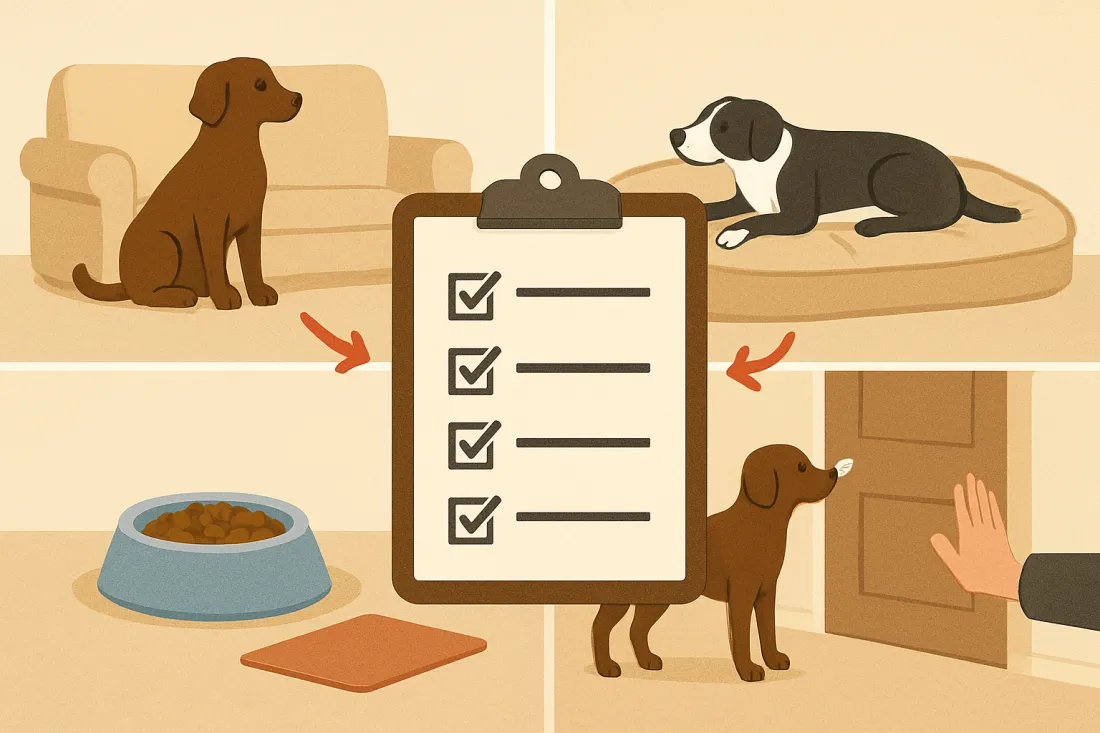
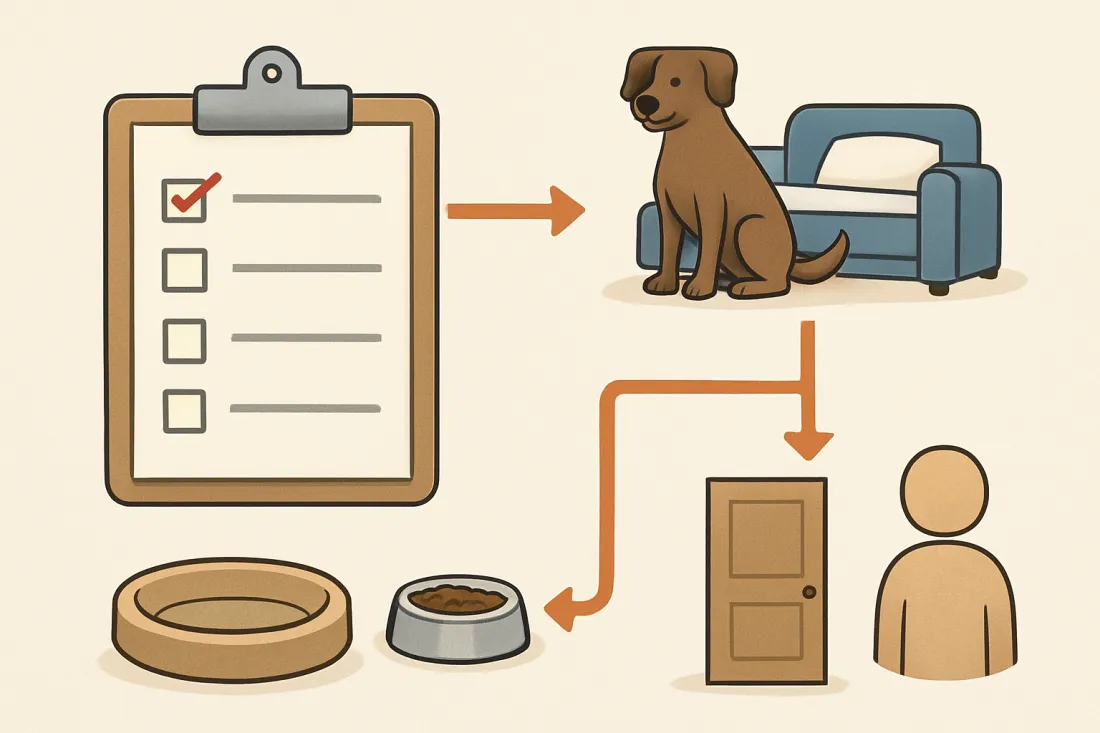
Bringing home a new dog is exciting, but the first days are when habits start forming. The most helpful thing you can do is decide a few clear house rules before your dog walks through the door and stick to them. At minimum, decide these seven rules in advance and make sure every person in the home agrees:
- Is the dog allowed on the couch?
- Is the dog allowed on human beds?
- Where does the dog sleep at night (crate, dog bed, bedroom, separate room)?
- Where and when does the dog eat, and who feeds them?
- What are the rules around visitors (jumping, barking, greeting at the door)?
- What are the rules around kids (no hugging, no bothering while eating or sleeping, supervised play only)?
- Where can the dog go when left alone (which rooms, crate or not, access to windows, etc.)?
Once you decide, write the rules down, post them somewhere visible, and teach them to your dog with calm, consistent routines and simple training cues. This guide walks you through:
- Why house rules matter for responsible ownership
- How to plan rules before your dog arrives
- A practical, ready-to-use house rules checklist
- Room-by-room safety and access rules
- How to keep everyone in the household consistent
- Kind, simple scripts for teaching rules
- How to troubleshoot common rule-breaking issues
- Where basic training commands fit into your house rules
Why house rules matter for responsible dog ownership
House rules are not about being strict for the sake of it. They are about safety, predictability, and helping your dog relax. Clear rules help your dog feel safe Dogs thrive on patterns. When the same behavior leads to the same outcome every time, they learn quickly and feel more secure. When rules change from day to day or person to person, dogs get confused and may:
- Jump more, bark more, or grab food because sometimes it “works”
- Guard couches, beds, or toys because access feels unpredictable
- Become anxious when left alone because alone-time routines are unclear
Rules prevent many behavior problems Many common issues first-time owners face are really rule problems:
- Pulling on leash often starts because the dog is allowed to drag people to interesting things sometimes, but not others.
- Begging at the table starts the first time someone slips a bite of food from their plate.
- Jumping on guests continues because some visitors pet the dog when they jump and others push them away.
- Resource guarding can be made worse if people sometimes grab things from the dog and sometimes trade calmly.
You do not need to be perfect, but you do need to be predictable. Rules protect kids, visitors, and your dog Responsible pet ownership means protecting everyone involved:
- Kids learn how to interact safely (no climbing on, no disturbing while eating or sleeping).
- Visitors know what to do (ignore jumping, reward calm, no feeding from the table).
- Your dog avoids dangerous items (trash, cords, toxic foods, small toys) and stressful situations.
A simple checklist of house rules is one of the easiest ways to be a responsible owner from day one. For a broader view of daily care, you can also use a responsible pet ownership checklist for new dog owners alongside these house rules.
Plan your house rules before your new dog arrives
Before you pick up your dog, sit down with everyone who lives in your home and walk through these decisions. This pre-arrival planning prevents confusion and arguments later.
Step-by-step pre-arrival planning checklist
- Decide where the dog is allowed to go
- Which rooms are always allowed (e.g., living room, kitchen)?
- Which rooms are off-limits (e.g., nursery, formal dining room)?
- Will you use baby gates, closed doors, or a crate to manage access?
- Choose a sleeping and resting spot
- Crate in your bedroom, crate in living room, or dog bed in a quiet corner?
- Is the dog allowed on beds at night or only during the day, or never?
- Where will the dog rest when overwhelmed (a “safe zone”)?
- Set feeding rules
- Who feeds the dog and at what times?
- Where is the food bowl located (kitchen corner, laundry room)?
- Are table scraps ever allowed? (If yes, how and when?)
- Agree on people-interaction rules
- How should the dog greet family members (four paws on floor, sit, or go to mat)?
- What are the rules around kids (no hugging, no rough play, always supervised)?
- What should visitors do when they arrive (ignore dog until calm, no feeding treats without permission)?
- Plan alone-time and crate rules
- Will the dog be crated when alone, or confined to one room?
- How long will the dog typically be alone at first?
- What will the pre-departure and return routines look like (calm, low-key)?
- Pick your core training cues
- Choose 5–7 basic commands you will all use (for example: sit, down, stay, come, leave it, drop it, place).
- Agree on the exact words and hand signals so everyone is consistent.
- Plan short daily training sessions (even 5–10 minutes, 2–3 times a day).
Write your decisions down. A simple one-page sheet on the fridge keeps everyone on the same page.
Printable-style house rules checklist for new dog owners
Use this checklist as a template you can copy into a note app or print and customize. The key is to turn vague ideas (“probably no couch”) into clear rules (“dog only on couch when invited, on a blanket”).
Core household rules checklist
- Couch rules
- Dog never allowed on couch
- Dog allowed on couch only when invited
- Dog allowed on couch anytime, but must stay on a blanket
- Everyone knows how to remove the dog calmly if they break the rule (lure off with treat, ask for “off” then reward on floor)
- Bed rules
- Dog never allowed on human beds
- Dog allowed on bed only after a cue (for example, “up”)
- Dog allowed on bed but must get off when asked
- Kids know not to invite the dog on beds without an adult’s permission
- Feeding rules
- Dog eats in the same spot every day
- Dog has set meal times (for example, morning and evening)
- No one feeds the dog from the table or counters
- Treats are given only for training or calm behavior, not for begging
- Kids are not allowed to touch the dog’s bowl while the dog is eating
- Visitors and greeting rules
- Dog goes to a specific spot (mat, crate, or behind gate) when the doorbell rings
- Visitors ignore the dog until all four paws are on the floor
- No one encourages jumping, even if they “don’t mind”
- Only adults hand out treats to the dog when guests are over
- Kids and dog interaction rules
- An adult always supervises kids and dog together
- Kids never hug, ride, or pull on the dog
- Kids leave the dog alone when the dog is eating, sleeping, or in their crate/bed
- Kids know how to give treats with a flat hand and drop toys instead of grabbing
- Alone-time rules
- Dog has a safe space for alone time (crate or dog-proofed room)
- Dog is given a safe chew or toy when left alone
- Departures and arrivals are kept calm and low-key
- Dog is not left alone longer than they can realistically handle at their age and training level (check with your vet or trainer if unsure)
Comparison table: strict vs flexible house rules
| Rule style | What it looks like | Pros | Cons | Best for |
|---|---|---|---|---|
| Very strict (no couch, no bed, limited rooms) | Dog stays on floor or dog bed, access to a few rooms only, clear structure | Easier to prevent damage and bad habits; simpler for kids; helpful for anxious or pushy dogs | Requires more management with gates/crates; some people find it less cuddly | First-time owners, multi-kid homes, large or boisterous dogs |
| Moderate (couch/bed by invitation only) | Dog can join on furniture when calm and invited, has clear off-limits times | Good balance of comfort and structure; teaches impulse control | Needs consistent enforcement; confusing if some people allow “anytime” | Most families willing to train and stay consistent |
| Very relaxed (dog allowed almost everywhere) | Dog has free run of home, frequent couch/bed access, few restrictions | Feels very inclusive; easy in small, quiet homes with one or two adults | Higher risk of damage, guarding, and boundary issues; harder to change later | Experienced owners with calm dogs and minimal safety concerns |
Use this table to decide how strict you want to be. It is easier to relax rules later than to tighten them once your dog has gotten used to more freedom.
Room-by-room safety and access rules
A big part of house rules is simply deciding where your dog can go and what they can do there. This room-by-room guide helps you dog-proof your home and prevent accidents.
Entryway and front door
Goals: prevent door-dashing, jumping on guests, and barking chaos.
- Use a baby gate or leash when opening the front door, especially in the early weeks.
- Teach a “wait” or “stay” spot a few feet back from the door.
- Store leashes, harnesses, and poop bags in one place so departures are calm and quick.
- Decide whether the dog is allowed to greet guests at the door or must stay on a mat/crate until released.
Living room
Goals: protect furniture, manage couch rules, and give the dog a calm resting place.
- Place a dog bed or mat where the dog can see the family but is not in the main traffic path.
- If the dog is allowed on the couch, use a washable blanket or cover and teach an “up” and “off” cue.
- Keep remote controls, small toys, and cords out of reach or covered.
- Decide whether rough play is allowed indoors; if not, redirect to a tug toy or play outside.
Kitchen and dining area
Goals: prevent counter-surfing, food theft, and begging.
- Keep trash in a lidded can or behind a cabinet door.
- Store food (including pet food) in closed containers or cabinets.
- Teach a “place” or “mat” cue where the dog lies while people cook or eat.
- Make a firm rule: no feeding the dog from plates, counters, or the table.
- Check for toxic foods (like chocolate, grapes, onions) and make sure everyone knows not to share them.
Bedrooms
Goals: protect sleep, manage bed rules, and keep small items safe.
- Decide which bedrooms, if any, are dog-free zones and keep doors closed.
- Store shoes, socks, and small objects in closets or drawers, not on the floor.
- If the dog sleeps in your room, choose a spot for a crate or bed and keep it consistent.
- Teach the dog to wait at the doorway if you do not want them rushing in.
Bathrooms and laundry room
Goals: avoid chemical exposure and chewing hazards.
- Keep cleaning products, detergents, and medications in closed cabinets.
- Close toilet lids to prevent drinking from the toilet.
- Store laundry in hampers with lids so the dog cannot grab socks or underwear.
- Check for dangling cords (irons, hairdryers) and keep them out of reach.
Kids’ rooms and play areas
Goals: protect both kids and dog from unsafe play.
- Use baby gates or closed doors to limit unsupervised access.
- Teach kids to pick up small toys, art supplies, and stuffed animals.
- Set a rule: dog and kids play only when an adult is present.
- Provide dog-safe toys in a separate basket so kids know what is okay to share.
Yard and outdoor spaces
Goals: prevent escapes and unsafe chewing.
- Check fences and gates for gaps or loose boards before letting the dog off-leash.
- Remove or fence off toxic plants and any sharp or dangerous objects.
- Decide if digging is allowed in a specific area or not at all, and be consistent.
- Pick a designated potty area if possible and reward the dog for using it.
For more detail on setting boundaries in a new environment, you can also review house rules for dogs and cats new home once you have your basic checklist in place.
How to keep families and roommates consistent
The fastest way to confuse a dog is for one person to allow something and another to forbid it. Consistency is more important than perfection.
Simple consistency system for multi-person households
- Post the rules where everyone can see them
- Print your house rules checklist and put it on the fridge or near the leash hook.
- Highlight non-negotiables (for example, no feeding from the table, no unsupervised kid–dog time).
- Agree on cue words and hand signals
- Pick one word per behavior (for example, “down” for lying down, not “down” and “lie” and “floor”).
- Write them on the rules sheet so everyone uses the same language.
- Assign responsibilities
- Who walks the dog in the morning?
- Who feeds breakfast and dinner?
- Who handles training sessions on weekdays vs weekends?
- Hold a 10-minute weekly check-in
- Ask: What is going well? What rules are hard to keep?
- Adjust rules if needed, but only after everyone agrees.
- Back each other up in front of the dog
- If someone forgets and breaks a rule, gently remind them later, not in the moment.
- In front of the dog, keep responses calm and consistent so the dog does not learn to play people against each other.
Kind example scripts for teaching house rules
You do not need to be harsh to teach rules. Calm, reward-based training works best and builds trust. Here are simple scripts you can use.
Teaching “off” for couch or bed
Goal: Dog gets off furniture when asked, without yelling or pushing.
- Say your cue in a neutral voice: “Off.”
- Pause for one second. If the dog does not move, lure them off with a treat held to their nose and moved toward the floor.
- As soon as all four paws hit the floor, say “Yes!” or click if you use a clicker, then give the treat.
- Guide them to a dog bed or mat and reward again when they settle there.
- Repeat consistently. Do not let the dog stay on the couch after you say “off,” even once.
Teaching “place” or “go to your bed”
Goal: Dog goes to a mat or bed and stays there while you cook, eat, or answer the door.
- Stand near the mat and toss a treat onto it. As the dog steps on the mat, say your cue: “Place.”
- When the dog eats the treat, drop another treat between their paws.
- After a few seconds, say “Okay!” and toss a treat off the mat to release them.
- Repeat until the dog happily runs to the mat when you say “place.”
- Gradually increase how long they stay on the mat before you say “okay,” rewarding every few seconds at first.
Teaching polite greetings (no jumping)
Goal: Dog keeps four paws on the floor when greeting people.
- Clip the dog to a leash before guests arrive.
- Ask your guest to ignore the dog completely if the dog jumps (no eye contact, no talking, no touching).
- When all four paws are on the floor, say “Yes!” and let the guest calmly pet the dog or give a treat.
- If the dog jumps again, the guest immediately stands up straight and turns away.
- Repeat until the dog learns that calm feet on the floor make good things happen.
Teaching kids how to interact kindly
Use simple, repeatable phrases:
- “If the dog walks away, we let them go.”
- “We pet with one hand on the back, not on the face.”
- “We never bother the dog in their bed or crate.”
- “We trade toys with treats; we do not grab from the dog’s mouth.”
Practice with stuffed animals first so kids can learn the motions before working with the real dog.
Troubleshooting common rule-breaking issues
Even with clear rules, your new dog will test boundaries. That is normal. The key is how you respond.
Dog keeps jumping on the couch or bed
Likely reasons: it is comfy, they get attention, or the rule is not consistent. What to do:
- Block access when you are not supervising (close doors, use baby gates, or crate).
- Provide an equally comfy alternative (thick bed, blanket, or raised cot).
- Every single time they jump up, calmly say “off,” help them down if needed, and reward on the floor.
- Do not scold after the fact; dogs do not connect delayed punishment with past behavior.
Dog begs at the table
Likely reasons: someone has fed them from the table, or dropped food without managing it. What to do:
- Stop all table feeding immediately, from everyone.
- Feed the dog their meal or a stuffed food toy in another room while you eat.
- If the dog comes to the table, quietly stand up, guide them back to their mat or crate, and reward them there.
- Be patient; if begging has been rewarded before, it may take many meals to fade.
Dog ignores rules with one person but not another
Likely reasons: that person is less consistent or accidentally rewards bad behavior. What to do:
- Watch a few interactions and notice what is different (tone of voice, timing, treats, letting the dog get away with things).
- Practice together: the more confident person can coach the other through a few training sessions.
- Keep cue words and responses identical across people.
Dog barks or whines when left alone
Likely reasons: alone time is new, departures are emotional, or the dog is not tired enough. What to do:
- Start with very short alone times and build up gradually.
- Give the dog a safe chew or food puzzle only when you leave, so alone time predicts something good.
- Keep departures and returns calm and low-key.
- If barking or distress is intense or does not improve, consult a trainer or vet to rule out separation-related problems.
Dog breaks rules only when you are not watching
Likely reasons: the dog has learned that rules only apply when humans are present. What to do:
- Manage the environment: use crates, gates, and closed doors to prevent access when unsupervised.
- Remove temptations (food on counters, trash cans, shoes on the floor).
- Reward calm, rule-following behavior when you are home so the dog practices the right habits.
If you want more structure around training sessions themselves, a resource like basic dog training rules for responsible owners can complement your house rules.
How basic training commands support your house rules
House rules work best when paired with a few simple obedience cues. You do not need advanced tricks; a small set of reliable commands makes daily life much easier.
Core commands that make house rules easier
- Sit – default polite behavior for greetings, before meals, and at doors.
- Down – helps the dog relax and stay in one place.
- Stay – keeps the dog from bolting out doors or crowding the table.
- Come – essential for safety and calling the dog away from trouble.
- Leave it – prevents the dog from grabbing unsafe items or food.
- Drop it – lets you safely get items back from the dog.
- Place – sends the dog to a mat or bed during meals or when guests arrive.
You can layer these commands onto your rules. For example:
- Before opening the front door, ask for “sit” and “stay.”
- When the dog eyes the trash can, say “leave it” and reward turning away.
- When kids are playing on the floor, send the dog to “place” with a chew.
If you already have a training overview on your site, link to it from your rules checklist so new owners can see how commands and rules fit together.
Checklist: your next steps after reading
Use this quick action list to put your house rules into practice today.
- Hold a 20-minute family or roommate meeting
- Decide on couch, bed, feeding, visitor, kid, and alone-time rules.
- Pick your core training cues and write them down.
- Dog-proof your home room by room
- Walk through each room and remove or secure obvious hazards.
- Set up gates, crate, and dog bed in chosen locations.
- Create and post your house rules checklist
- Copy the checklist into a note app or document and customize it.
- Print and post it where everyone can see it.
- Start teaching 1–2 rules right away
- Focus on the most important rule for your home (for example, no jumping, no couch, or crate training).
- Use the example scripts to keep training calm and positive.
- Review and adjust weekly
- Notice which rules are working and which need clearer boundaries.
- Update your checklist as your dog matures and learns.
House rules are not about perfection. They are about giving your dog a predictable, safe life and giving yourself a calmer, more enjoyable home. Start simple, stay consistent, and build from there.
FAQ: house rules checklist for new dog owners
When should I start enforcing house rules with my new dog?
Start from the moment your dog enters your home. Dogs learn patterns quickly. If you let them on the couch “just for today” and change the rule later, training will take longer. Keep rules gentle but consistent from day one.
Are house rules different for puppies and adult rescue dogs?
The basic rules can be the same, but puppies usually need more management (gates, crates, supervision) and more frequent potty breaks. Adult rescue dogs may already have habits from previous homes, so you might need extra patience and clear, reward-based training to change them.
How many rules should I have for my new dog?
Focus on a small number of high-impact rules at first: where the dog can go, furniture rules, feeding rules, greeting rules, and alone-time rules. You can always add more detail later. Too many rules at once can overwhelm both you and your dog.
What if my family cannot agree on the rules?
Start with safety non-negotiables: no unsupervised kid–dog time, no grabbing things from the dog’s mouth, no feeding from the table, and secure confinement when alone. For less critical rules (like couch access), choose a temporary compromise and agree to review it after a few weeks of living with the dog.
Do I need professional training if I have clear house rules?
Clear rules and consistency go a long way, but a good trainer can help if you are struggling with specific issues like aggression, severe anxiety, or persistent rule-breaking. Look for reward-based trainers and ask how they will support your house rules and family routines.