
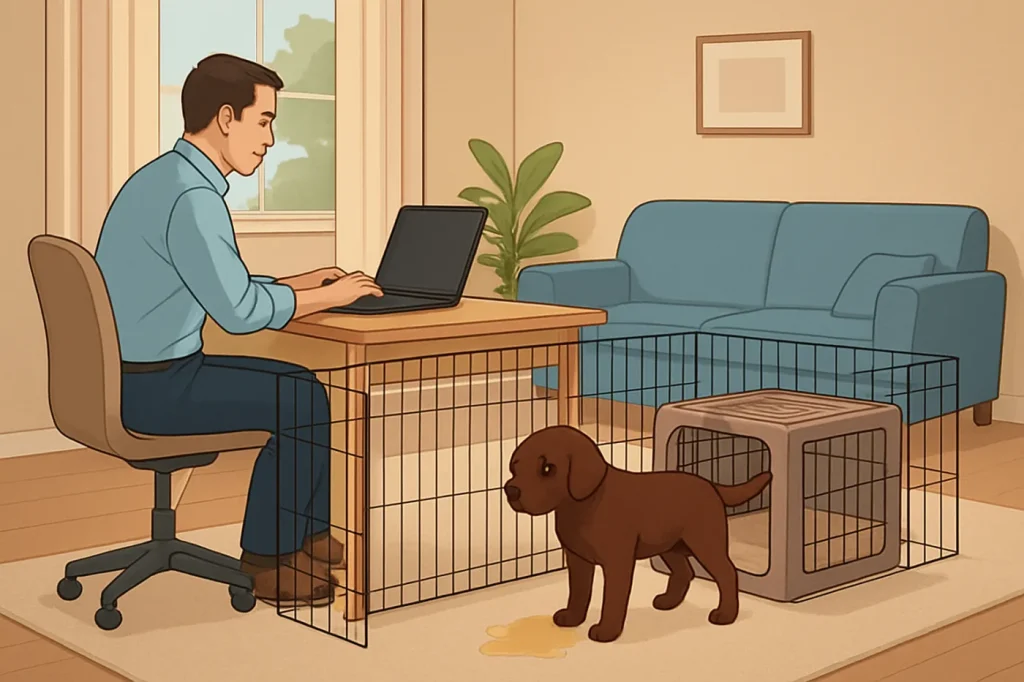
Can you house train a puppy while working full time
Yes, you can house train a puppy while working full time, but only if you:
- set up the home so the puppy cannot rehearse accidents everywhere
- provide enough daytime potty breaks (through a helper, dog walker, or adjusted schedule)
- use a crate and playpen together instead of free roaming
- follow a consistent routine for feeding, sleep, and toilet trips
- have realistic expectations for your puppy’s age and bladder control
House training is not about punishment. It is about preventing accidents, rewarding the right behavior, and managing time so your puppy is never forced to hold it too long.
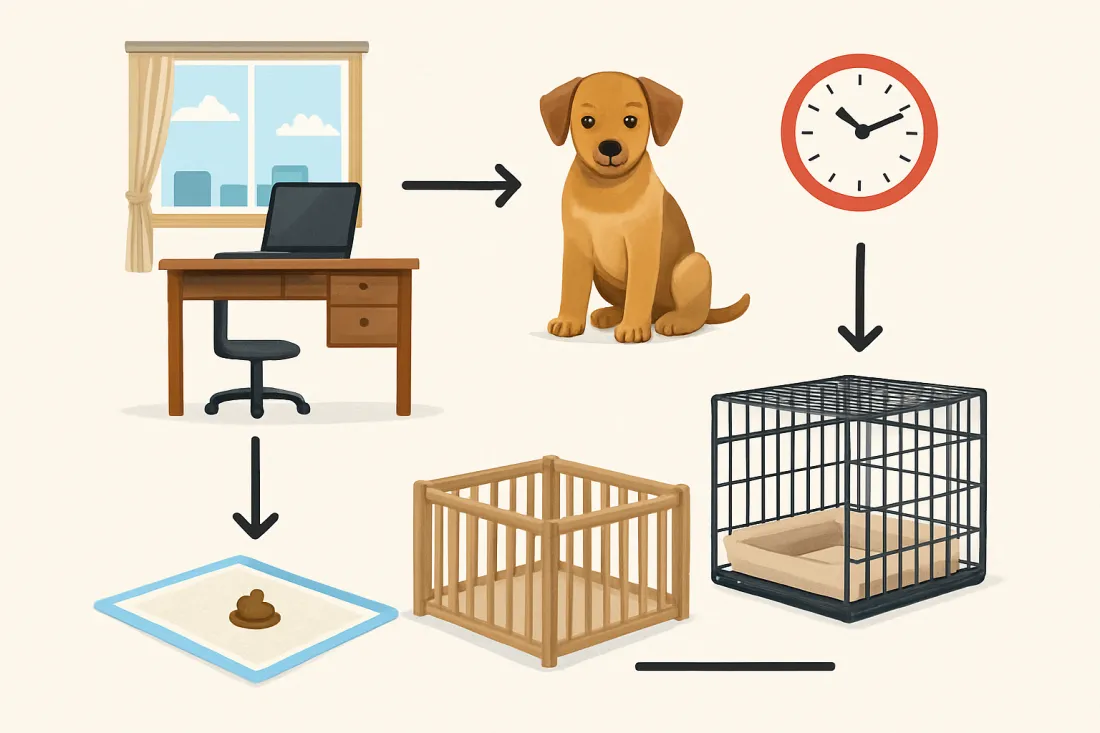
What successful house training really requires
Before building a schedule, it helps to understand what you are actually training. Successful house training depends on four pillars:
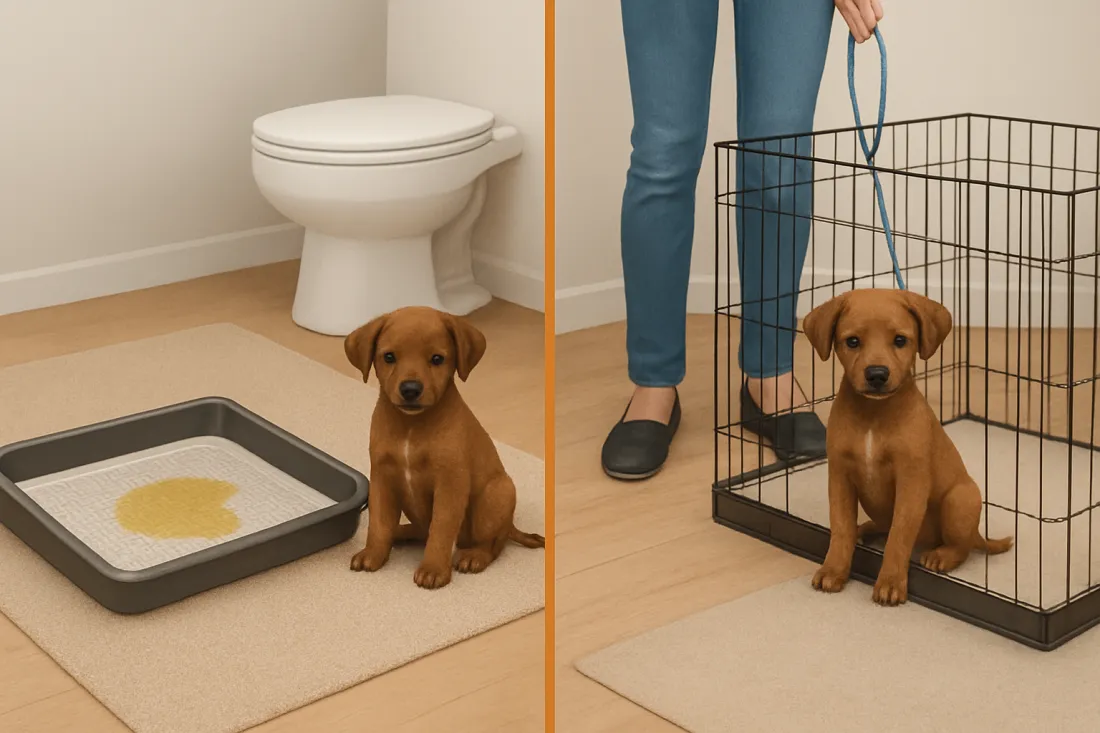
- Biology – how long your puppy can physically hold their bladder and bowels at their current age.
- Management – how you control space (crate, playpen, baby gates) so accidents are limited to one easy-to-clean area.
- Timing – how often you give your puppy a chance to go in the right place.
- Reinforcement – how quickly and consistently you reward them for going where you want.
When one of these is missing, house training stalls. When all four work together, even full-time workers can make steady progress.
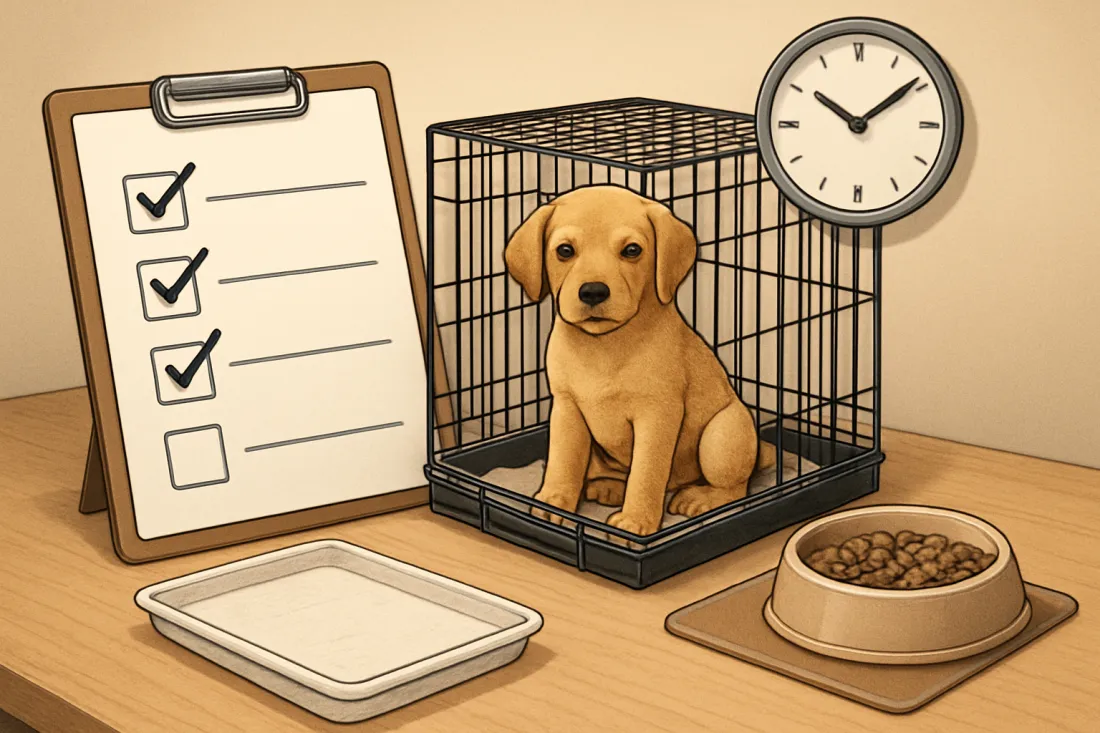
Age-based expectations for puppy bladder control
Puppies are not small adult dogs. Their bladder and bowel control develops over months, not days. You cannot “train” a 9-week-old puppy to last 8 hours; you can only manage their environment so they do not suffer or learn bad habits.
Use the following table as a planning guide, not a strict rule. Individual puppies vary, and health issues can change what is realistic.
| Puppy age | Typical awake time between potty breaks | Overnight expectations | What this means for full-time workers |
|---|---|---|---|
| 8–10 weeks | About 1–2 hours when awake | May need 1–2 potty trips at night | Cannot be left alone all workday; you need a midday helper and a safe potty area (pads or outdoor access). |
| 10–16 weeks | Roughly 2–3 hours when awake | Many can sleep 5–6 hours, sometimes longer | Still need at least one daytime visit; playpen with pads or a dog walker is important. |
| 4–6 months | Often 3–4 hours when awake | Many sleep through most of the night | Some can manage a half workday; a lunch break, neighbor, or walker usually covers the rest. |
| 6–12 months | About 4 hours is a reasonable planning limit | Most sleep through the night | Healthy juveniles may manage a full workday with a single midday break and good morning/evening routines. |
If your puppy regularly has accidents even with frequent breaks, or suddenly loses control after doing well, contact your veterinarian to rule out medical issues such as urinary problems or digestive upset.
Setting up crate and playpen for a full-time schedule
For working owners, the most practical setup is a crate + attached playpen. Think of it as a small studio apartment for your puppy:
- Crate = bedroom (sleeping and resting only)
- Playpen = living room + bathroom (toys, water, and – if needed – a puppy pad area)
Basic crate guidelines
- Choose a crate just big enough for your puppy to stand, turn around, and lie down comfortably, but not so big that they can toilet in one corner and sleep in another.
- Use a soft bed or crate mat for comfort, unless your puppy chews bedding unsafely.
- Place the crate in a quiet but social area (for example, a living room corner), not in total isolation.
- Introduce the crate gradually with treats and meals inside so it feels safe, not like punishment.
Basic playpen guidelines
- Attach a sturdy playpen to the crate door so your puppy can walk in and out when you leave the crate open.
- Cover the floor with easy-to-clean material (washable mat, vinyl, or a section of floor you do not mind cleaning).
- Set up distinct zones:
- Rest zone: crate with bed.
- Play zone: toys, chew items, and water bowl.
- Toilet zone (if needed): puppy pad or indoor potty tray at the opposite end from the crate.
- Avoid giving full run of the house. More space means more hidden accidents and slower training.
Simple layout description
Imagine looking down from above:
- On the left: the crate door opens directly into the playpen.
- In the middle: a small area with toys and a water bowl.
- On the right: a clearly separate corner with a puppy pad, ideally on a slightly different surface (for example, pad on a tray).
This layout teaches your puppy that bed and play areas stay clean, and if they must go while you are gone, there is only one acceptable spot.
Step-by-step house training plan for full-time workers
Use this as a practical algorithm. Adjust times to your own commute and work hours.
Step 1: Plan your support for the first 2–3 months
- List your realistic options: coming home at lunch, partner’s schedule, trusted neighbor, family member, professional dog walker, or reputable daycare.
- For puppies under about 4 months, arrange at least one daytime visit on workdays; very young puppies may need two.
- If no human help is possible, consider delaying getting a very young puppy or arranging remote work days during the first weeks.
Step 2: Build a consistent feeding and water routine
- Feed at predictable times (for example, breakfast before work and dinner after work, plus a lunch meal if your vet recommends it for age/size).
- Leave fresh water available, but avoid large, sudden water “chugging” right before long crate periods.
- After each meal, plan a potty trip within about 10–20 minutes, as many puppies need to go soon after eating.
Step 3: Create a weekday schedule with and without a dog walker
Below is a sample schedule for a 12-week-old puppy. Adjust for your puppy’s age and your work hours.
Sample weekday with a dog walker or helper
- 6:30 a.m. – Wake up, go straight outside to potty. Reward with praise and a small treat the moment they finish.
- 6:45 a.m. – Short play or walk, then breakfast.
- 7:15 a.m. – Another potty trip (many puppies need a second chance after eating).
- 7:30–8:00 a.m. – Supervised play and training. Then settle puppy in crate + playpen with safe chew.
- Mid-morning (around 10:00 a.m.) – Dog walker or helper arrives: takes puppy outside to potty, short play, returns puppy to playpen.
- Early afternoon (around 1:00–2:00 p.m.) – Second visit if puppy is very young: potty break and brief interaction.
- 5:30–6:00 p.m. – You arrive home, go straight outside for potty, then play and training.
- 6:30 p.m. – Dinner, followed by another potty trip.
- Evening – Rotate between supervised free time, short crate naps, and regular potty trips every 1–2 hours.
- Bedtime – Final potty trip, then puppy sleeps in crate.
Sample weekday without a dog walker (older puppy)
This is more realistic for puppies closer to 6 months who can handle longer gaps.
- 6:00 a.m. – Potty, breakfast, second potty.
- 6:30–7:30 a.m. – Play, training, and mental enrichment.
- 7:30 a.m. – Potty again, then into crate + playpen with toys and water. If needed, leave a pad in the toilet zone.
- 12:00–1:00 p.m. – You come home for lunch: potty, short walk or play, quick snack if appropriate, potty again before you leave.
- 1:00–5:30 p.m. – Back in crate + playpen with pad available.
- 5:30 p.m. – Potty immediately, then play and dinner routine.
- Evening – Frequent potty trips, supervised free time, and crate naps.
Step 4: Use a simple potty routine every time
- Take puppy to the chosen potty spot (outdoor area or pad) on leash.
- Stand mostly still and quiet for about 5 minutes. Avoid turning it into playtime.
- When they start to go, stay calm. The moment they finish, praise warmly and give a small treat.
- After a successful potty, give a few minutes of play or a short walk as a bonus reward.
- If they do not go within 5 minutes, bring them back to the crate for 10–15 minutes, then try again.
Step 5: Supervise or confine between potty trips
- When you are home, keep your puppy either in the same room under active supervision or in the crate/playpen.
- Use baby gates or closed doors to limit access to carpeted rooms and hidden corners.
- Watch for early signs they need to go: circling, sniffing, suddenly wandering off, whining, or heading toward the door.
If you live in a small space, you may also want to look at guidance on house training a puppy in an apartment for more layout ideas.
How to use puppy pads responsibly (and phase them out)
Puppy pads are a tool, not a long-term lifestyle. For full-time workers, they can be a humane backup so your puppy is not forced to hold it too long. The key is to use them in a controlled way.
When puppy pads make sense
- You live in an apartment with a long elevator ride or stairs.
- You have a very young puppy who cannot physically wait until your next visit.
- Weather or safety sometimes makes outdoor trips difficult (extreme cold/heat, unsafe neighborhood at night).
- You are recovering from illness or surgery and cannot manage frequent outdoor trips.
Rules for using pads without confusing your puppy
- Place pads only in the designated toilet zone of the playpen or a single consistent area of your home.
- Do not scatter pads all over the house; that teaches your puppy that any soft surface is acceptable.
- Still prioritize outdoor potty trips whenever you are home. Pads are for when you cannot be there.
- Reward outdoor potty trips more generously than pad use so your puppy learns that outside is the best option.
How to phase out pads
- Once your puppy is reliably using the pad and can hold it longer, move the pad closer to the door that leads outside.
- Start taking your puppy outside at the same times they would normally use the pad. If they go outside, reward heavily and skip the pad for that trip.
- Gradually reduce the size or number of pads in the pen.
- When accidents become rare and your puppy can wait for scheduled outdoor breaks, remove the pad completely from the main living area.
Comparison table: different daytime potty options for workers
Different homes and jobs call for different solutions. Use this table to compare common options.
| Option | Best for | Main benefits | Potential downsides | Key decision point |
|---|---|---|---|---|
| Family member or friend visit | Owners with nearby trusted people | Personal care, flexible timing, puppy gets social time | May be inconsistent if schedules change; depends on goodwill | Is there someone reliable who can commit to regular visits for at least the first few months? |
| Professional dog walker | Most urban and suburban owners | Predictable schedule, experienced with puppies, can adjust as puppy grows | Ongoing cost; you must choose a reputable, insured professional | Can you budget for regular walks and find a walker who understands puppy needs? |
| Dog daycare (part-time) | Social, confident puppies with vaccines as advised by vet | Lots of activity and potty opportunities, reduces boredom and loneliness | Can be overwhelming for shy puppies; not all daycares manage house training consistently | Does your puppy enjoy group settings, and does the daycare follow safe, clean practices? |
| Indoor pad or potty area only | Short-term backup for very young puppies or mobility-limited owners | Prevents discomfort from over-holding, useful in emergencies | Can slow outdoor training if used as the main option; risk of confusion about where to go | Are you prepared to actively transition from pads to outdoor potty as your schedule allows? |
Practical house training checklist for busy owners
Use this checklist to make sure you have the essentials covered.
- Environment
- Crate sized for current puppy, not adult size.
- Sturdy playpen attached to crate.
- Clear toilet zone (pad or tray) far from bed and food, if needed.
- Easy-to-clean flooring in puppy area.
- Schedule
- Fixed morning and evening routines with multiple potty trips.
- Daytime helper, walker, or lunch break planned for at least the first few months.
- Regular feeding times that fit around potty opportunities.
- Training routine
- Same outdoor potty spot used consistently when possible.
- Rewards ready (treats in your pocket or near the door).
- Calm, short potty trips followed by praise and treats.
- Supervision or confinement between potty breaks.
- Health and welfare
- Vet check completed or scheduled to rule out medical issues.
- Puppy not regularly left longer than they can comfortably hold it.
- Enough mental and physical exercise outside of crate time.
To balance house training with the rest of your dog’s needs, you may also find a structured daily dog care routine for working owners helpful.
Common mistakes that cause house training setbacks
Many full-time workers struggle not because they are gone during the day, but because of avoidable mistakes at home. Watch out for these:
1. Expecting an 8-hour workday from a tiny puppy
Leaving a young puppy alone for a full workday without help often leads to:
- frequent accidents in the crate or around the house
- stress, whining, or barking
- puppies learning that their bed is also a toilet, which is hard to unteach
Fix: Arrange at least one midday break, use a playpen with a toilet zone, or adjust your work pattern temporarily.
2. Giving too much freedom too soon
Allowing a partially trained puppy to roam the whole house usually means accidents in hidden corners.
Fix: Use gates, close doors, and stick to crate + playpen until your puppy has been accident-free in a small area for several weeks.
3. Punishing accidents after the fact
Scolding, rubbing a puppy’s nose in urine, or yelling when you find a mess later does not teach them where to go. It often just teaches them to hide from you when they need to toilet.
Fix: Clean accidents calmly with an enzymatic cleaner and focus on catching them in the act so you can gently interrupt and take them to the right spot.
4. Inconsistent routines
Some days lots of outdoor trips, other days almost none, makes it hard for your puppy to predict when relief is coming.
Fix: Choose a realistic schedule you can keep most days and adjust gradually as your puppy matures.
5. Overusing puppy pads without a plan
Leaving pads everywhere and relying on them all day and night can blur the line between “inside” and “outside” toilets.
Fix: Limit pads to one area, reward outdoor potty more, and follow a clear phase-out plan once your puppy can hold it longer.
Troubleshooting stubborn house training problems
Even with a good plan, some puppies progress slowly. Use these checks to figure out what to adjust.
Check 1: Is your puppy physically able to hold it
- Frequent small puddles, straining, blood in urine, or sudden changes in habits can signal a medical problem.
- If your puppy was improving and suddenly regresses without a clear reason, schedule a vet visit.
Check 2: Are you giving enough potty opportunities
- Compare your current schedule with the age-based expectations earlier.
- If accidents happen at predictable times (for example, late afternoon), add a potty break 30–60 minutes before that time.
Check 3: Are you supervising closely enough when home
- Accidents during your off-hours often mean the puppy is out of sight.
- Try a week of “tether training” – clip the leash to your belt indoors so the puppy stays near you, or keep them in the same room.
Check 4: Are you rewarding at the right moment
- Rewards must come immediately after your puppy finishes going in the right spot.
- If you wait until you come back inside, they may think they are being rewarded for coming indoors, not for toileting outside.
When to seek a trainer or behavior professional
Consider contacting a qualified trainer or behavior consultant if:
- your puppy regularly soils their crate despite reasonable break times
- they seem anxious or panicked when left alone, even for short periods
- you feel stuck and frustrated after several weeks of consistent effort
A professional can review your setup, schedule, and timing, and suggest small changes that often make a big difference.
When to see a veterinarian
Book a vet appointment promptly if you notice:
- straining, discomfort, or crying when urinating or defecating
- blood, mucus, or unusual color in urine or stool
- drinking and urinating much more or much less than usual
- leaking urine while sleeping or resting
Medical issues can make house training nearly impossible until they are treated.
Decision criteria: is your current plan fair to your puppy
Use these questions to evaluate whether your setup matches responsible pet ownership:
- Is my puppy regularly forced to hold it longer than seems comfortable for their age?
- Do I have at least one reliable daytime potty option on workdays?
- Is my puppy’s main area clean, safe, and free from hazards or choking risks?
- Am I giving my puppy enough social time, play, and rest outside of crate hours?
- Have I ruled out health problems with a vet if progress is unusually slow?
If you answer “no” to several of these, adjust your plan or seek help from a trainer or vet. For broader manners and boundaries, you can also review guidance on basic house rules for dogs and cats so your puppy learns how to behave in every room, not just the bathroom area.
FAQ about house training a puppy while working full time
How long can I leave a puppy alone during the workday
Very young puppies usually need a potty opportunity every few hours when awake. For most homes, that means arranging at least one midday visit or break. As your puppy grows and gains control, you can gradually increase the time between breaks, but planning for around four hours between daytime potty trips is a reasonable upper limit for many juveniles.
Is it cruel to crate a puppy while I am at work
A crate used correctly and combined with a playpen and regular breaks is not cruel. It can feel safe and cozy for a puppy. Problems arise when puppies are crated too long without breaks, exercise, or social contact. Aim to balance crate time with play, training, and affection whenever you are home.
Should I wake my puppy at night to go potty
For very young puppies, setting an alarm for one planned nighttime potty trip can prevent accidents and help them learn the routine. As your puppy starts sleeping longer without accidents, you can gradually push the alarm later or stop using it. If your puppy wakes and cries at night, take them out calmly for a quick potty break, then return them to the crate without turning it into playtime.
What should I do if my puppy keeps peeing in the crate
First, check that the crate is not too large and that bedding is not soaking up accidents unnoticed. Then review your schedule to make sure your puppy is not being asked to hold it longer than they can. Clean the crate thoroughly with an enzymatic cleaner. If accidents continue despite reasonable timing, contact your veterinarian to rule out medical causes and consider working with a trainer to adjust your routine.
What is the next step after setting up my schedule
Once you have your crate and playpen arranged and a basic schedule in place, focus on consistency. Follow the same potty routine every day for at least a couple of weeks before judging progress. Keep a simple log of potty times and accidents so you can spot patterns and adjust. If you are also dealing with general manners or household rules, you may want to review guidance on basic house rules for dogs and cats to support calm behavior alongside house training.