
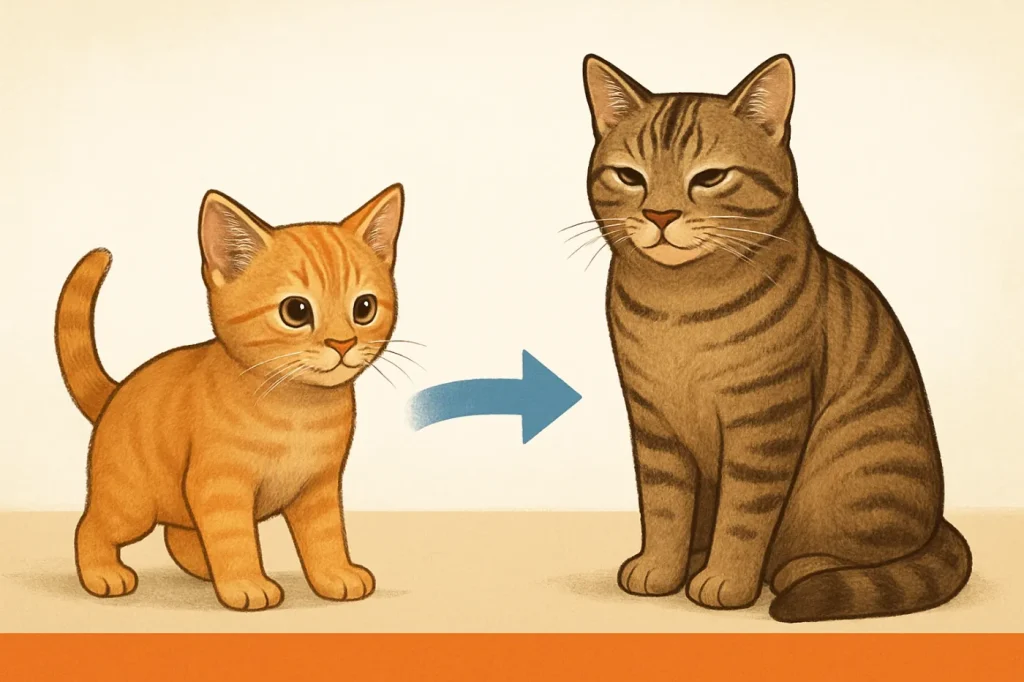
Trying to decide whether to adopt a kitten or an adult cat usually comes down to one core question: how much time, patience, and flexibility do you realistically have over the next few years?
If you want a playful, high-energy companion and you can invest a lot of time in supervision and training, a kitten can be a great fit. If you prefer a calmer, more predictable personality with fewer training surprises, an adult cat is usually the better choice.
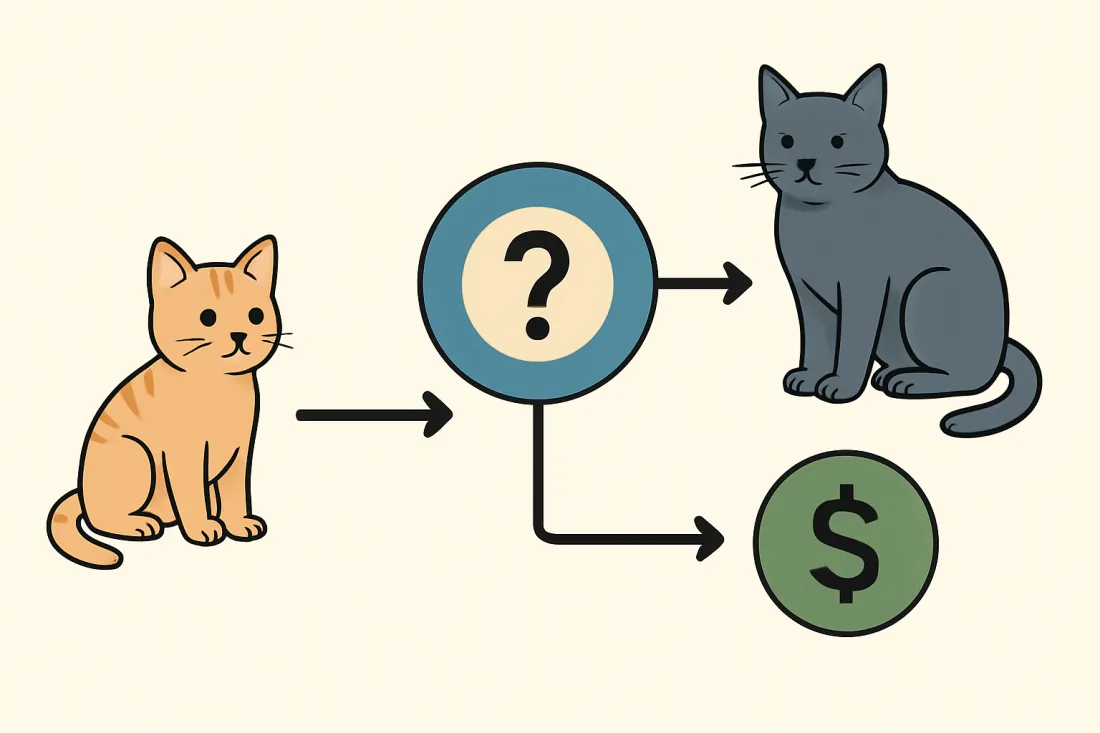
The rest of this guide walks through the real-life differences so you can choose the cat that fits your home, schedule, and budget—not just your heart in the moment.
Key differences between adopting a kitten and an adult cat
Both kittens and adult cats can be loving, wonderful companions. The differences are mostly about energy level, predictability, and how much work you are ready to take on.
- Energy and play needs
- Kittens: Very high energy, especially in the first 6–18 months. Expect multiple daily play sessions and zoomies at odd hours.
- Adults: Still playful, but usually with more predictable bursts of energy and longer naps.
- Personality predictability
- Kittens: Personality is still forming. A sweet kitten can grow into a shy or independent adult, and vice versa.
- Adults: What you see is much closer to what you will get long term—energy level, cuddly vs. independent, talkative vs. quiet.
- Training and supervision
- Kittens: Need litter box guidance, scratching training, gentle handling lessons, and constant supervision to stay safe.
- Adults: Often already litter trained and used to household life, with fewer “baby” behaviors like chewing cords.
- Household fit
- Kittens: Can be overwhelming for very young kids, seniors with mobility issues, or anyone with a very busy schedule.
- Adults: Easier to match to kids, seniors, or multi-pet homes because shelters already know how they handle those situations.
- Costs over time
- Kittens: Often need a series of vet visits in the first year (vaccines, spay/neuter, microchip), plus kitten-proofing and extra supplies.
- Adults: Many are already spayed/neutered and vaccinated, so the first-year medical costs can be lower, though older cats may need more care later.
Kitten vs adult cat: pros and cons comparison table
| Factor | Kitten | Adult cat |
|---|---|---|
| Energy level | Very high; frequent play sessions and zoomies; may wake you at night | Moderate; tends to have set play times and long naps, easier to fit around work |
| Personality predictability | Uncertain; personality still developing, future behavior is hard to predict | High; shelter can usually describe temperament, likes, and dislikes accurately |
| Training needs | Needs guidance on litter box, scratching posts, gentle play, and household rules | Often already litter trained and familiar with indoor life; may just need routine and patience |
| Supervision time | Requires close supervision for safety (cords, small objects, falls, rough play) | Usually safe to leave alone for a workday once settled, with food, water, and enrichment |
| Fit for young kids | Can scratch or bite if handled roughly; needs constant monitoring with small children | Easier to choose a cat already known to be patient with kids |
| Fit for seniors | May be physically demanding and a tripping risk; can be lonely if owner tires easily | Calmer companion; many seniors enjoy a mellow adult or senior cat |
| Fit for busy professionals | Challenging; long hours away can lead to boredom and behavior issues | More realistic; many adult cats do well with a standard work schedule |
| First-year vet care | Multiple visits for vaccines, spay/neuter, and checkups; higher first-year workload | Often already altered and vaccinated; first-year care may focus on wellness checks |
| Long-term health | Longer potential lifespan; future health needs are unknown | Some history may be known; older adults may develop age-related issues sooner |
| Adoption chances | Usually adopted quickly; many people seek kittens first | Often overlooked; adopting an adult can literally be a life-saving choice |
| Bonding experience | Many enjoy raising a cat from babyhood and seeing every stage | Can bond just as strongly; often grateful, affectionate companions |
| Household damage risk | Higher; more likely to climb curtains, knock things over, and chew | Lower; many adults are past the most destructive phase |
Time and training needs: which fits your daily life?
One of the biggest decision points is how much time and mental energy you can give to a new pet, especially in the first few months.
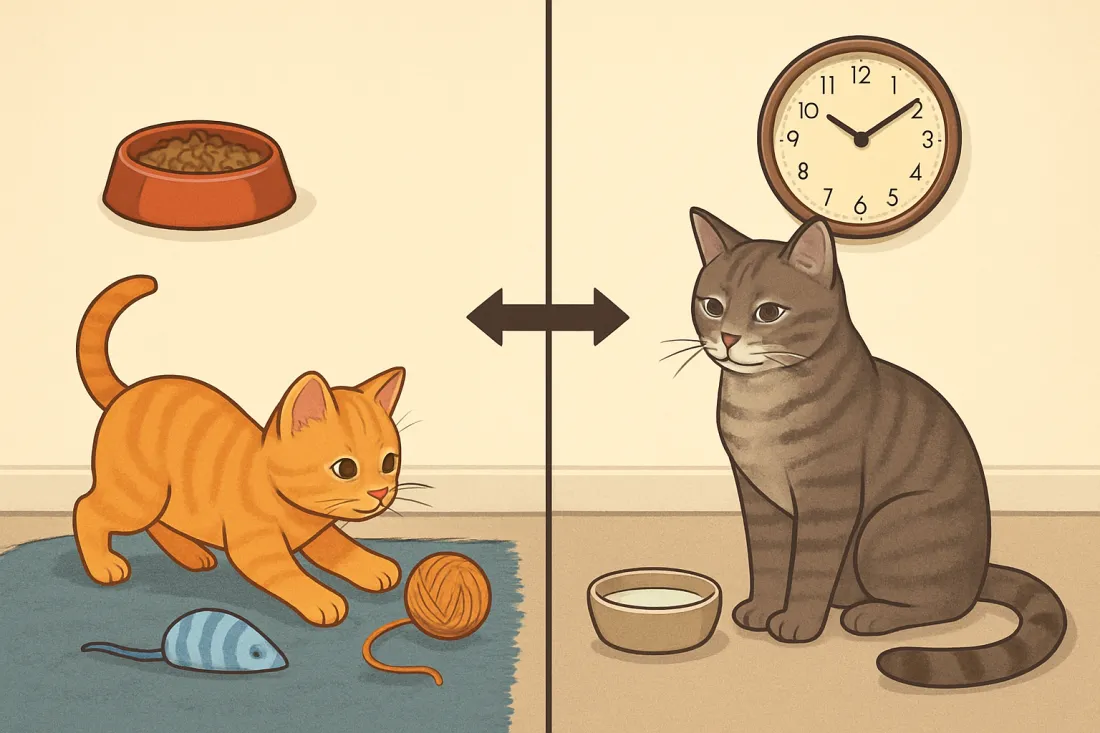
Time demands of a kitten
- Daily play: Expect at least 2–4 short, active play sessions every day to burn off energy and prevent boredom.
- Supervision: Kittens explore everything with teeth and claws. You will need to watch for hazards like cords, small objects, and open windows or balconies.
- Training moments: Redirecting scratching to posts, teaching gentle play (no hands as toys), and reinforcing litter box habits happen many times a day.
- Sleep disruption: Kittens often have bursts of energy late at night or early morning. Light sleepers may struggle at first.
If your schedule is already packed with work, school, or caregiving, these needs can feel overwhelming and may lead to frustration—for you and the kitten.
Time demands of an adult cat
- Routine play: Most adult cats do well with 1–2 focused play sessions per day plus casual interaction.
- Lower supervision: Once settled, an adult cat is usually safe to roam the home while you work or sleep, as long as the environment is cat-proofed.
- Adjustment period: Adults still need time to decompress and learn your routine, but they usually do not require constant monitoring.
- Predictable nights: Many adult cats adjust to your sleep schedule more easily than kittens.
If you work full-time or have an irregular schedule, an adult cat is often the more realistic and kinder choice.
Household fit: kids, seniors, roommates, and renters
Your living situation matters as much as your personal preferences. Think about who shares your home and what your housing allows.
Homes with children
- Toddlers and young kids (under ~6–7):
- Kittens are fragile and can be easily injured by rough or clumsy handling.
- Kittens also play with teeth and claws, which can scare or hurt small children.
- An adult cat known to be patient with kids is usually safer and less stressful.
- Older, responsible kids:
- Kittens can be a fun project if kids are genuinely ready to help with play, feeding, and gentle handling.
- Adults can still be playful and may be better for families that want a calmer home overall.
Seniors and people with limited mobility
- Kittens: Can dart under feet, climb legs, and cause trips or falls. Their high energy can be tiring.
- Adult cats: A mellow adult or senior cat is often a better match—less physically demanding and more content to cuddle and nap.
Roommates and shared housing
- Noise and disruption: Kittens may knock things over at night, chew cords, and explore every room. Roommates may not appreciate the chaos.
- Consistency: Adult cats often handle a rotating schedule of roommates better, as long as they have a quiet safe space.
- Responsibility: Decide clearly who is responsible for feeding, litter, and vet visits. A kitten’s needs can cause conflict if no one has time.
Renters and small apartments
- Space: Both kittens and adults can thrive in apartments with enough vertical space (cat trees, shelves) and enrichment.
- Damage risk: Kittens are more likely to scratch carpets, blinds, and furniture, which can threaten your security deposit.
- Landlord rules: Some rentals have age or weight limits, or require extra pet deposits. Always confirm before adopting.
Cost and vet care differences: kitten vs adult cat
Exact costs vary widely by location and clinic, but the pattern is fairly consistent: kittens usually require more frequent vet visits in the first year, while adult cats may have lower upfront medical needs but can develop age-related conditions later.
Typical first-year needs for a kitten
- Several rounds of core vaccinations during the first months.
- Spay or neuter surgery if not already done by the shelter.
- Microchipping, deworming, and flea prevention as recommended.
- Kitten-specific food, which they may eat in multiple small meals per day.
- Extra supplies: smaller litter box at first, more toys, scratching posts, and kitten-proofing items like cord protectors.
These are not one-time decisions; you will need to schedule and attend several appointments in that first year.
Typical first-year needs for an adult cat
- Wellness exam soon after adoption to establish baseline health.
- Booster vaccines or updates if needed, based on records.
- Routine parasite prevention and dental checks.
- Many adults are already spayed/neutered and microchipped before adoption, which simplifies early care.
Older adult or senior cats may need more frequent monitoring for issues like dental disease or joint discomfort, but you can often plan this with your vet once you know the cat’s age and health status.
Who should choose a kitten vs who should choose an adult cat
Use these scenario-based recommendations as a starting point, then adjust based on individual cats you meet.
Adopting a kitten may fit you if:
- You genuinely enjoy high-energy, mischievous behavior and can laugh off minor chaos.
- You have several hours each day for play, supervision, and training, especially in the first year.
- Your household is physically safe for a tiny, curious animal (no open balconies, dangerous gaps, or heavy items that can be pulled down).
- You are prepared for multiple vet visits in the first year and can budget for them.
- You are okay with some uncertainty about the cat’s eventual personality and size.
Adopting an adult cat may fit you if:
- You want a calmer companion who can fit around a standard work or school schedule.
- You prefer to know a cat’s personality—cuddly vs. independent, talkative vs. quiet—before committing.
- You live with young kids, seniors, or other pets and need a cat already tested in those situations.
- You want to make a big impact: adult cats are often overlooked, so adopting one can literally save a life.
- You are okay with the possibility that an older cat may need more medical support sooner than a kitten would.
If you are still unsure whether a cat is the right species for you at all, you may find it helpful to step back and look at your lifestyle more broadly using tools like a should I adopt a dog or cat quiz before deciding on age.
Decision flowchart: kitten or adult cat?
Use this simple text-based flow to see which option fits your situation better right now.
- How many hours are you regularly away from home on weekdays?
- More than 8–9 hours most days: Lean toward an adult cat.
- Under 8 hours, with flexibility for breaks and play: Either can work; continue.
- How much daily time can you reliably spend on active play and training?
- Under 1 hour most days: Adult cat is usually a better fit.
- 1–2 hours or more, most days: Kitten or adult could work; continue.
- Who else lives in your home?
- Very young kids, frail seniors, or people with balance issues: Favor an adult cat known to be gentle.
- Adults/teens who understand cat behavior: Either can work; continue.
- How do you handle noise and disruption at night?
- Light sleeper, easily stressed by noise: Adult cat is usually easier.
- Flexible sleeper, okay with some chaos: Kitten is more realistic.
- What matters more to you emotionally?
- Raising a cat from babyhood and seeing every stage: Kitten.
- Giving a home to a cat that might otherwise be overlooked: Adult cat.
If you answered mostly in favor of predictability, calm, and limited time, an adult cat is likely the better choice. If you consistently chose options that assume extra time, patience, and tolerance for chaos, a kitten could be a great match.
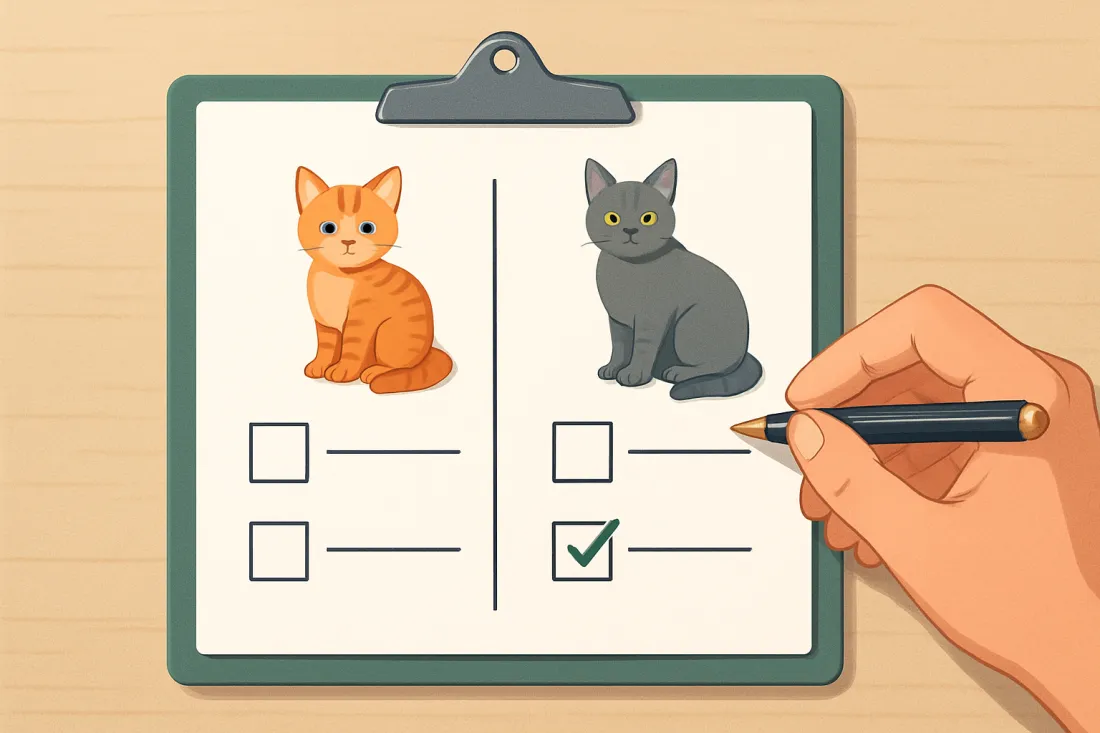
Practical checklist before you choose kitten or adult cat
Use this checklist to reality-check your decision before you visit a shelter or rescue.
- Time and schedule
- I know how many hours I am away from home on a typical day.
- I can commit at least 1–2 play sessions every day, even when I am tired or busy.
- I have a plan for vacations, long weekends, and emergencies.
- Household and environment
- Everyone in the home agrees to having a cat and understands basic cat behavior.
- I have safe spaces for a cat to retreat (quiet room, high perch, hiding spots).
- I can block off dangerous areas (balconies, open windows, unstable shelves).
- Budget and vet care
- I can afford routine vet care, food, litter, and basic supplies every month.
- I am prepared for several vet visits in the first year if I choose a kitten.
- I have a plan for unexpected vet bills (savings, credit, or pet insurance).
- Personality and expectations
- I know whether I prefer a cuddly lap cat, an independent roommate, or something in between.
- I understand that kittens may not grow into the exact personality I imagine.
- I am open to meeting several cats and letting personality guide my choice.
- Long-term commitment
- I am ready for a commitment that can last well over a decade.
- I have thought about how a cat fits into future plans like moving, relationships, or kids.
Questions to ask shelters or rescues before choosing
Staff and foster families know their cats well. Ask targeted questions to match the right cat to your lifestyle.
Questions about any cat (kitten or adult)
- What do you know about this cat’s personality? (Shy, outgoing, cuddly, independent, vocal, quiet?)
- How does this cat react to new people and new environments?
- Has this cat lived with children, dogs, or other cats before? How did it go?
- What is this cat’s energy level like during the day and at night?
- Does this cat have any known medical issues or special dietary needs?
- Is this cat fully litter trained? Any history of accidents?
Extra questions for kittens
- How old is the kitten, and is it eating solid food well?
- Is the kitten comfortable being handled, picked up, and touched on paws and belly?
- Has the kitten been socialized with people and, if relevant, other animals?
- What vet care has the kitten already received, and what is still needed?
- Do you recommend adopting this kitten with a sibling or another young cat for company?
Extra questions for adult cats
- Do you know why this cat was surrendered or how it came to the shelter?
- How long has this cat been in the shelter or foster home?
- How does this cat handle being left alone during the day?
- Does this cat have any behavior quirks I should know about (door-dashing, counter-surfing, fear of loud noises)?
- Is this cat on any long-term medication or special diet?
Take notes as you go. Often, the right cat becomes obvious when you compare what you hear with your checklist and daily reality.
Common mistakes when choosing between kitten and adult cat
Avoid these frequent pitfalls that lead to mismatches and stress for both humans and cats.
- Choosing only by looks: Picking the fluffiest or “cutest” kitten without considering energy level, personality, or your schedule.
- Underestimating kitten work: Assuming a kitten is like a small adult cat; in reality, they are closer to toddlers in curiosity and risk.
- Ignoring household limits: Adopting a high-energy kitten into a home with very young kids or frail seniors who cannot safely manage the chaos.
- Over-romanticizing rescue: Wanting to “save” a cat without honestly checking whether you can meet its needs for the next decade or more.
- Not planning for behavior issues: Expecting any cat to be perfectly behaved without training, enrichment, or patience.
- Skipping the trial mindset: Not giving yourself and the cat time to adjust, or not using the shelter’s advice on gradual introductions and decompression.
FAQ about adopting a kitten vs an adult cat
Is it better to get a kitten or a full grown cat?
Neither is universally “better.” A kitten is better only if you have plenty of time, patience, and energy for training, play, and supervision, and you are comfortable with an unpredictable personality as the cat matures. A full grown cat is usually better if you want a calmer, more predictable companion who can fit around work or family life with fewer surprises. Think about your schedule, household members, and how much chaos you are truly okay with, then choose the age that matches that reality.
What is the 3-3-3 rule for adopting a cat?
The 3-3-3 rule is a simple way to remember that adjustment takes time. Many cats need roughly:
- 3 days to start decompressing and realize they are in a new, safe place.
- 3 weeks to begin learning the household routine and showing more of their personality.
- 3 months to feel fully at home and bonded with their new family.
Some cats adjust faster and some slower, but this rule is a good reminder not to panic if your new kitten or adult cat seems shy, hides, or acts differently at first.
Can a kitten be left alone for 5 days?
No. A kitten should not be left alone for several days. They need daily feeding, litter box cleaning, social interaction, and safety checks. Leaving a kitten alone for 5 days, even with extra food and water, is unsafe and can lead to health and behavior problems. If you need to be away, arrange for a trusted person to visit at least once or twice a day, or use a reputable pet sitter or boarding option that is comfortable with kittens.
Are cats happier with two, especially if I get a kitten?
Many cats enjoy having another cat companion, especially kittens who often benefit from a playmate close to their age. Two kittens can burn off energy with each other and may be less demanding of human attention every minute. However, not all adult cats want another cat in their space, and some prefer being the only pet. If you are considering two, talk with the shelter about bonded pairs or cats that have already lived peacefully with others. Also be sure your budget and space can comfortably support two cats for the long term.
How do I know if I am ready for any cat at all?
You are more likely to be ready if you can commit time every day for care and interaction, have a stable living situation that allows pets, and can handle ongoing costs like food, litter, and vet care. It also helps to think through how a cat fits into your future plans, not just your current mood. If you are unsure, you can reflect more broadly on your lifestyle and responsibilities using tools like an am I ready to adopt a dog quiz as a general readiness check for long-term pet commitments, then apply the same honesty to cats.