
You are not a bad person for wondering, “Should I rehome my dog?” That question usually comes from exhaustion, guilt, and love all mixed together. The goal is not to judge you, but to help you make the kindest, safest decision for both you and your dog.
This quiz-style guide walks you through the hard questions step by step, then explains what your results mean and what to do next in the United States—whether that is getting more help and keeping your dog, or planning an ethical rehoming.
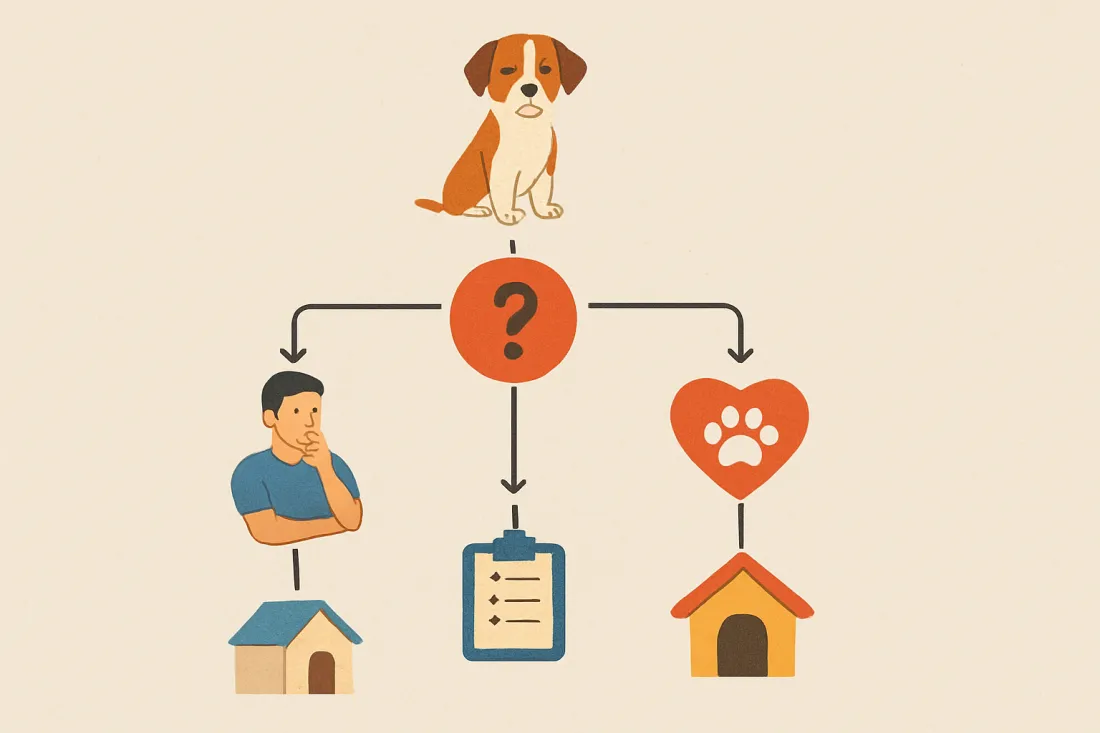
Important disclaimer: This quiz cannot replace a veterinarian, certified trainer, behavior professional, mental health professional, or legal advice. Use it as a starting point, then confirm decisions with qualified local professionals, especially for safety, medical, or housing issues.
Keep working on problems vs rehoming: how this quiz helps you decide
Most owners considering rehoming are stuck between two fears:
- Fear of failing their dog if they give them up
- Fear of harming their family, other pets, or the dog by keeping a situation that is not working
This quiz focuses on six areas that usually decide whether you should keep working on things or seriously consider rehoming:
- Safety
- Time and energy
- Finances
- Housing and lifestyle
- Behavior and training
- Health and special needs
After you answer, you will see how to interpret your score, plus concrete next steps for both paths: getting more support to keep your dog, or planning a responsible rehoming if that is truly the kinder option.
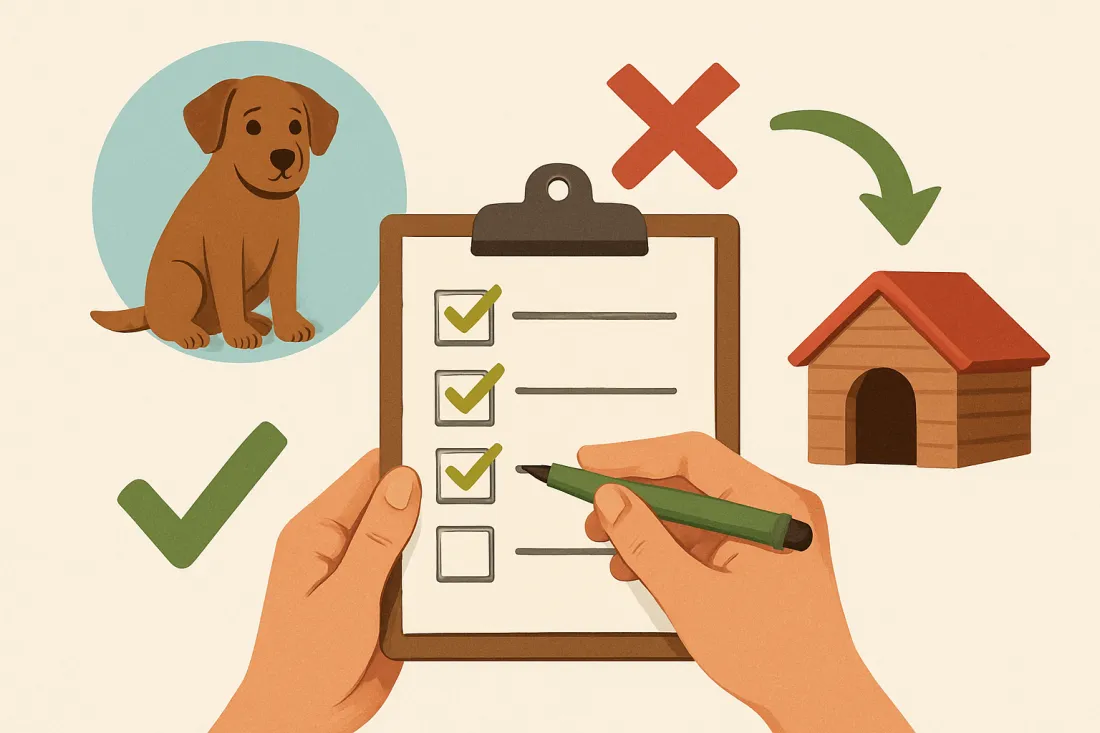
Self-assessment quiz: should I rehome my dog or keep trying?
Use this like an interactive quiz. For each question, choose the option that fits best right now, not what you wish were true. Keep a running total as you go.
How to score
- “A” answers: 0 points each
- “B” answers: 1 point each
- “C” answers: 2 points each
Write down your points for each question, then add them at the end.
Section 1 – Safety
- Has your dog bitten or seriously scared anyone?
A. No, only normal puppy nips or play mouthing – 0
B. Growls, snaps, or air-bites, but no skin broken – 1
C. Has broken skin or caused a serious bite, or I am afraid of my dog – 2 - How safe do you feel managing your dog around kids, visitors, or other pets?
A. I feel confident and can prevent problems with simple rules – 0
B. I am on edge and constantly managing, but we have not had a major incident – 1
C. I am scared something serious will happen even with my best efforts – 2 - Is anyone in the home being hurt or at real risk?
A. No one is being hurt; issues are mostly annoying – 0
B. Minor scratches or scuffles happen, but nothing serious – 1
C. Someone has needed medical care, or I worry they might – 2
Section 2 – Time and energy
- How much time can you realistically give your dog each day?
A. I can usually meet their exercise, play, and training needs – 0
B. I am stretched thin and often cut corners – 1
C. I am overwhelmed; some days I can barely meet basic needs – 2 - How burned out do you feel?
A. Tired sometimes, but overall glad to have my dog – 0
B. Frequently frustrated and resentful – 1
C. Emotionally drained; I dread interacting with my dog – 2
Section 3 – Finances
- Can you afford basic care (food, vaccines, flea/tick, routine vet visits)?
A. Yes, with normal budgeting – 0
B. It is tight; I sometimes delay or skip non-urgent care – 1
C. I cannot reliably cover basics – 2 - Can you handle unexpected costs (emergency vet visit, behavior help, medication)?
A. I have some savings, credit, or pet insurance – 0
B. I could manage a small bill but not a big one – 1
C. I have no realistic way to cover unexpected costs – 2
Section 4 – Housing and lifestyle
- Is your current housing compatible with your dog?
A. Yes, my lease or home situation allows this dog’s size and breed – 0
B. There are some restrictions, but we are managing for now – 1
C. My landlord, HOA, or city rules are not compatible with my dog – 2 - Are neighbors or roommates seriously affected?
A. Occasional complaints, but nothing major – 0
B. Repeated complaints about barking, damage, or safety – 1
C. Threats of eviction, legal action, or being forced to give up the dog – 2
Section 5 – Behavior and training
- Have you tried structured training or behavior help?
A. Yes, with a qualified trainer/behavior professional, and we see progress – 0
B. I have tried some classes or online tips, but not consistently – 1
C. I have not been able to get any real help yet – 2 - Is your dog’s behavior improving, staying the same, or getting worse?
A. Slowly improving – 0
B. Up and down; some better, some worse – 1
C. Clearly getting worse or more dangerous – 2 - How severe are the behavior issues?
A. Mostly manners (jumping, pulling, house training) – 0
B. Anxiety, reactivity, or resource guarding that is hard to manage – 1
C. Severe aggression, repeated escapes, or behavior that feels unmanageable – 2
Section 6 – Health and special needs
- Does your dog have medical or special needs?
A. Only routine care needed – 0
B. Manageable chronic issues (allergies, meds) – 1
C. Serious or complex medical/behavioral needs that require major time or money – 2 - Can you realistically meet those needs long term?
A. Yes, with planning – 0
B. I am not sure I can keep this up – 1
C. I already cannot keep up with what is required – 2
Quiz scoring: what your total suggests about rehoming vs working through problems
Add up your points from all 14 questions. Then use this guide to understand what your score may mean. These ranges are not a diagnosis; they are a starting point for reflection and conversation with professionals.
| Total score range | What it usually means | Suggested next focus |
|---|---|---|
| 0–8 points | Challenges are present but mostly manageable. Safety risks are low to moderate, and many issues are likely solvable with support. | Lean toward keeping your dog while getting more structured help (training, schedule changes, financial support). |
| 9–16 points | Multiple areas are strained (time, money, housing, or behavior). You may be approaching burnout, and some risks may be rising. | Take this as a yellow light. Intensify support now and have an honest backup plan. Rehoming might become the kindest option if things do not improve. |
| 17–28 points | High stress and/or serious safety, housing, or financial problems. The current situation may be unsafe or unsustainable for you, your family, or your dog. | Strongly consider that ethical rehoming may be the most responsible choice, especially if professionals confirm the risks. |
Regardless of your score, any clear safety risk (serious bites, threats of eviction, or a dog’s needs you absolutely cannot meet) deserves immediate professional input, even if your total points are low.
Problems that can often be solved with support instead of rehoming
Many issues that push people toward rehoming are actually fixable with the right help. Before you decide, check whether your main struggles fall into these “often solvable” categories.
Commonly solvable behavior and training issues
- House training accidents – Often improved with a consistent schedule, crate or pen use, and ruling out medical issues with a vet.
- Leash pulling and jumping on people – Usually respond well to basic obedience training, proper equipment, and regular exercise.
- Barking from boredom – Can improve with more mental enrichment (puzzle toys, sniff walks, training games) and predictable routines.
- Mild separation distress – Often helped by gradual alone-time training, background noise, and sometimes professional guidance.
Life logistics that can be adjusted
- Busy work schedule – Dog walkers, doggy day care, or trading help with neighbors can reduce guilt and give your dog needed activity.
- Limited space – Even in small apartments, structured walks, indoor games, and training sessions can meet many dogs’ needs.
- Family routines – Clear rules for kids (no bothering the dog while eating or sleeping, for example) can prevent many conflicts.
Financial support options to explore
If money is the main barrier, it may be possible to keep your dog by combining several supports:
- Payment plans or wellness packages at local veterinary clinics
- Low-cost vaccine and spay/neuter clinics run by shelters or nonprofits
- Pet food banks or community pet pantries
- Charitable funds or grants for emergency vet care (availability varies by area)
Because programs change, check with local shelters, humane societies, or your vet’s office for current options in your part of the United States.
U.S. resources that can help you keep your dog safely
Before deciding to rehome, it is worth having at least one conversation with each of these types of helpers if they apply to your situation.
Training and behavior help
- Certified dog trainers – Can help with manners, leash skills, and many behavior issues. Look for positive, reward-based methods.
- Veterinary behavior professionals – For serious aggression, anxiety, or complex cases, your regular vet can refer you to a specialist.
- Group classes or day training – Sometimes cheaper than private sessions and still very effective.
If you are new to dog ownership and feel overwhelmed, a broader guide like a first time dog owner checklist USA can help you see which basics you might be missing.
Low-cost veterinary and financial aid options
- Local shelters and humane societies – Often run low-cost vaccine, microchip, or spay/neuter clinics.
- Nonprofit vet clinics – Some cities have clinics that offer sliding-scale fees based on income.
- Emergency assistance funds – Certain charities and breed rescues maintain small funds for urgent medical needs; availability and rules vary.
Housing and legal guidance
- Tenant support organizations – May help you understand your lease and options if you are facing pet-related housing pressure.
- Local animal control or city offices – Can explain local pet rules, licensing, and complaint processes.
- Legal information resources – For a broader overview, you can review guides such as US pet laws every dog owner should know and then confirm details locally.
When rehoming your dog may be the kindest option
Rehoming is not automatically a failure. Sometimes it is a deeply responsible act. Consider that rehoming may be the most humane choice if one or more of these are true, even after seeking help:
- Serious safety risk – Your dog has caused significant injury, or professionals believe the risk of future harm is high despite management.
- Unfixable housing conflict – You are facing eviction, homelessness, or must move to non-pet housing, and all realistic alternatives have been exhausted.
- Unmet medical or special needs – Your dog needs care, equipment, or time that you simply cannot provide, and there is no sustainable support system.
- Severe, lasting mismatch – Your dog’s energy level, size, or temperament is fundamentally incompatible with your household, and everyone (including the dog) is chronically stressed.
- Chronic burnout – You feel only dread, resentment, or numbness toward your dog, and efforts to reset and get support have not changed that.
In these situations, staying together at all costs can actually be less kind than carefully placing your dog in a home that is a better fit.
Comparison: keep working on issues vs plan a responsible rehoming
Use this table to compare what each path usually involves. It can clarify which option fits your reality better.
| Aspect | Keep working through problems | Plan a responsible rehoming |
|---|---|---|
| Main goal | Improve life with your current dog so everyone is safer and happier. | Find a home that can better meet your dog’s needs and protect your household. |
| Time and energy | Requires ongoing training, management, and routine changes; effort is front-loaded but can pay off long term. | Requires short-term effort to screen homes, work with rescues, and support your dog’s transition. |
| Costs | Training, vet care, equipment, and possibly behavior specialists. | Usually low direct cost; may include vet updates, microchipping, or small rehoming fees. |
| Risks if done poorly | Safety incidents, eviction, worsening behavior, or emotional burnout. | Dog ending up in an unsafe home, being passed around, or landing in an overcrowded shelter. |
| Best fit when | Safety risks are manageable, you have some resources, and you still feel bonded or hopeful. | Safety, housing, or needs are beyond what you can realistically provide, even with support. |
| Emotional impact | Can be stressful but often strengthens the bond as progress appears. | Grief and guilt at first, but also relief if you know your dog is truly better off. |
Step-by-step guide to responsible rehoming in the United States
If you and your advisors conclude that rehoming is the kindest option, how you do it matters enormously for your dog’s safety.
Step 1 – Talk honestly with trusted friends and family
- Explain why you need to rehome and what kind of home your dog needs.
- Ask if anyone is interested or knows someone who might be a good fit.
- Be honest about behavior or medical issues; hiding problems sets everyone up to fail.
Step 2 – Contact reputable rescues or shelters
- Reach out to breed-specific rescues if your dog is a recognizable breed or mix.
- Ask local shelters if they have owner-surrender programs, waiting lists, or “courtesy posting” to help you find adopters while the dog stays with you.
- Provide vet records, behavior history, and clear photos to help them evaluate and promote your dog.
Step 3 – Decide on no-fee vs low-fee placements
- Low adoption fee – Often recommended to discourage impulsive adopters and help cover basic costs like vaccines or microchips.
- No-fee placement – Can be appropriate when rehoming to someone you know well and trust, or when working through a rescue that screens adopters.
Whatever you choose, focus on screening and written agreements more than the exact dollar amount.
Step 4 – Screen potential adopters carefully
- Ask about their schedule, experience with dogs, other pets, and children.
- Confirm that their housing allows dogs of your dog’s size and type.
- Request references if you do not know them personally.
- Arrange a meet-and-greet in a neutral, safe location, and then a home visit if possible.
Step 5 – Plan a thoughtful handover
- Provide all vet records, microchip information, and any medications.
- Send your dog with familiar items: bed, toys, and a small supply of current food.
- Review your written agreement together and make sure everyone understands expectations.
How to write an honest adoption profile and simple contract
A clear, truthful profile and basic contract protect both your dog and the new family.
Key elements of an honest adoption profile
- Basics – Name, age, size, breed or mix, spay/neuter status, and whether vaccines are current.
- Personality – What your dog loves (fetch, cuddles, car rides) and what stresses them (loud noises, being left alone, certain types of handling).
- Daily needs – Exercise level, mental stimulation, and routines that help them feel secure.
- What they are good with – Kids of certain ages, cats, other dogs, or if they should be an only pet.
- Challenges and management – Any history of bites, reactivity, resource guarding, or medical issues, plus what has helped.
- Ideal home description – For example, “quiet adult-only home,” “active family with a fenced yard,” or “experienced dog owner comfortable with ongoing training.”
Simple contract points to cover
Consider putting these items in a written agreement signed by both parties:
- Dog’s identifying information (name, description, microchip number if applicable)
- Statement that you are transferring ownership and medical records to the adopter
- Disclosure that you have shared all known medical and behavior history to the best of your knowledge
- Agreement about what happens if the adopter cannot keep the dog (for example, they contact you or the rescue first)
- Any specific care requirements you both agree to follow (for example, keeping the dog as an indoor family pet)
If you work with a rescue or shelter, they will usually provide their own adoption contract and handle this for you.
What to avoid when rehoming your dog
Some common shortcuts can put your dog at serious risk, even if they seem convenient.
- Unscreened “free to good home” ads – Without screening, you cannot know if someone has good intentions or the ability to care for your dog long term.
- Anonymous online listings with no vetting – Meeting strangers without checking references, housing, or experience can lead to unsafe placements.
- Abandoning your dog – Leaving a dog tied outside a shelter, at a park, or with someone who did not agree to take them is dangerous and may be illegal in many places.
- Hiding serious issues – Failing to mention aggression, bite history, or major medical needs can result in your dog being bounced between homes or euthanized after an incident.
- Rushing the decision – Rehoming in a panic, without planning, increases the chance of a poor match.
Decision checklist: are you closer to “keep” or “rehoming” right now?
Use this quick checklist alongside your quiz score to clarify your next step.
If you check most of these, focus on keeping your dog with more support
- No one has been seriously injured by your dog.
- Your housing allows your dog, and eviction is not imminent.
- You can cover basic care with some budgeting or small adjustments.
- You still feel some bond or hope that things can improve.
- You have not yet tried structured, positive training or behavior help.
- Your main issues are manners, mild anxiety, or routine challenges.
If you check most of these, it is time to plan for ethical rehoming
- There has been a serious bite or near-miss, and you are afraid.
- You are facing eviction, homelessness, or must move where dogs like yours are not allowed.
- You cannot reliably provide basic care, even with local aid.
- Multiple professionals have tried to help, but the situation remains unsafe or unmanageable.
- You feel chronically burned out and have tried to reset without success.
- You can clearly describe the kind of home that would suit your dog better than your current situation.
Resource directory template and national-level options
Because programs and organizations change, use this template to build your own local resource list in the United States.
Local resource checklist to fill in
- Nearest open-admission animal shelter: [name, phone, website]
- Local humane society or SPCA: [name, phone, website]
- Low-cost vet clinic or mobile vaccine clinic: [name, schedule]
- Pet food pantry or community aid program: [location, hours]
- Certified positive-reinforcement dog trainer: [name, contact]
- Veterinary behavior professional (if available): [clinic, referral process]
- Breed-specific rescue for your dog’s type: [organization, contact]
Examples of national-level help types
Across the U.S., you can often find:
- National or regional rescue networks for specific breeds or size categories
- Charities that help with emergency vet bills for qualifying owners
- Online directories of trainers and behavior professionals who use humane methods
- Educational resources on integrating rescue dogs, such as a first 30 days with a rescue dog routine if you eventually adopt again
Search using your city or ZIP code plus terms like “humane society,” “low-cost vet clinic,” “pet food pantry,” or “dog behavior help” to find current options.
FAQ: guilt, kids, and staying in touch after rehoming
At what point should you rehome a dog?
Rehoming should be considered when you have:
- Addressed basic training and routine issues as best you can
- Consulted at least one professional (vet, trainer, or behavior expert) about serious problems
- Clear evidence that safety, housing, or your dog’s needs cannot be met in your current situation
If professionals agree that the situation is unsafe or unsustainable despite reasonable efforts, it is responsible to plan an ethical rehoming rather than waiting for a crisis.
Do dogs cope with being rehomed?
Many dogs do adjust well to new homes, especially when the new environment fits their needs better. It is normal for a dog to be confused or stressed at first, but with patient, consistent care, most settle into new routines. Choosing a home that understands your dog’s personality and challenges gives them the best chance to thrive.
What is the 3-3-3 rule for rehoming dogs?
The “3-3-3 rule” is a common guideline describing how long it may take a newly adopted or rehomed dog to adjust:
- First 3 days – Many dogs feel overwhelmed, shut down, or extra clingy.
- First 3 weeks – They start to learn the routine and show more of their personality.
- First 3 months – They are often more fully settled and bonded with their new family.
Every dog is different, but this rule can help you and the new family set realistic expectations.
What is the 90/10 rule for dogs?
People use “90/10 rule” in different ways, but one common idea is that if a dog is doing well most of the time (for example, 90% of walks or interactions go smoothly), you can focus on improving the remaining 10% with training and management. If the “10%” includes serious safety incidents or extreme stress, that small portion still matters a lot and deserves professional attention.
How do I handle my guilt about rehoming?
Guilt usually comes from caring deeply. Remind yourself that:
- You sought information and tried to make a thoughtful decision.
- You looked for help and did not give up at the first inconvenience.
- You chose a path aimed at your dog’s long-term well-being, not just short-term relief.
Talking with a trusted friend, counselor, or support group can help you process the loss and move forward without punishing yourself.
What should I tell my kids about rehoming our dog?
Adjust your explanation to their age, but keep it honest and simple:
- Explain that the dog needs a different kind of home to be happy and safe.
- Emphasize that adults are responsible for the decision, not the children.
- Allow kids to say goodbye in a calm, positive way if appropriate.
- Offer ways to stay connected if the new family is open to updates.
Reassure them that loving an animal sometimes means making hard choices for its good.
Should I stay in touch with my dog’s new owners?
Many people find comfort in occasional updates, but it depends on what the new family is comfortable with. You might:
- Agree on a few initial updates (for example, after the first week and first month)
- Share photos and notes that help them understand your dog’s history
- Then step back so the dog can fully bond with their new family
Whatever you decide, respect the new owners’ boundaries and focus on your dog’s ability to settle into their new life.
Whether you ultimately keep your dog or rehome them, taking the time to think, ask hard questions, and plan carefully is a powerful act of responsible pet ownership.