
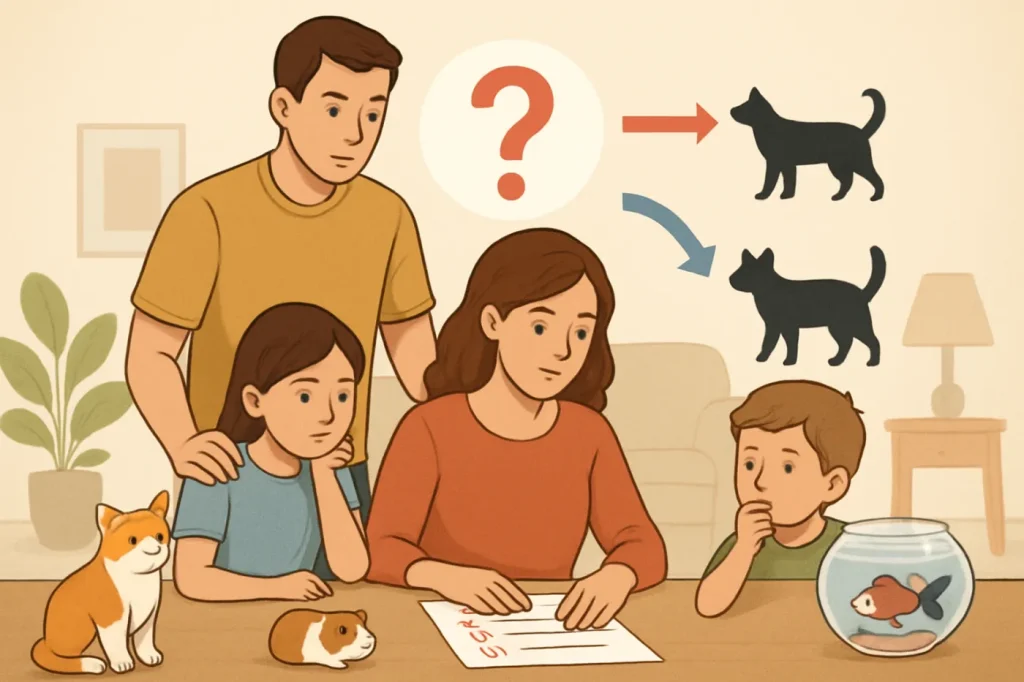
Choosing a pet is exciting, but the “cute” choice is not always the right choice. The best pet for your family is the one whose energy, space needs, and care level match your real life, not your ideal life.
For many U.S. families, the most realistic first pets are:
- Busy, out-of-the-house most days: adult cat, pair of guinea pigs, or fish.
- Active family home most afternoons/evenings: mid-size, even-tempered dog or confident adult cat.
- Very young kids (under ~6): sturdy, gentle dog from a calm breed line or well-handled guinea pigs (with adult supervision).
- Small apartment, thin walls: cat, small quiet dog, or small pets like fish or some rodents (check landlord rules first).
The rest of this guide walks you through a simple process to decide what kind of pet fits your family, then compares common options so you can choose with confidence.

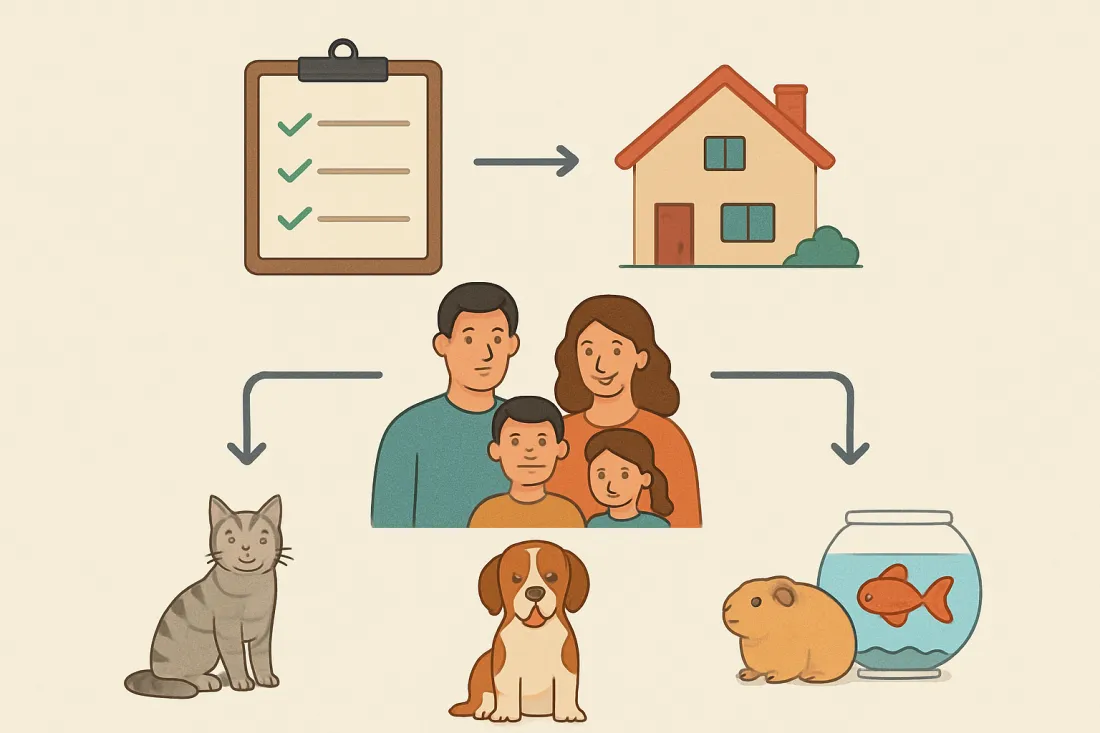
Start With a Family Lifestyle Assessment, Not a Pet Type
Before falling in love with a specific animal, get clear on what you can realistically offer a pet every day. That is the core of responsible pet ownership.

Key lifestyle questions to answer together
- Time at home
- On a typical weekday, how many waking hours is at least one adult or responsible teen at home?
- Are there long stretches (6–10 hours) when the home is empty?
- Energy level
- Do you enjoy daily walks, hikes, or play in the yard?
- Or do you prefer quiet evenings on the couch and low-key weekends?
- Predictability
- Are your schedules fairly stable, or do shifts, travel, or kids’ activities change week to week?
- Children in the home
- How old are they, and how used are they to animals?
- Is anyone nervous around animals?
- Health and allergies
- Does anyone have asthma or known pet allergies?
- Is anyone physically limited in walking, lifting, or cleaning?
- Budget comfort zone
- Are you ready for ongoing costs like food, basic vet care, and occasional emergencies?
- If you are unsure, plan a conversation with a local vet about typical ranges for the species you are considering.
Once you have honest answers, you can match pet energy to family lifestyle instead of guessing.
How Your Home Environment Limits or Expands Pet Options
Your home size, layout, and rules can make some pets easy and others stressful. Think about:
Space and layout
- Apartment or condo
- Thin walls and shared hallways can make barking or strong pet odors a problem.
- Limited outdoor space means more leashed walks and less off-leash play.
- House with yard
- Fenced yards help with dogs but do not replace walks or training.
- Yard size matters less than how often you interact with the pet.
- Stairs and accessibility
- Very small children and steep stairs can be risky with large, boisterous dogs.
- Heavy tanks or cages need stable, safe surfaces.
Landlord, HOA, and household rules
- Check pet policies before you decide: species allowed, size limits, breed restrictions, and deposits.
- Some “pet-friendly” rentals still limit the number of pets or require extra cleaning at move-out. If you are unsure, review guidance on what does pet friendly apartment really mean and clarify with your landlord in writing.
- Consider family rules: Are certain rooms off-limits? Is anyone strongly opposed to certain animals (for example, snakes or rodents)?
Noise and neighbors
- Frequent barking, howling, or loud vocalizations can strain neighbor relationships.
- Some small pets (like certain birds) can be surprisingly loud; research typical noise levels and ask current owners what daily life is like.
Time Commitment: What Different Pets Need From You
Every pet needs daily care, but the type and intensity vary. Instead of exact minutes, think in relative levels and non-negotiable tasks.
Daily and weekly responsibilities by pet type
- Dogs
- Multiple daily bathroom breaks and walks, regardless of weather.
- Training, socialization, and play to prevent boredom and behavior issues.
- Grooming needs vary by coat type; some require regular professional grooming.
- Cats
- Daily feeding, fresh water, and litter box scooping.
- Play and enrichment (toys, climbing, scratching posts) to prevent stress and destructive behavior.
- Most cats groom themselves but still need nail trims and health checks.
- Small mammals (guinea pigs, rabbits, hamsters, etc.)
- Daily feeding, fresh water, and spot-cleaning of cages.
- Regular full cage cleanings to control odor and keep them healthy.
- Gentle handling and supervised out-of-cage time for exercise (especially rabbits and guinea pigs).
- Birds
- Daily feeding, water changes, and cage cleaning.
- Social interaction and mental stimulation; many birds are highly social and can become distressed if ignored.
- Fish
- Daily feeding and quick visual health checks.
- Regular water changes and filter maintenance; water quality is critical.
- Reptiles
- Feeding schedules vary (some eat daily, others less often).
- Maintaining proper temperature, humidity, and lighting in their enclosure.
Ask yourselves: Can we commit to this level of care every day for the pet’s entire life? Dogs and cats can live well over a decade; some birds and reptiles can live much longer.
Comparison Table: Which Pet Fits Which Family Lifestyle?
| Pet type | Best for families who | Key benefits | Main challenges | Check before choosing |
|---|---|---|---|---|
| Dog (adult, calm breed or mix) | Are home several hours daily and enjoy walks or outdoor time | Strong companionship, encourages exercise, great for many kids | Needs daily walks, training, and reliable pet care during travel | Landlord/HOA rules, access to outdoor space, budget for vet and training |
| Puppy | Have lots of time, patience, and consistency for training | Can grow with the family, training from scratch | House-training accidents, chewing, frequent supervision needed | Work schedules, who handles night wake-ups and accidents |
| Adult cat | Are out of the house most days but home mornings/evenings | Independent, uses litter box, usually quieter than dogs | Needs enrichment to prevent boredom; some dislike rough handling | Allergies, litter box location, ability to keep toxic plants/cords out of reach |
| Kitten | Want a playful pet and can supervise kids closely | Very engaging and fun, can adapt to your routine | Sharp claws, high energy, may be overwhelming for toddlers | Plan for scratching posts, safe spaces, and gentle kid–pet rules |
| Guinea pigs (pair) | Have limited space and moderate time for daily care | Generally gentle, good for supervised older children | Cages need frequent cleaning; sensitive to heat and drafts | Space for a roomy cage, nearby vet comfortable with small mammals |
| Rabbits | Can rabbit-proof areas and supervise daily exercise | Social, can bond strongly with people | Chewing on cords/furniture, litter training takes effort | Indoor vs. outdoor housing, safe play area, vet experienced with rabbits |
| Fish | Want a low-interaction pet and enjoy tank maintenance | Quiet, space-efficient, calming to watch | Water quality issues can be tricky; not cuddly or interactive | Weight and location of tank, access to water and power outlets |
| Birds (small species) | Are home daily and enjoy interactive, vocal pets | Social, intelligent, can learn routines and sounds | Noise, mess around cage, some species live a very long time | Noise tolerance, time for daily interaction, nearby avian vet |
| Reptiles | Are detail-oriented and comfortable with specialized setups | Low dander (may suit some allergy-prone families), fascinating to observe | Precise temperature and humidity needs, some eat live prey | Availability of proper equipment, local vet experienced with reptiles |
Pet Type Recommendations by Lifestyle Pattern
Use these patterns as starting points, then adjust for your specific home and preferences.
1. Very active, outdoorsy family
Typical pattern: You enjoy hikes, runs, or sports; someone is home most evenings; kids are school-age or older.
Often a good fit:
- Adult dog with medium to high energy and good temperament.
- Possibly a second pet (like a cat) once the first is well-settled.
Watch out for: Choosing a dog whose energy level is far beyond yours. High-drive working breeds can struggle in average homes without structured training and jobs to do.
2. Busy working parents, kids in school and activities
Typical pattern: House is empty most weekdays; evenings are a mix of homework, dinner, and occasional activities.
Often a good fit:
- Adult cat (or pair of cats) that can handle alone time.
- Guinea pigs or rabbits, if someone can reliably handle daily feeding and cage care.
- Fish, if you want something low-interaction but still living.
Be cautious with: Puppies or very high-energy dogs unless you have a solid plan for midday breaks and training help.
3. Apartment living with limited space
Typical pattern: Smaller living area, possibly shared walls, maybe a balcony but no yard.
Often a good fit:
- Adult cat, especially one already used to indoor-only life.
- Small, quieter dog breeds or mixes, if allowed by your lease.
- Small mammals, fish, or some reptiles.
Important checks: Confirm building rules and think about noise. If you are unsure how rental rules apply, review guidance like what to do if my landlord says no pets before committing.
4. Family with toddlers or preschoolers
Typical pattern: Unpredictable days, lots of noise and movement, adults already stretched thin.
Often a good fit:
- Calm, sturdy adult dog known to be gentle with children, if adults can supervise closely.
- Guinea pigs, with adults handling most care and supervising interactions.
Use extra caution with: Tiny, fragile pets (hamsters, small birds) and very young kittens, which can be easily injured by rough handling.
5. Quiet household, older kids or adults only
Typical pattern: Calm environment, predictable routines, interest in bonding deeply with a pet.
Often a good fit:
- Cats (kittens or adults), especially for people who enjoy interactive play but also quiet time.
- Dogs, if you are ready for daily walks and training.
- Birds or reptiles, if someone is eager to learn their specific care needs.
Structured Checklist: Decide What Kind of Pet Is Right for Your Family
Use this step-by-step checklist to narrow your options from “anything” to a short, realistic list.
Step 1 – Clarify your non-negotiables
- We must have a pet that is:
- Allowed by our landlord/HOA.
- Comfortable in our home size (apartment/house/yard).
- Within our comfort zone for noise and mess.
- We cannot have a pet that:
- Requires long daily walks we cannot provide.
- Sheds heavily if allergies are a concern.
- Needs frequent specialized vet care we cannot access locally.
Step 2 – Map your weekly schedule
- On weekdays, our home is empty for about:
- Less than 4 hours most days.
- 4–8 hours most days.
- More than 8 hours most days.
- We can realistically commit to daily pet care of:
- Multiple walks and training sessions (dogs).
- Short play sessions and litter/cage cleaning (cats or small pets).
- Quick feeding and weekly maintenance (fish or some reptiles).
Step 3 – Match energy levels
- Our family energy is mostly:
- High – we like being active and outdoors.
- Moderate – some activity, some couch time.
- Low – we prefer quiet, low-key days.
- So we should look for pets that are:
- High-energy (only if we checked “High” above).
- Moderate-energy.
- Low-energy or independent.
Step 4 – Consider kids and handling
- Youngest child in the home is:
- Under 6.
- 6–12.
- Teen or older.
- Based on that, we should prioritize pets that are:
- Sturdy and tolerant of noise (calm dogs, some cats, guinea pigs).
- Okay with gentle handling (older kids and teens).
- Fine with limited handling (fish, some reptiles).
Step 5 – Shortlist 1–3 realistic options
- From the comparison table and our answers, our top candidates are:
- Dog (puppy or adult, energy level …).
- Cat (kitten or adult, indoor-only or indoor/outdoor where safe and legal).
- Small mammals (which species?).
- Fish.
- Bird.
- Reptile.
- Next step: Visit a local shelter or rescue to meet animals that fit your shortlist. If you are leaning toward adoption, it helps to read about how to choose the right shelter dog or cat before you go.
Example Family Scenarios and What Pet Fits
These scenarios show how different answers lead to different “right” pets.
Scenario 1 – Two working parents, kids 8 and 10, suburban home
Details: House is empty from morning until late afternoon. Evenings are busy but most weekends are free. Yard is fenced. No one has allergies.
Good options:
- Adult dog with moderate energy, if they can arrange midday breaks (dog walker, neighbor, or flexible work).
- Adult cat or a pair of cats, if they want a lower-maintenance companion.
Why: Kids are old enough to help, and the family has weekend time for walks and play. An adult dog or cat is usually easier than a baby animal for a first pet.
Scenario 2 – Single parent, toddler, small apartment
Details: Parent works full-time; child is in daycare. Evenings are focused on dinner, bath, and bedtime. Apartment has strict pet rules and thin walls.
Good options:
- Guinea pigs in a secure cage, with the parent handling most care.
- Fish as a first pet to introduce the child to animal care.
Why: Time and energy are limited, and noise could bother neighbors. A high-needs or noisy pet like a puppy or loud bird would add stress.
Scenario 3 – Retired couple, quiet home, love gardening
Details: Home most days, enjoy walks and time in the yard, no young children visiting regularly.
Good options:
- Adult dog that enjoys walks but is not extremely high energy.
- Cat that likes companionship and lap time.
Why: They have time and stability for a pet that wants daily interaction and can enjoy a calm environment.
Scenario 4 – Teen-focused household, unpredictable schedules
Details: Parents work, teens have sports and social lives, evenings vary, and the home is sometimes empty for long stretches.
Good options:
- Adult cat that is comfortable alone during the day.
- Fish or reptiles for families that like observing more than cuddling.
Why: A pet that tolerates alone time and does not need strict walk schedules fits better than a dog that depends on consistent exercise and training.
Common Mistakes When Choosing a Family Pet
Avoiding a few frequent errors can save you and the animal a lot of stress.
- Choosing based on looks or trends
Picking a pet because of a movie, social media, or a cute photo often ignores real needs like exercise, grooming, and training. - Underestimating long-term commitment
Pets can live many years. Think about upcoming life changes: moves, college, job shifts, or aging parents. - Assuming kids will do all the work
Children can help, but adults remain responsible for daily care, vet visits, and training. - Skipping allergy checks
If anyone has respiratory issues, spend time around the species you are considering before adopting or buying. - Not planning for vacations and emergencies
Decide in advance who can pet-sit or board your pet when you travel or face unexpected events.
FAQ: Choosing the Right Pet for Your Family
What is the 3-3-3 rule for pets when bringing one home?
The “3-3-3 rule” is a simple way to remember that pets need time to adjust after joining your family:
- First 3 days: Many pets feel overwhelmed and may hide, pace, or ignore food. Keep things calm and predictable.
- First 3 weeks: They start to learn your routine and show more of their personality, including some behavior challenges.
- First 3 months: Most pets begin to feel truly at home and secure, especially if you are consistent with rules, training, and affection.
This is a guideline, not a strict timeline, but it helps set realistic expectations so you do not panic if your new pet is shy or unsettled at first.
What is a good pet for a family with young children?
For many families with young children, a calm, well-socialized adult dog or guinea pigs are common starting points. A sturdy, gentle dog can be a great companion if adults supervise all interactions and manage training. Guinea pigs are usually more tolerant of gentle handling than very small, fast pets like hamsters, but they still need careful supervision and regular cage cleaning. Whatever you choose, teach kids simple rules: no pulling, no chasing, and always let the pet move away if it wants to.
How do I decide what pet is right for my family?
Start by listing your real schedule, space, and energy level, then rule out any pets whose needs clearly do not match. Use a checklist: How long is the home empty each day? How much daily exercise can you provide? Are there allergies or landlord limits? Once you have those answers, compare 1–3 pet types that fit your situation and visit local shelters or reputable sources to meet real animals. Choose the individual whose temperament and needs match your family, not just the species or breed label.
What is the most family-friendly pet overall?
There is no single “most family-friendly” pet that fits every household. Many families do well with even-tempered dogs or adult cats, while others are happier starting with small mammals or fish. The best pet for your family is the one whose care needs, energy level, and lifespan match your daily life and long-term plans. A so-called family-friendly pet can still struggle if it is placed in the wrong environment.
Is it better to adopt from a shelter or get a pet from a breeder?
Both options can work if you focus on responsible pet ownership. Shelters and rescues often know an animal’s personality and may help match you to a pet that fits your lifestyle. Responsible breeders focus on health and temperament but require careful research to avoid irresponsible sellers. Whichever route you choose, ask detailed questions about the animal’s behavior, health history, and daily needs, and be honest about your home and schedule.
Bringing It All Together
The right pet for your family is not the one that looks cutest today; it is the one you can care for consistently and lovingly for years. Start with your lifestyle, home, and time, then use a structured checklist and comparison table to narrow your options. Involve everyone in the decision, especially the adults who will handle daily care.
Once you have a shortlist, visit shelters, rescues, or reputable sources to meet real animals and ask questions. If you are leaning toward adoption, reviewing a resource on what to do before adopting a pet checklist can help you confirm that your family is truly ready. Matching pet energy to family lifestyle from the start gives you the best chance of a happy, long-term bond for both your family and your new companion.