
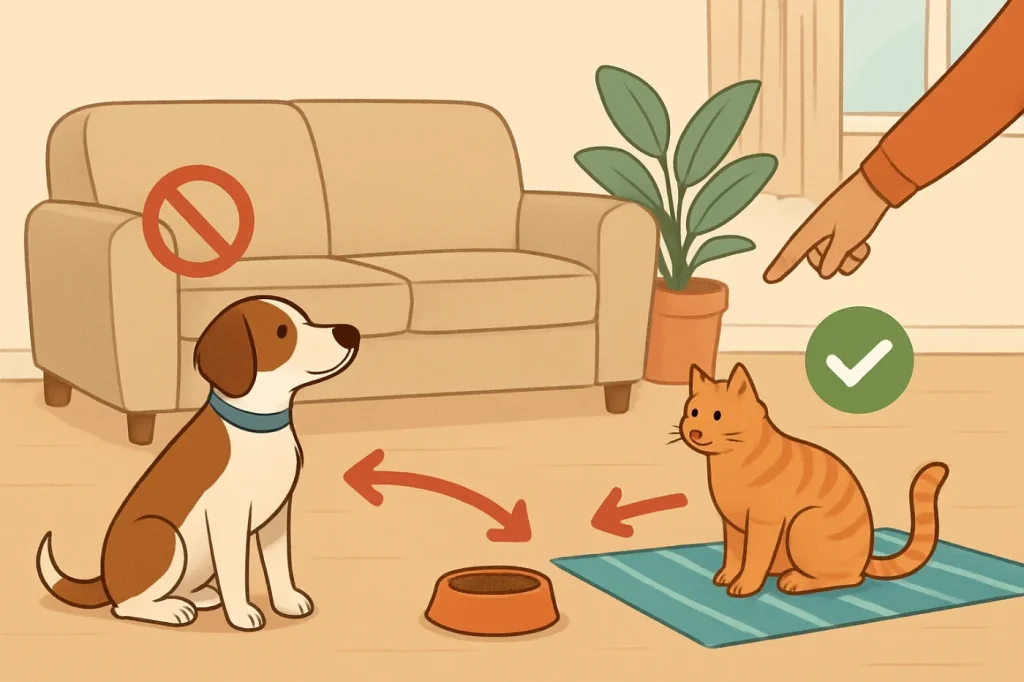
Clear, consistent house rules are one of the simplest ways to prevent behavior problems in dogs and cats. Decide what is allowed, teach it kindly, and stick to it. That is the core of responsible pet ownership and a calmer home.
How to create basic house rules for dogs and cats that actually work
Use this simple framework for any rule in your home:
- Decide the rule in advance (before the pet comes home if possible).
- Make it specific and easy to follow (for pets and humans).
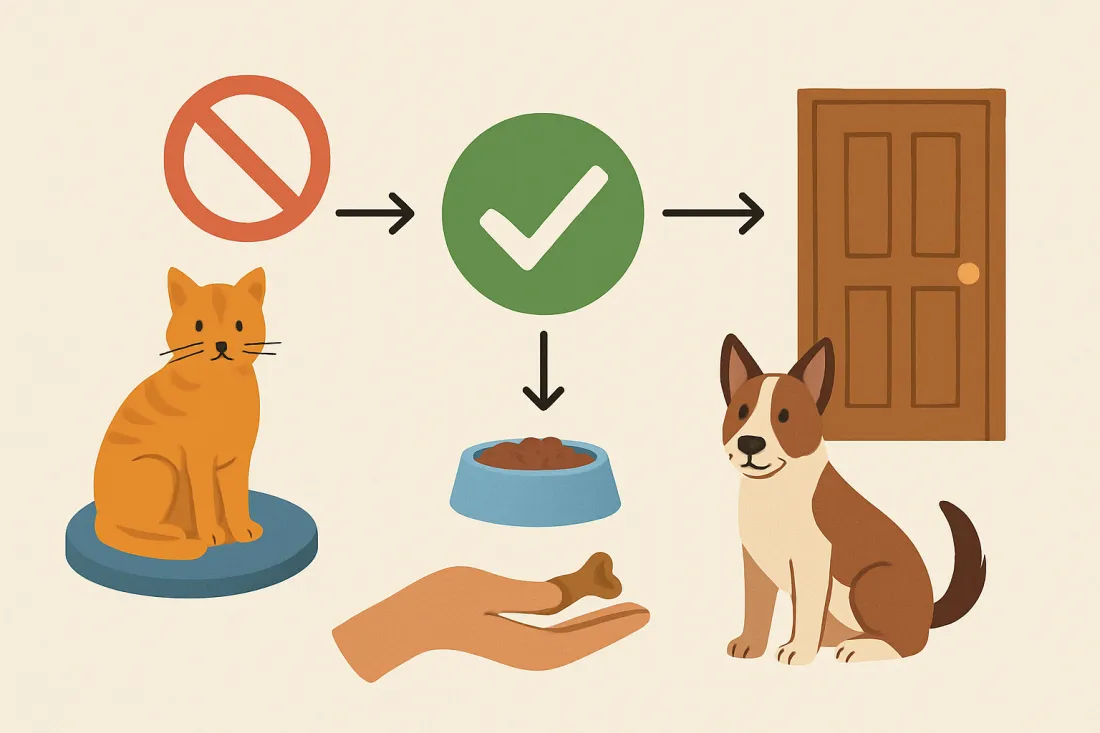
- Show your pet what to do instead of only saying “no.”
- Reward the behavior you want every time at first.
- Make sure every person in the home follows the same rule.
When you do this, most common issues—jumping, scratching, barking, counter-surfing, rough play—either never start or stay manageable.
Why consistent rules are part of responsible pet ownership
Dogs and cats do not understand “sometimes.” If the sofa is allowed when you are relaxed but not when guests visit, your pet only learns that humans are unpredictable. That confusion often shows up as anxiety, pushy behavior, or what looks like “stubbornness.”
Consistent rules help because they:
- Keep everyone safe – Rules about doors, kids, and food reduce bites, escapes, and resource guarding.
- Protect your home – Clear rules about chewing, scratching, and toileting save furniture and floors.
- Lower stress for pets – Predictable routines and boundaries make it easier for animals to relax.
- Make training faster – When every person responds the same way, pets learn much more quickly.
Think of rules as a kindness: they tell your pet exactly how to succeed in your home.
Planning household rules before bringing a dog or cat home
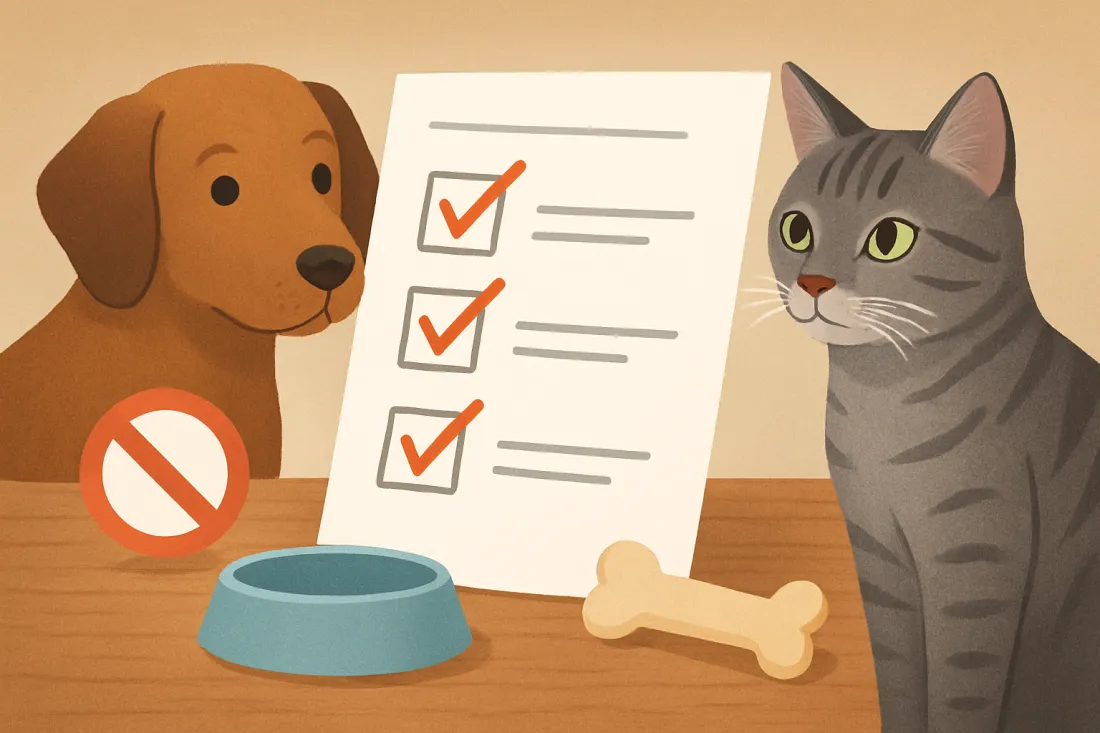
Before a new dog or cat arrives, sit down with everyone in the household and answer these questions. Write the answers and post them where you can all see them.
Furniture and sleeping spots for pets
- Sofa and chairs: Is your pet allowed on any furniture? Only when invited? Never? If “sometimes,” define what that means (for example, “only on the blanket on the right side of the couch”).
- Human beds: Is the pet allowed on beds at all? Only after potty time? Only at the foot of the bed? Decide now, not at midnight on day three.
- Pet beds: Where will dog and cat beds be placed so they can rest without being stepped on or pestered?
- Retreat zones: Choose at least one quiet spot where children and guests are not allowed to bother pets.
Feeding rules for multi-species homes
- Location: Where will each pet eat? Separate areas reduce food guarding and stress, especially in multi-pet homes.
- Schedule: Who feeds in the morning and evening? Will you free-feed the cat or use set mealtimes?
- Table scraps: Are human foods ever given from the table? If the rule is “never,” everyone must follow it, including guests.
- Kids and food: Children should not bother pets while they eat. Make this a non-negotiable rule.
Visitor and front-door rules with pets
- Greeting guests: Should the dog sit, go to a mat, or stay behind a baby gate when people enter?
- Cat safety: How will you prevent door-dashing? For example, keep cats in a separate room or behind a gate when the door is open.
- Guest rules: Will visitors be asked not to feed from the table, chase the cat, or roughhouse with the dog?
Kids and pet interaction boundaries
- Handling rules: No pulling tails, ears, or fur. No hugging if the pet tries to move away.
- Quiet zones: Designate at least one “no kid” space where the pet can retreat and must not be disturbed.
- Supervision: Decide that young children are never alone with pets, even “just for a minute.”
Sample rule sets for dogs: jumping, barking, doors, and kids
Use these as ready-made starting points. Adjust them to your home, but keep them clear and consistent.
Dog rule set for jumping and greetings
- Rule: All four paws stay on the floor when greeting people.
- What humans do:
- Walk in calmly and ignore the dog if they jump (no eye contact, no talking, no touching).
- Reward with attention and treats the moment the dog sits or stands with paws on the floor.
- Ask guests to turn away from jumping and only pet when the dog is calm.
- Helpful cue: Teach “sit” at the door and pay generously for it.
Dog rule set for barking at noises or people
- Rule: One or two “alert” barks are allowed; then the dog comes to you.
- What humans do:
- Thank the dog (“Good job, all done”) and call them away from the window or door.
- Reward coming to you with a treat or brief play.
- Close blinds or use background sound if outside triggers are constant.
- What to avoid: Yelling “quiet” repeatedly, which often sounds like excited barking to the dog.
Dog rule set for door manners and leash exits
- Rule: Dog waits at doors until released.
- What humans do:
- Ask for a “sit” before opening any outside door.
- If the dog moves forward, calmly close the door and try again.
- Use a release word like “okay” or “let’s go” when it is time to move.
- Safety tip: Keep a leash on before opening doors to the street or yard until the dog has a reliable wait.
Dog rule set for dogs and children together
- Rule: Dog and kids interact only under adult supervision.
- What humans do:
- Teach kids to invite the dog over instead of chasing.
- End play if the dog hides, licks lips repeatedly, yawns, or stiffens.
- Provide a crate or gated area where the dog can rest undisturbed.
- Non-negotiables: No riding the dog, no grabbing toys from the dog’s mouth, no disturbing a sleeping dog.
Sample rule sets for cats: scratching, counters, litter box, and nights
Cats need outlets for natural behaviors like scratching, climbing, and hunting. Rules work best when you give them “legal” ways to do those things.
Cat rule set for scratching furniture
- Rule: Cats scratch only on approved posts or pads.
- What humans do:
- Place sturdy scratching posts near favorite nap spots and in rooms where you spend time.
- Use catnip or toys to encourage scratching on the post.
- Cover high-value furniture temporarily with throws or scratch-resistant covers while training.
- What to avoid: Punishing scratching. Redirect instead: gently move the cat to the post and reward when they use it.
Cat rule set for kitchen counters and tables
- Rule: No cats on food-preparation surfaces.
- What humans do:
- Provide alternative high perches (cat trees, shelves) near the kitchen.
- Reward the cat with treats or play when they choose the perch instead of the counter.
- Keep counters clean of food and crumbs so they are less interesting.
- Management tip: Block access to the kitchen when you cannot supervise if counter-surfing is a strong habit.
Cat rule set for litter box habits
- Rule: All elimination happens in the litter box.
- What humans do:
- Scoop at least once daily and change litter regularly based on product guidance.
- Provide enough boxes: many behavior professionals suggest at least one per cat, plus one extra, placed in quiet but accessible spots.
- Avoid covered boxes if your cat seems reluctant to enter or is startled easily.
- Red flag: Sudden changes in litter box use can signal medical issues. Contact your veterinarian promptly.
Cat rule set for nighttime activity
- Rule: Nights are for sleeping, not for pouncing on faces.
- What humans do:
- Schedule active play sessions in the evening, followed by a meal, to mimic hunt–eat–sleep cycles.
- Ignore nighttime meowing if you are sure the cat is healthy and has food, water, and a clean box. Responding with food or play teaches them to wake you.
- Consider closing the bedroom door and providing a cozy sleeping area elsewhere if needed.
Positive reinforcement basics and why punishment backfires
Positive reinforcement means rewarding the behavior you want so it happens more often. For most pets, rewards include food, play, toys, or attention.
To use it effectively:
- Reward quickly – within a second or two of the behavior.
- Start with frequent rewards – every success at first, then gradually less often.
- Use small rewards – tiny treats or brief praise to avoid overfeeding.
- Pair rewards with a cue – say “sit” or “on your bed” just before the behavior you want.
Punishment (yelling, hitting, shock, spraying, or throwing things) often backfires because it:
- Makes pets fearful of you or the situation.
- Does not teach what to do instead.
- Can increase aggression or anxiety, especially in already sensitive animals.
When you feel frustrated, pause, manage the situation (gate, leash, separate room), and plan how to reward the behavior you want next time.
Daily routines that support good behavior in dogs and cats
Rules only work if daily life makes it easy for pets to follow them. Use routine to your advantage.
Daily routine ideas for dogs
- Morning: Potty break, breakfast, 5–10 minutes of training (sits, stays, leash walking), then a chew or rest.
- Midday: Potty break and short walk or play session. If you work long hours, arrange a dog walker, daycare, or trusted helper.
- Evening: Longer walk or play, dinner, calm time with the family, then a final potty break before bed.
- Rest: Provide at least one quiet spot where the dog is not disturbed by kids or guests.
For more structured training ideas, you can also review the basic dog training rules for responsible owners.
Daily routine ideas for cats
- Play sessions: Several short interactive playtimes (5–10 minutes) using wand toys or chase toys.
- Feeding: If not free-fed, offer meals at predictable times. Food puzzles or scatter feeding can provide mental stimulation.
- Environment: Maintain clean litter boxes, fresh water, and safe vertical spaces for climbing and hiding.
- Quiet time: Respect naps. Avoid waking cats for play or cuddles if they are deeply asleep.
Comparison table of example house rules for dogs vs. cats
Use this table to compare common rule areas and see how expectations differ between species.
| Household area | Typical dog rules | Typical cat rules | Key training focus |
|---|---|---|---|
| Furniture | On furniture only when invited; paws off guests’ laps unless asked. | Allowed on specific furniture or blankets; no access to kitchen counters. | Teach clear “on/off” cues; provide alternative beds and perches. |
| Doors and exits | Wait at doors until released; no bolting outside. | No door-dashing; stay back when doors open. | Practice “wait” and recall; use gates or closed rooms for management. |
| Toileting | Eliminate only outdoors or on designated pads. | Use litter boxes consistently; no elimination on rugs or beds. | Regular potty schedule for dogs; clean, accessible litter boxes for cats. |
| Food and kitchen | No begging at the table; no stealing from counters or trash. | No walking on food-prep surfaces; no stealing from plates. | Never feed from table; provide food puzzles and feeding stations. |
| Kids and guests | Greet calmly; no jumping, mouthing, or rough play. | No chasing kids; no swatting or biting during play. | Supervised interactions; teach gentle handling and safe retreat spaces. |
| Nighttime | Sleep in bed, crate, or dog bed; no barking for attention. | Quiet during human sleep; no pouncing on faces or loud play in bedroom. | Evening exercise and potty/play; ignore attention-seeking at night. |
Household agreement checklist for sharing pet responsibilities
Use this checklist as a quick agreement so everyone shares responsibility and follows the same rules.
- Feeding
- Who feeds in the morning?
- Who feeds in the evening?
- Who measures food and monitors weight and body condition?
- Water and bowls
- Who washes food and water bowls and how often?
- Who refills water during the day?
- Toileting
- Who takes the dog out first thing in the morning and last thing at night?
- Who scoops the litter box daily?
- Who buys litter and poop bags when supplies run low?
- Exercise and play
- Who walks the dog on weekdays and weekends?
- Who is responsible for daily cat play sessions?
- Who rotates toys and checks them for damage?
- Training and rules
- Who leads short daily training sessions?
- What words/cues does everyone agree to use (for example, “down” for lying down vs. “off” for getting off furniture)?
- Who reminds guests of house rules for interacting with pets?
- Health and vet care
- Who schedules vet visits and keeps records?
- Who gives any prescribed medications?
For long-term planning, it can also help to review an annual vet care schedule for dogs and cats USA so you can decide who handles which appointments.
Practical checklist for building your own house rules
Work through this checklist to create a simple, written rule set for your home.
- List your “non-negotiables.”
- Examples: “No pets on kitchen counters,” “No unsupervised time with kids under 8,” “Dog must be leashed outside the yard.”
- Decide on furniture access.
- Allowed everywhere, only on certain items, only on cue, or not at all?
- Define feeding rules.
- Where each pet eats, whether they are separated, and rules about table food.
- Set greeting and door rules.
- What should the dog do when someone knocks? Where should the cat be?
- Plan daily exercise and play.
- Minimum walks or play sessions per day for each pet, and who is responsible.
- Agree on training cues.
- Pick one word for each behavior (sit, down, off, come, stay) and write them down.
- Choose a calm retreat space.
- Crate, room, or perch where pets can rest without being disturbed.
- Post the rules.
- Keep a one-page summary in a visible spot so everyone remembers.
Fridge-friendly house rules summary you can use
Keep a short, clear list of your main pet rules where the whole family can see it. Update that list as your pet grows and your routines change.
Common mistakes when setting house rules for pets
Avoid these frequent pitfalls that make rules fail even in well-meaning homes.
- Inconsistent enforcement – Sometimes allowing jumping or counter-surfing and sometimes scolding for it. To a pet, that looks random.
- Too many rules at once – Overloading a new puppy or rescue cat with dozens of rules instead of focusing on a few key ones (toileting, safety, gentle play).
- Relying on punishment – Using spray bottles, loud noises, or physical corrections instead of management and rewards.
- No plan for guests – Letting visitors undo your training by feeding from the table or encouraging rough play.
- Ignoring exercise and enrichment – Expecting calm behavior from a bored dog or cat with no outlet for energy or curiosity.
- Not adjusting for age or health – Holding senior pets or very young animals to the same standards as fit adults.
Decision criteria for managing, training, or seeking behavior help
Use these criteria to decide your next step when a rule keeps getting broken.
- Is the behavior normal for the species and age?
- Puppies chew and mouth; kittens climb and pounce. Training and safe outlets are the first step.
- Is the behavior dangerous?
- Growling, biting, serious resource guarding, or intense fear reactions are reasons to contact a qualified trainer or veterinary behavior professional.
- Could there be a medical cause?
- Sudden house-soiling, changes in appetite, or new aggression can be linked to pain or illness. Call your veterinarian.
- Can you change the environment?
- Baby gates, crates, closed doors, and rearranged furniture often solve problems faster than willpower alone.
- Are all humans truly on board?
- If one person still sneaks food from the table or allows rough play, fix that first.
Troubleshooting early behavior problems in new pets
Early weeks with a new pet often bring challenges. Address them quickly before they become habits.
Early behavior problems in dogs
- House-soiling
- Increase potty breaks, especially after eating, drinking, playing, or waking.
- Supervise indoors; use leashes or baby gates to prevent wandering off to eliminate.
- Clean accidents thoroughly with an enzymatic cleaner to remove odor.
- Chewing and destruction
- Provide a variety of safe chew toys and rotate them.
- Confine the dog when unsupervised to a puppy-proofed area or crate.
- Increase physical and mental exercise.
- Fear or reactivity
- Give the dog space from triggers (strangers, other dogs) and avoid forcing interactions.
- Pair the presence of triggers with treats at a distance where the dog stays calm.
Early behavior problems in cats
- Hiding constantly
- Provide safe hiding spots and do not force contact.
- Offer food, water, and litter nearby; let the cat approach on their own timeline.
- Rough play and biting
- Use toys, not hands, for play.
- End play immediately if teeth or claws touch skin; resume later with a toy.
- Scratching in unwanted places
- Add more scratching posts with different textures and orientations (vertical and horizontal).
- Place posts near problem areas and reward use.
When to call a trainer or veterinary behavior professional
Seek professional help if you notice any of the following:
- Bites, serious snaps, or repeated growling directed at people or other animals.
- Severe separation distress (howling, destruction, or self-injury when left alone).
- Persistent house-soiling despite careful training and vet checks.
- Self-harm behaviors such as excessive licking, tail chasing, or over-grooming.
- Sudden, dramatic changes in behavior without an obvious cause.
Look for professionals who use humane, reward-based methods and who are comfortable working with your veterinarian when needed.
Adjustment timelines: 3-3-3, 7-7-7, and 10-10-10 ideas for dogs and cats
These “rules” are not strict laws but simple ways to remember that adjustment takes time, especially for adopted pets.
- 3-3-3 guideline (often used for dogs, sometimes cats)
- First 3 days: Many pets feel overwhelmed and may be shut down or overly excited. Keep rules simple: safety, toileting, gentle handling.
- First 3 weeks: Pets start to relax and test boundaries. This is when consistent house rules really matter.
- First 3 months: Many pets begin to feel truly at home. Training and routines are settling in.
- 7-7-7 and 10-10-10 ideas
- These are variations on the same theme: behavior and comfort change over weeks and months, not overnight.
- Use them as reminders to be patient and to keep reinforcing your rules kindly over time.
FAQ on house rules and alone time for dogs and cats
What is the 3-3-3 rule for dogs and cats?
The 3-3-3 rule is a guideline for how long it can take a new pet, especially a rescue, to adjust. Roughly: 3 days to start coming out of shock, 3 weeks to begin learning your routine and testing boundaries, and 3 months to feel truly settled. Use this as a reminder to keep rules simple at first, be patient, and stay consistent.
What is the 7-7-7 rule for dogs?
The 7-7-7 idea is another way of saying that behavior changes over time, often in stages of weeks. Some people use it to describe changes around week 1, week 7, and beyond. The exact numbers are less important than the message: expect your dog’s behavior to shift as they relax, and keep reinforcing your house rules calmly.
What is the 10-10-10 rule for dogs?
The 10-10-10 rule is not a formal standard. It is sometimes used informally to highlight that meaningful training and adjustment can take many weeks or months. Rather than focusing on exact numbers, track your dog’s progress: are they more relaxed, following rules more easily, and recovering faster from stress than they did at the start?
Can a dog be left alone for 5 days?
No. A dog should not be left completely alone for five days. Dogs need regular access to water, food, toileting, and social contact. If you must be away, arrange for a trusted caregiver, boarding facility, or pet sitter to provide daily care and company. Even with automatic feeders or cameras, a dog still needs in-person checks and interaction.
How many house rules should I start with for a new pet?
Focus on a small set of safety and comfort rules at first: toileting location, gentle play, where they sleep, and how they interact with kids and other pets. As your dog or cat settles in, you can add more detailed rules about furniture, visitors, and advanced training.
What if my family cannot agree on pet rules?
Start by agreeing on non-negotiables: safety around doors, kids, and food. Then compromise on lower-stakes issues like sofa access. Use a written house rules sheet in a visible place so everyone sees the same plan. If disagreements continue, consider a session with a reward-based trainer who can explain the pros and cons of different options.
With clear, humane rules, daily routines, and patience, dogs and cats can learn exactly how to fit into your home—and you can enjoy life together with fewer conflicts and far less stress.