
Thinking about rehoming your dog can feel heavy, shameful, or confusing. You might love your dog and still feel like you are drowning in stress, guilt, or safety worries. You are not a bad person for asking whether keeping your dog is still the right thing for both of you.
This guide walks through how to decide, step by step: when to keep trying, when to get serious help, and when rehoming is actually the kindest, most responsible option.
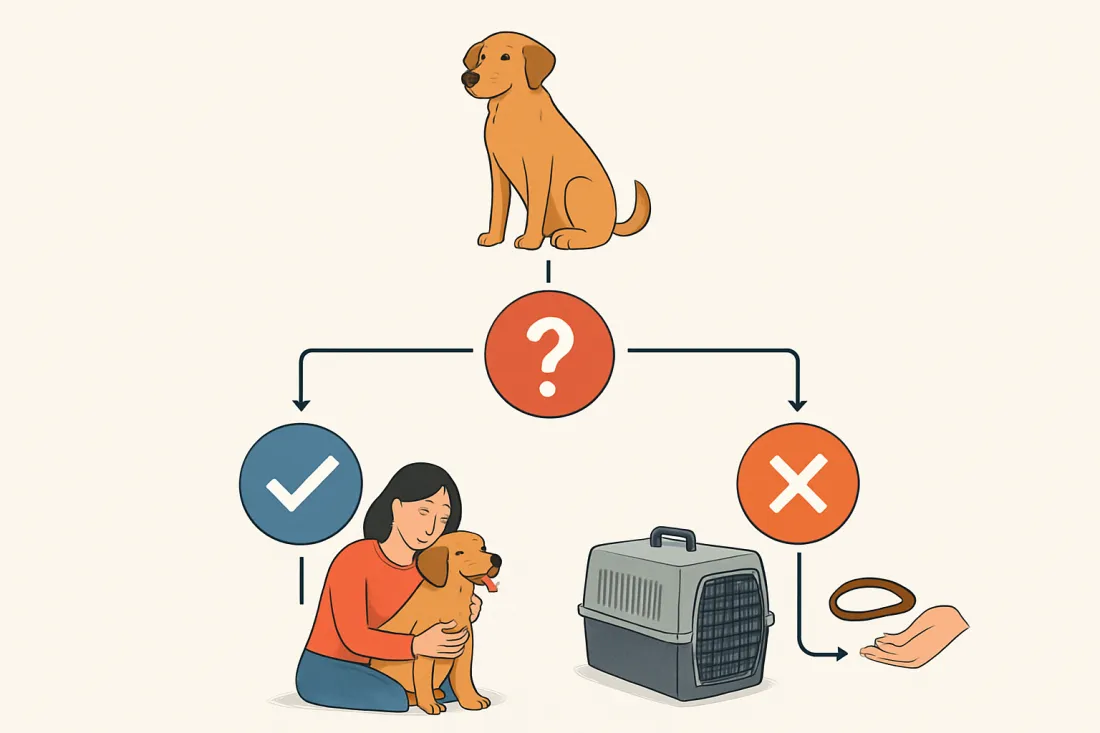
First reality check: Is rehoming always wrong?
No. Rehoming is not automatically a failure or a betrayal. Sometimes it is the most humane choice for the dog and the people involved.
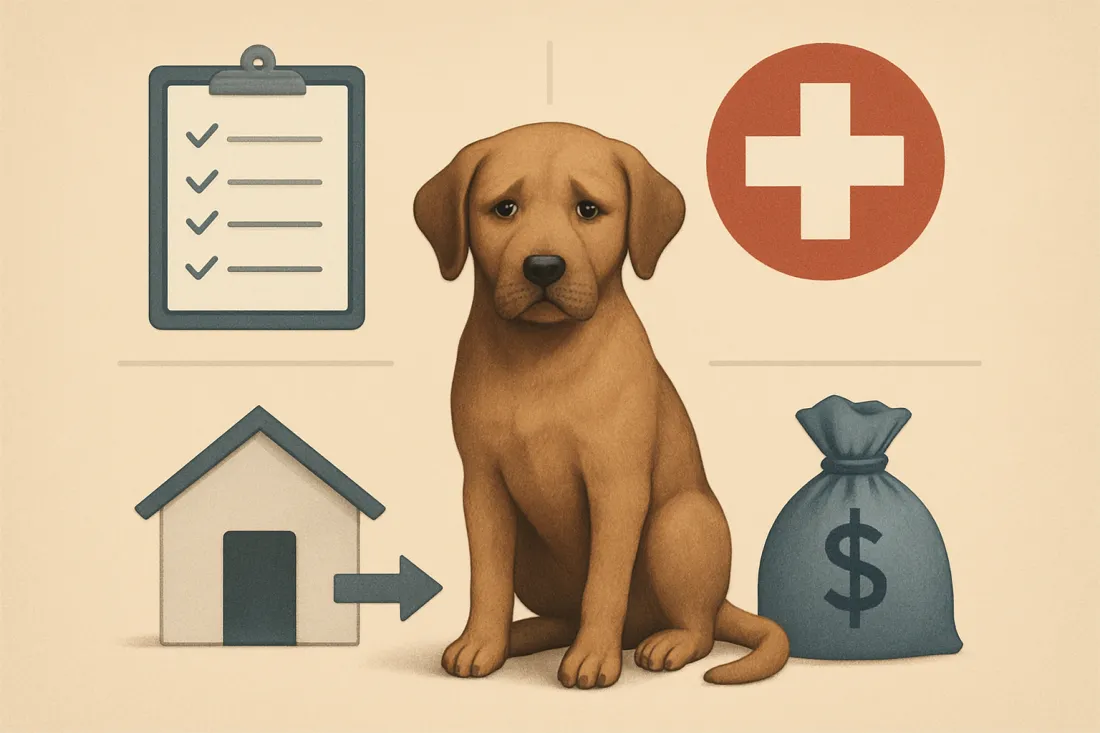
But it is also true that many dogs are surrendered for reasons that could be solved with information, training, or short-term support. The key decision is not “Do I love my dog enough?” but:
- Can I realistically meet this dog’s needs in the next 6–12 months?
- Is anyone’s safety or basic wellbeing at risk if I keep trying?
- Do I have options for help that I have not used yet?
Keep those three questions in mind as you go through the rest of the guide.
Checklist: Common triggers that make people consider rehoming
Most rehoming decisions cluster around a few big stressors. Use this checklist to see where you are struggling. Check everything that feels true right now.
Time and energy pressures
- I am working much longer hours than when I got my dog.
- I feel constant guilt because my dog is alone or under-stimulated most days.
- Walks, play, and training feel like one more impossible task on my list.
- My health, disability, or age makes it hard to exercise or care for my dog.
Money and unexpected costs
- Routine vet care, food, and supplies are already a strain.
- A new medical or behavioral issue has added big, ongoing costs.
- I am choosing between essential human expenses (rent, food, medicine) and dog expenses.
- I have no savings or credit to handle emergencies like surgery or hospitalization.
Behavior and safety concerns
- My dog has bitten or seriously tried to bite a person.
- My dog has attacked or injured another dog or pet.
- I am afraid of my dog or afraid to have guests, kids, or other pets around them.
- Training attempts have not improved the behavior, or it is getting worse.
Housing and life changes
- I have to move and cannot find housing that accepts my dog’s size or breed.
- My landlord or HOA has given a firm deadline to remove the dog.
- A new baby, partner, or roommate has changed what is safe or realistic at home.
- I am facing eviction, homelessness, or a shelter stay where dogs are not allowed.
Emotional connection and burnout
- I feel resentful or numb toward my dog most of the time.
- I dread coming home because of the mess, noise, or stress.
- I feel trapped or stuck because of my dog.
- I am dealing with grief, depression, or anxiety and have no emotional bandwidth left.
If you checked only one or two items and they are recent, you are likely in a rough patch that might be fixable. If you checked several in multiple categories and this has been going on for months, it is time to seriously evaluate whether keeping your dog is still fair to anyone involved.
Decision tree: Keep, get help, or rehome?
Use this simplified decision tree to see which path fits your situation best right now. Be brutally honest with your answers.
Step 1: Is anyone’s safety at real risk?
- Yes, there is a real risk of serious injury (to a person, another pet, or the dog) that I cannot reliably prevent.
→ Go to Path C: Consider rehoming or humane alternatives. - No, it is stressful but not dangerous (e.g., barking, mild resource guarding, house-soiling).
→ Go to Step 2.
Step 2: Are the main problems time, money, or skills?
- Mostly time/energy (work hours, kids, burnout).
→ Go to Path B: Keep the dog but change the setup. - Mostly money (vet bills, training costs).
→ Go to Path B and focus on financial support options. - Mostly behavior/skills (you do not know how to train or manage the dog).
→ Go to Path B and focus on training and management. - All of the above, and it has been this way for a long time.
→ Go to Step 3.
Step 3: Have you already tried realistic help options?
- No, I have not tried much yet (no trainer, no vet check, no schedule changes).
→ Start with Path B for at least 1–3 months if safety allows. - Yes, I have tried several options (training, vet, routine changes, support from family) and things are still not workable.
→ Go to Path C: Consider rehoming or humane alternatives.
Path A: Keep the dog with minor adjustments
This path fits if:
- There are no serious safety concerns.
- Your main issues are stress, guilt, or mild behavior problems.
- You have at least some time, money, and emotional capacity to adjust.
Typical actions on Path A:
- Short, frequent walks instead of long ones; more mental games at home.
- Basic training (sit, stay, leave it) to reduce chaos.
- Dog-proofing the house to prevent damage and accidents.
- Asking friends, neighbors, or family for occasional help.
Path B: Keep the dog but change the setup and get help
This path fits if:
- Problems are serious but not life-threatening.
- You are overwhelmed but still want to try to make it work.
- You are willing to change routines and ask for outside help.
Typical actions on Path B:
- Consulting a vet to rule out medical causes for behavior changes.
- Working with a reputable trainer or behavior professional.
- Using management tools (baby gates, crates, leashes indoors, muzzles when appropriate).
- Arranging dog walkers, daycare, or trusted sitters if you can.
- Seeking financial help from local pet support programs if available.
Path C: Consider rehoming or humane alternatives
This path fits if:
- There is ongoing risk of serious harm, and you cannot manage it safely.
- You have tried realistic help options and the situation is still unworkable.
- Your mental health, housing, or finances are in crisis.
- You feel more relief than grief when you imagine your dog living safely elsewhere.
If you are leaning toward Path C, it is important to think about how to rehome responsibly. When you reach that point, a detailed guide like how to responsibly rehome a dog in the US can walk you through safe, ethical options.
Questions to ask yourself before you decide to rehome
Use these questions as a self-interview. Honest answers will clarify whether you are in a temporary storm or a long-term mismatch.
1. How long has this been a problem?
- Weeks: You may still be in an adjustment period, especially with a new dog or a big life change.
- Months: It is time to actively problem-solve and get help.
- Years: This may be a chronic mismatch between your life and your dog’s needs.
2. What have I already tried, and for how long?
List concrete actions, not just feelings:
- Have you spoken to a vet about behavior or health changes?
- Have you done any structured training (classes, one-on-one, or online programs)?
- Have you changed your routine (more exercise, different feeding schedule, enrichment)?
- Have you asked for help from family, friends, or local support groups?
If your list is short, you may not have enough information yet to know whether rehoming is necessary.
3. What would need to change for keeping my dog to feel okay?
Imagine your life six months from now. What would have to be different for you to feel, “This is manageable”?
- More time at home?
- Less destructive behavior?
- Fewer vet bills?
- Less fear around kids or guests?
Now ask: Are those changes realistic? If the only way this works is if your job, income, housing, or family situation magically changes, that is a sign that rehoming might be the more honest path.
4. Is my dog suffering in my current situation?
Look at your dog’s daily life:
- Are they alone for 10+ hours most days with little interaction?
- Are they frequently yelled at, punished, or confined because you are overwhelmed?
- Are they living in constant conflict with other pets or family members?
- Are medical or behavioral issues going untreated because of cost or time?
If your dog’s basic needs for safety, social contact, and health are not being met and you cannot change that, rehoming can be an act of care, not abandonment.
5. How do I feel when I imagine each option?
Close your eyes and imagine two futures:
- Future A: You keep your dog and nothing major changes.
- Future B: Your dog is safe in a good home elsewhere.
Notice your body’s reaction:
- If Future A brings dread, panic, or hopelessness, and Future B brings relief and sadness, that mix often means rehoming is worth serious consideration.
- If Future A brings determination and hope, and Future B feels unbearable, you may be in a tough phase but still committed to working through it.
When rehoming your dog can be the kindest option
There are situations where keeping a dog at all costs is not the most loving choice. Rehoming can be kind when:
1. There is ongoing, serious risk to people or other animals
If your dog has a history of serious bites, repeated attacks on other pets, or unpredictable aggression, and you cannot safely manage or treat it, rehoming to a more suitable, experienced home may be safer for everyone. In some cases, even rehoming is not safe or ethical, and humane euthanasia may be the least cruel option. That decision should always be made with a qualified veterinary professional who understands behavior.
2. Your life circumstances have changed beyond your control
Examples include:
- Severe illness or disability that makes basic care impossible.
- Sudden loss of housing with no pet-friendly options in reach.
- Domestic violence or family crises where staying safe means moving quickly without pets.
In these cases, you may not be able to “try harder” or “plan better.” Ensuring your dog lands in a safe, stable home can be the most responsible thing you can do.
3. Your dog’s needs are far beyond what you can realistically provide
Some dogs have extremely high exercise, training, or medical needs. If you are consistently unable to meet those needs despite your best efforts, your dog may be chronically stressed, under-stimulated, or in pain.
Rehoming to a home that is better matched—more time, more space, more experience, or more financial resources—can dramatically improve your dog’s quality of life.
4. The relationship is broken and not improving
Sometimes the emotional bond never really forms, or it has been eroded by constant stress, fear, or resentment. If you feel:
- Angry at your dog most of the time.
- Unable to enjoy them even on good days.
- That your mental health is deteriorating because of the situation.
Then it may be kinder to let your dog live with someone who can genuinely enjoy and connect with them.
Red-flag reasons not to surrender your dog
Some reasons for rehoming are understandable but often fixable. Before you decide, be cautious if your main reason is one of these:
- “The dog is not a cute puppy anymore.”
Growing up is not a behavior problem. Adult dogs can be calmer and easier than puppies with the right routine. - “The dog is not perfectly trained after a few days or weeks.”
Most dogs need consistent training and structure over months, not days. - “The dog chews, barks, or has accidents when left alone.”
These are common issues that often improve with training, management, and gradual alone-time practice. - “We are having a baby, so the dog has to go automatically.”
Some families safely keep dogs and babies together with planning and management. Rehoming may still be right in some cases, but it is not the only option. - “The dog is not the breed or personality I imagined.”
Many mismatches can be improved by adjusting expectations and routines, especially if safety is not an issue.
If your main reason is on this list and there are no serious safety or welfare concerns, consider giving yourself a set trial period (for example, 1–3 months) to work on the issues with support before making a final decision.
Comparison table: Keep, get help, or rehome?
Use this table to compare your options side by side. It is not a test with a right answer, but it can clarify which path fits your reality.
| Option | Best fits when | Main benefits | Main risks or costs | Key questions to ask yourself |
|---|---|---|---|---|
| Keep things mostly as they are | Problems are mild, temporary, and not about safety. | Stability for the dog; no rehoming stress; you keep the bond. | Issues may slowly get worse; your stress may build. | Can I realistically see this getting better on its own in the next few months? |
| Keep the dog but get structured help | Behavior, time, or money issues are serious but not dangerous. | Chance to fix root problems; keeps dog in your home; you learn new skills. | Requires time, effort, and some resources; progress may be slow. | Am I willing to commit time and energy to a plan for at least 1–3 months? |
| Rehome to a private adopter or rescue | Dog’s needs or your situation are not a good match long-term, but dog is safe and adoptable. | Dog can thrive in a better-suited home; you reduce ongoing stress and guilt. | Emotional pain; uncertainty during transition; requires careful screening. | Can I put in the effort to find a safe, appropriate home and be honest about my dog? |
| Surrender to a shelter | No safe or realistic way to rehome privately; urgent housing or safety crisis. | Professional placement support; may reach more adopters. | Stressful for the dog; outcome is not guaranteed; some shelters are full. | Have I contacted local shelters to understand their process and capacity? |
| Discuss humane euthanasia with a vet | Severe, dangerous behavior or untreatable suffering; rehoming would be unsafe or cruel. | Prevents further suffering or serious harm; avoids passing a dangerous dog to others. | Profound grief; emotionally very hard; permanent decision. | Have I consulted a qualified vet or behavior professional about all realistic options? |
Step-by-step checklist to work through before rehoming
If safety allows, walk through this checklist over several weeks. You may confirm that rehoming is necessary, or you may find a way to make things work.
- Get a full vet check.
Sudden behavior changes, house-soiling, irritability, or aggression can be linked to pain, illness, or hormonal shifts. Ask your vet to rule out medical causes and discuss behavior. - Write down your dog’s daily routine.
Include wake-up time, walks, meals, alone time, play, and sleep. Many dogs are under-exercised or over-stimulated without structure. Small changes (short training sessions, puzzle feeders, calmer evenings) can help. - Identify your top 1–2 problems.
Instead of “everything is awful,” pick the two biggest issues (for example, “barking at neighbors” and “pulling on leash”). Focus your efforts there first. - Try at least one structured training or management plan.
That could be a local class, virtual coaching, or a reputable online program. Commit to a realistic schedule (for example, 10–15 minutes a day) for at least a few weeks. - Ask for practical help.
Friends, family, neighbors, or local volunteers may be able to help with walks, transport to the vet, or temporary fostering during a crisis. - Review your finances honestly.
List regular dog costs (food, routine vet care) and any big upcoming expenses. Look for local low-cost clinics, vaccination events, or assistance programs if available. - Set a decision date.
Pick a date 4–12 weeks away (depending on safety and severity). Until then, you are in “active problem-solving mode.” On that date, reassess: Is it better, worse, or the same? - Reassess with clear eyes.
On your decision date, ask: Have things improved enough to continue? If not, and you have truly tried, it may be time to plan responsible rehoming.
US-specific legal and ethical considerations before rehoming
In the United States, pet ownership is shaped by both legal responsibilities and ethical expectations. Before you rehome or surrender a dog, consider the following:
1. Your responsibility for your dog’s behavior
As a dog owner, you are generally responsible for preventing your dog from injuring people or other animals and from causing property damage. If your dog has a history of aggression or bites, it is important to:
- Be honest with any potential adopter or rescue about that history.
- Use appropriate safety tools (leashes, secure fencing, muzzles when advised) until the dog is safely placed.
- Understand that passing a dangerous dog to someone else without disclosure can create serious risk for them and their community.
2. Local rules, housing, and breed or size restrictions
Many US cities, counties, and housing providers have rules about dogs, including:
- Limits on the number of dogs per household.
- Restrictions on certain breeds or sizes in rentals or communities.
- Requirements for leashes, tags, and sometimes microchips.
Before rehoming, check what applies in your area and in any potential adopter’s area. A dog that is not allowed in a particular building or city could be at risk of being surrendered again.
If you want a broader picture of your responsibilities as a dog owner in the US, a resource like US pet laws every dog owner should know can help you understand the basics to check locally.
3. Contracts with breeders, rescues, or shelters
If you adopted or bought your dog from a breeder, rescue, or shelter, you may have signed a contract that:
- Requires you to return the dog to them if you cannot keep the dog.
- Prohibits selling or giving the dog away without their consent.
Before rehoming privately, review any paperwork you have and contact the original organization or breeder. Many are willing to take the dog back or help with placement.
4. Ethical rehoming vs. abandonment
Ethical rehoming means:
- Never abandoning a dog in a public place, empty property, or unsafe environment.
- Never misrepresenting a dog’s behavior or health to “get rid of them.”
- Screening new homes as carefully as you reasonably can.
- Choosing reputable shelters or rescues if you must surrender.
Abandonment or neglect can lead to suffering for the dog and potential legal consequences for you. If you are unsure how to proceed safely, taking time to learn how to responsibly rehome a dog in the US can help you avoid common pitfalls.
Common mistakes when deciding whether to rehome
Being aware of typical mistakes can help you make a clearer, kinder decision.
- Waiting until a crisis forces an emergency decision.
When people wait until eviction, a serious bite, or a total burnout, options shrink. Start evaluating and planning as soon as you realize things are not working. - Making a permanent decision in a temporary emotional storm.
Major life events (breakups, moves, job loss) can make everything feel impossible. If safety is not at risk, give yourself time to stabilize before deciding. - Underestimating what training and management can do.
Many owners assume “this is just how the dog is.” In reality, structured training and simple management tools can transform daily life. - Overestimating what love alone can fix.
Love matters, but it does not replace time, money, or safety. If you cannot meet your dog’s basic needs, love alone will not make them okay. - Rehoming impulsively without screening.
Handing your dog to the first person who says yes can put them at risk of neglect, abuse, or being passed around again. - Feeling so ashamed that you do nothing.
Shame can freeze you in place. Remember: facing the situation honestly and making a plan—whether that is staying together with support or rehoming—is responsible, not selfish.
FAQ: Rehoming decisions and adjustment rules
What is the 3-3-3 rule for rehoming dogs?
The 3-3-3 rule is a simple way to remember how long it can take many dogs to adjust to a new home:
- First 3 days: Many dogs feel overwhelmed, shut down, or overexcited. They may not show their true personality yet.
- First 3 weeks: The dog starts to learn the household routine, relax a bit, and test boundaries.
- First 3 months: The dog often feels more fully settled, bonded, and comfortable.
This rule is a guideline, not a guarantee. Some dogs adjust faster, others much slower, especially if they have trauma or multiple previous homes.
What are signs you should consider rehoming your dog?
Signs that rehoming might be necessary include:
- Repeated or severe aggression that you cannot manage safely.
- Chronic stress, fear, or conflict in your household because of the dog.
- Major life changes (health, housing, finances) that make basic care impossible.
- Months or years of trying training and management with little or no improvement.
- Feeling more relief than grief when you imagine your dog living safely elsewhere.
What is the 7-7-7 rule for dogs?
Some people use a “7-7-7” idea similar to the 3-3-3 rule, describing adjustment in stages over roughly 7 days, 7 weeks, and 7 months. The exact numbers are not scientific; the point is that dogs often need many weeks or months to fully settle into a new home. When evaluating a new dog, it is important not to judge their long-term behavior based only on the first few days.
How traumatic is it for a dog to change owners?
Changing homes can be stressful for many dogs. They may show signs like:
- Loss of appetite or upset stomach.
- Clinginess or separation distress.
- House-training setbacks or new behavior issues.
However, many dogs also adapt well, especially if the new home is stable, calm, and responsive to their needs. The impact depends on the dog’s personality, history, and how the transition is handled. Careful planning, gradual introductions when possible, and clear routines can reduce stress and help the dog settle more comfortably.
How do I know if I am just overwhelmed vs. truly unable to keep my dog?
Ask yourself:
- Have I tried realistic changes and support options yet?
- Is anyone’s safety at risk if I keep trying?
- Is my dog’s basic welfare (food, shelter, medical care, social contact) being met?
- Do I see any path where things could improve in the next 6–12 months?
If you have not tried much yet and safety is not an issue, you are likely overwhelmed and may benefit from support and structure. If you have tried for a long time and still cannot meet basic needs or keep people safe, you may truly be unable to keep your dog.
Is there a tool to help me think through this more systematically?
If you want a more structured way to reflect on your situation, a resource like a should i rehome my dog quiz can help you organize your thoughts and identify which issues matter most right now. It does not replace your judgment, but it can make a confusing decision feel a bit more concrete.
Next steps if you are still unsure
If you have read this far and still feel torn, that is normal. This is a hard decision with no perfect answer. A few final suggestions:
- Talk it through with someone neutral. A trusted friend, therapist, or trainer who is not emotionally entangled in the situation can help you see options more clearly.
- Give yourself a defined trial period. For example, commit to 8 weeks of focused effort with training and routine changes. Mark the end date on your calendar and reassess honestly then.
- Start quietly researching rehoming options now. Even if you decide to keep your dog, knowing what responsible options exist can reduce panic and help you feel less trapped.
- Be kind to yourself. Wanting what is best for your dog and your family—even when that means facing painful choices—is a sign of responsibility, not failure.