
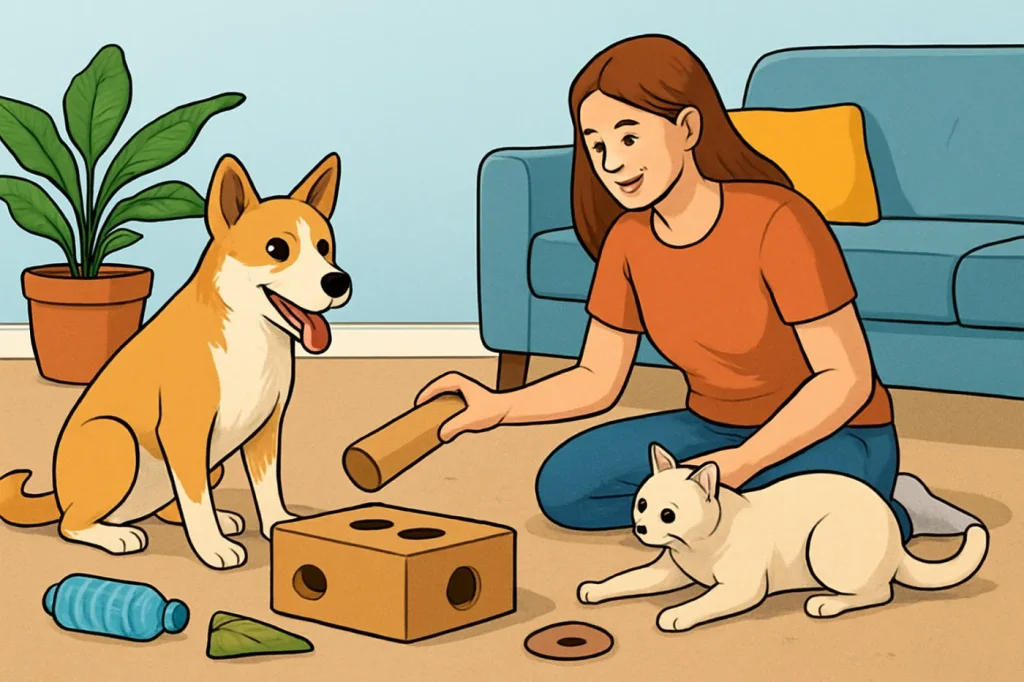
Entertaining your dog or cat at home does not have to mean buying new toys every week. With a few household items, some creativity, and a simple routine, you can give your pet rich mental and physical stimulation on a very small budget.
Why low-cost enrichment matters for your pet’s behavior and health
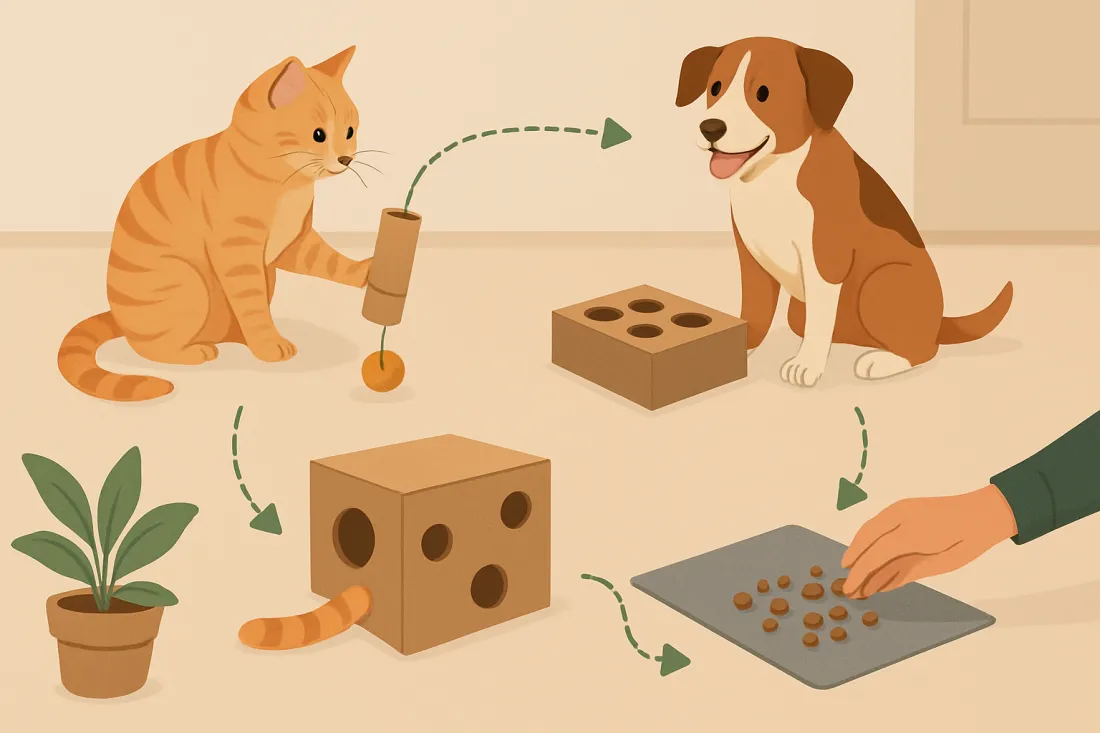
Dogs and cats are wired to explore, hunt, sniff, chew, climb, and solve problems. When they do not get enough of this “enrichment,” you are more likely to see:
- Restlessness and pacing
- Excessive barking or meowing
- Destructive chewing or scratching
- Over-grooming or withdrawal
- Weight gain from boredom eating
Regular enrichment helps:
- Burn energy so your pet is calmer between activities.
- Support joint and muscle health through gentle movement and play.
- Keep the brain sharp with problem-solving and new experiences.
- Strengthen your bond because you are part of the fun, not just the food provider.
You do not need expensive gadgets to get these benefits. Most pets care more about interaction, novelty, and challenge than price tags.
DIY dog toys from household items (with safety guidelines)
Many dogs are thrilled with simple, homemade toys. The key is to choose safe materials and supervise play, especially at first.
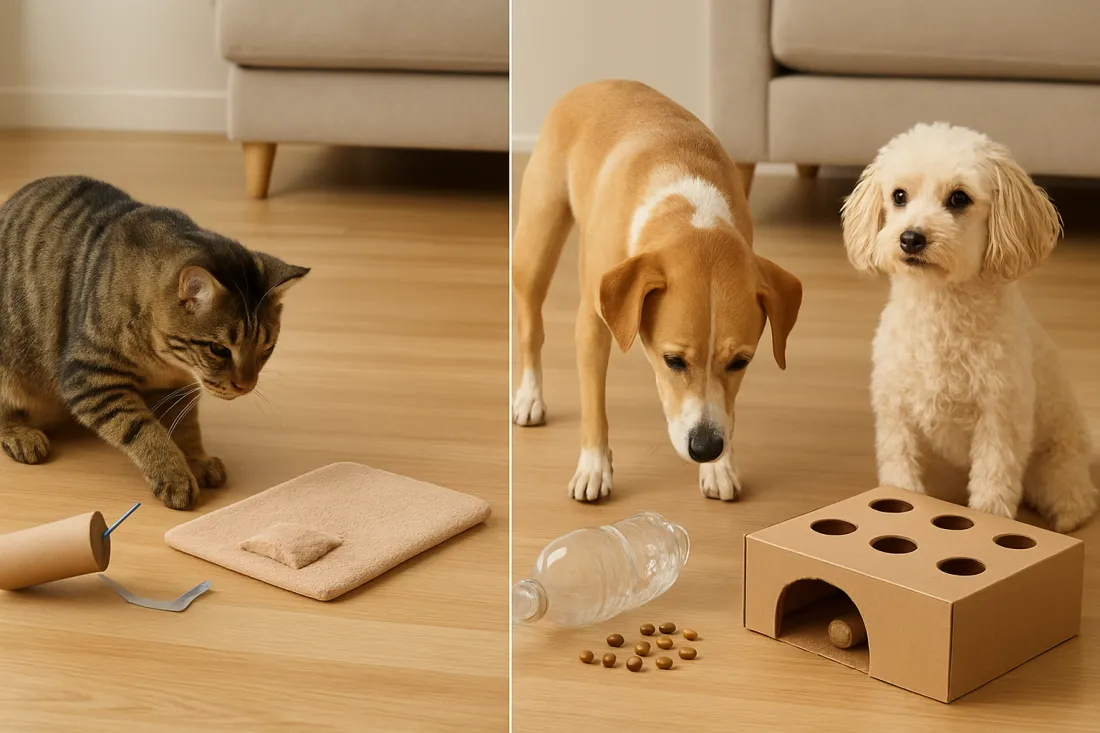
Simple DIY dog toy ideas
- Towel or T-shirt tug toy
Twist or braid an old towel or sturdy T-shirt into a rope and tie knots at each end. Use it for gentle tug, fetch, or hide-and-seek games. - Water bottle crinkle toy (inside a sock)
Place an empty plastic bottle (cap and ring removed) inside a thick sock and knot the end. Many dogs love the crunchy sound. - Cardboard tube treat roller
Use a paper towel tube. Fold one end, drop in a few dry treats or kibble, then fold the other end. Let your dog roll, paw, and tear it open. - Fleece or fabric snuffle mat substitute
Lay a small towel flat, sprinkle kibble on it, then scrunch it up loosely so the food hides in the folds. Let your dog sniff and search. - DIY flirt pole
Use a sturdy stick or old broom handle and tie a long rope to one end with a soft toy or fabric strip at the end of the rope. Drag it along the ground for your dog to chase in short bursts.
Safety guidelines for DIY dog toys
Homemade toys can be safe if you follow a few rules:
- Supervise new toys until you know how your dog plays with them.
- Avoid choking hazards like small bottle caps, buttons, or loose strings that can be swallowed.
- Skip sharp or brittle materials such as hard plastic that can splinter, metal parts, or anything that breaks into sharp pieces.
- Choose sturdy fabrics (towels, denim, fleece) instead of thin socks for heavy chewers.
- Remove toys when damaged so your dog does not ingest stuffing, fabric strips, or cardboard in large amounts.
- Do not use toxic or treated materials like cleaning rags with chemical residue or packaging with strong inks or coatings.
If your dog is a powerful chewer or has a history of swallowing objects, keep DIY toys soft, large, and supervised, and lean more on interactive games that do not involve chewable parts.
DIY cat toys and puzzle feeders on a budget
Cats often prefer simple, “prey-like” toys and small puzzles that mimic hunting. Many of these can be made from items already in your home.
Easy DIY cat toys
- Paper ball chase
Crumple a piece of plain paper into a light ball. Toss it down a hallway or into a box for your cat to bat and pounce. - Ribbon or string wand (with supervision)
Tie a ribbon or fabric strip to a stick or wooden spoon. Drag and wiggle it like a mouse or bird. Always put it away after play so your cat cannot chew and swallow the string. - Cardboard “prey”
Cut small shapes from cardboard (mice, fish) and punch a hole to attach to a string or wand toy. - Sock kicker toy
Fill a long sock with crinkled paper or fabric, sprinkle a pinch of catnip if your cat enjoys it, and knot the end. Many cats love to grab and bunny-kick it. - DIY tunnel
Open both ends of a large paper bag or cardboard box and cut side holes. This becomes a tunnel and ambush spot.
Budget-friendly DIY puzzle feeders for cats
- Egg carton feeder
Place a portion of your cat’s dry food in the cups of a clean egg carton. Your cat has to use paws and nose to get each piece. - Toilet paper tube puzzle
Stand several tubes upright in a small box or tray. Drop kibble into some of the tubes. Your cat must reach in or knock them over to get the food. - Box scatter hunt
Put a few small toys and crumpled paper balls in a shallow box, then scatter kibble among them. Your cat sniffs and digs to find it.
Safety tips for DIY cat enrichment
- Avoid loose string and yarn when unsupervised; these can cause serious internal problems if swallowed.
- Skip small, hard pieces that can be swallowed whole, such as beads or tiny bells.
- Use plain materials without staples, tape, or sharp edges.
- Rotate toys and remove damaged ones so your cat does not ingest bits of plastic or fabric.
Free or nearly free enrichment ideas for dogs and cats
Some of the best enrichment costs nothing at all. It is about how you use your time, space, and routine.
Ideas for dogs
- Sniff walks
On your regular walk, slow down and let your dog choose the route for a few minutes, sniffing bushes, posts, and grass. Smelling the world is mentally tiring and satisfying. - Indoor scent games
Ask your dog to sit and stay, then hide a few treats around one room (behind table legs, under a chair, in a folded towel). Release with a cue like “Find it!” and let them search. - Training mini-sessions
Spend 5–10 minutes teaching or refreshing simple cues: sit, down, spin, touch, or roll over. Use part of their regular meal as rewards. - Obstacle course
Use chairs, cushions, and boxes to create a small indoor course: step over a broom, weave around chairs, go under a table. Guide your dog slowly with treats. - Calm chewing time
Offer a safe chew item you already own (approved by your vet) in a quiet spot. Chewing can help many dogs relax.
Ideas for cats
- Cardboard box playground
Save boxes from deliveries. Cut doors and windows, stack a couple safely, and move them around every week to keep things new. - DIY climbing and perches
Clear a safe path on shelves or rearrange furniture to create higher resting spots near windows. - Window “TV”
Place a chair or box near a window so your cat can watch birds, people, and cars. Rotate which window you use. - Short daily play hunts
Use a wand toy or paper ball for 5–10 minutes of focused play, ending with a “catch” and then a small snack to mimic hunt–catch–eat. - Paper bag hideouts
Place a paper bag on its side with the handles removed. Toss a toy inside and rustle the bag to encourage pouncing.
Before adding new play setups, it can help to review a pet safety checklist for the home so boxes, bags, and makeshift tunnels stay safe.
Comparison table: low-cost enrichment options for dogs vs. cats
The table below compares common cheap enrichment ideas, when they work best, and what to watch for.
| Enrichment idea | Best for | When it fits | Main benefit | Key safety check |
|---|---|---|---|---|
| Sniff walks | Dogs | Daily walks, limited budget, energetic or anxious dogs | Strong mental workout without extra equipment | Use a secure leash and harness; avoid letting your dog eat unknown items |
| Indoor scent games | Dogs & cats | Rainy days, small apartments, short time windows | Encourages natural hunting and problem-solving | Use small, safe treats and avoid hiding food where it cannot be retrieved |
| Cardboard box playground | Cats & small dogs | When you have spare boxes and limited floor space | Provides hiding, climbing, and scratching opportunities | Remove tape, staples, and plastic; replace boxes when soggy or torn |
| Towel tug toy | Dogs | Interactive play with humans, low-cost toy replacement | Burns energy and builds your bond | Use sturdy fabric and stop if your dog starts shredding and swallowing pieces |
| Paper ball chase | Cats | Quick play sessions, limited space | Triggers chase and pounce instincts | Use plain paper without tape or staples; discard when soggy |
| DIY puzzle feeders (egg carton, tubes) | Dogs & cats (depending on size) | Mealtimes, pets that eat too fast, boredom between walks | Slows eating and adds mental challenge | Supervise at first; remove if your pet chews and eats the cardboard |
How to rotate toys so old toys feel new again
Many pets lose interest when all toys are always available. A simple rotation system can make existing toys feel exciting without buying more.
Basic toy rotation routine
- Sort what you already have
Gather all toys and separate them into 3–4 small groups (mixing textures and types: soft toys, balls, chew toys, wand toys, etc.). - Offer only one group at a time
Keep one group out for a week. Put the others in a closet or box your pet cannot access. - Swap weekly
Each week, swap the current group for a different one. Your pet will often react as if the toys are new. - Refresh during swaps
Check toys for damage, wash soft toys if needed, and repair or discard unsafe ones.
Rotation tips for dogs vs. cats
- Dogs often enjoy a mix of chew toys, fetch toys, and puzzle toys. Keep at least one calm chew available daily and rotate the more exciting toys.
- Cats usually benefit from daily access to scratching posts and a few solo toys (like small balls), while interactive toys (wands, laser pointers) can be stored and brought out only during play sessions.
When to invest in higher-quality toys and what to look for
DIY and cheap toys are great, but sometimes paying more up front saves money and keeps your pet safer over time.
Signs it is time to upgrade
- Your dog destroys soft toys within minutes and swallows pieces.
- Your cat ignores flimsy toys but loves sturdy, well-balanced wands or balls.
- You are replacing the same type of cheap toy over and over.
- Your pet needs more durable puzzle feeders or chews to stay engaged.
What to look for in better-quality toys
- Durable, pet-safe materials appropriate for your pet’s size and chewing style.
- Easy to clean surfaces that you can wash regularly.
- Size-appropriate design so toys cannot be swallowed whole.
- Simple construction without small parts that can break off easily.
- Clear usage guidance from the manufacturer about supervision and cleaning.
Before buying, think about your pet’s habits. A gentle, older dog may do well with softer toys, while a young power chewer might need tough rubber or similar materials. For cats, a sturdy scratching post or tree can replace many small, flimsy toys over time.
Structured weekly checklist: low-cost enrichment plan
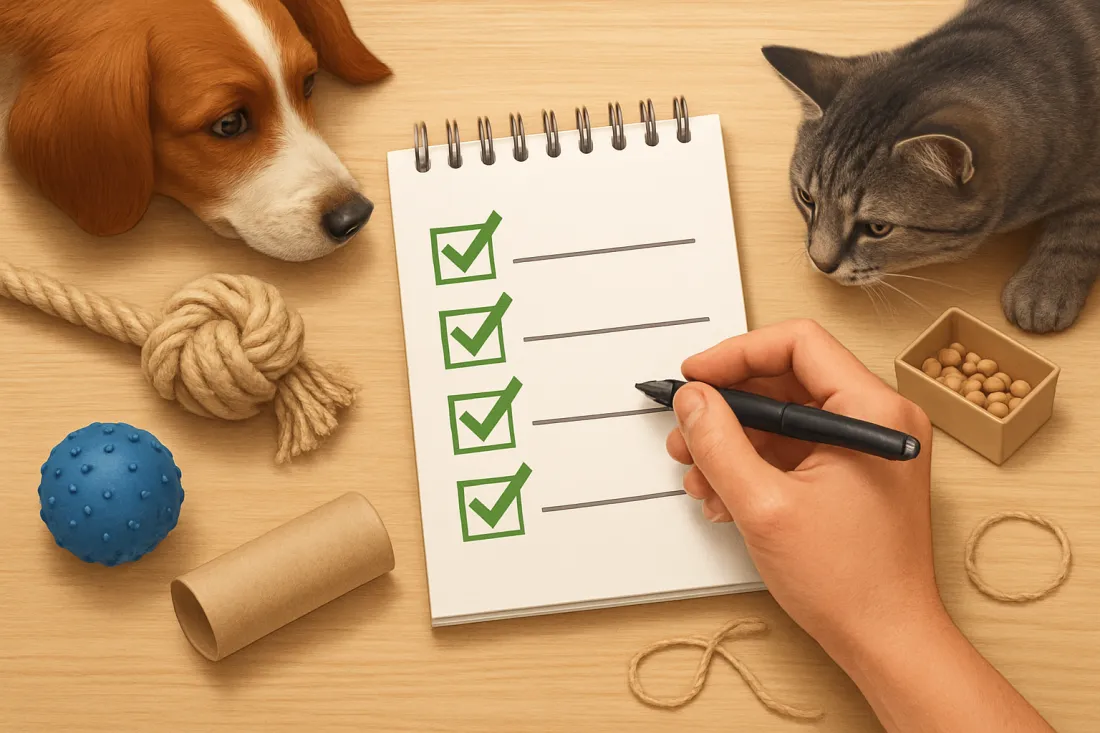
Use this checklist as a starting point. Adjust it to your schedule and your pet’s energy level.
Weekly low-cost enrichment checklist for dogs
- ✔ Daily sniff time – At least one walk or yard session where your dog can sniff freely for several minutes.
- ✔ 3–5 training mini-sessions – Short (5–10 minute) sessions teaching or refreshing cues using part of regular meals.
- ✔ 2–3 DIY puzzle meals – Serve part of your dog’s food in a towel snuffle, cardboard tube, or other simple puzzle.
- ✔ 3 interactive play sessions – Tug, fetch, or flirt pole games tailored to your dog’s age and health.
- ✔ 1–2 new scent games – Hide treats in different rooms, boxes, or under cups.
- ✔ Weekly toy rotation – Swap toy groups and remove damaged items.
- ✔ Calm bonding time – Daily gentle petting, brushing, or massage if your dog enjoys it.
Weekly low-cost enrichment checklist for cats
- ✔ Daily interactive play – 5–10 minutes with a wand toy, paper ball, or similar “prey” toy.
- ✔ 2–3 food puzzles – Offer dry food in an egg carton, tube puzzle, or scatter hunt.
- ✔ Window time – Ensure at least one comfy perch near a window is available each day.
- ✔ Box or bag refresh – Add or rearrange boxes and paper bags once or twice a week.
- ✔ Scratching options – Keep at least one sturdy scratching surface available and move or rotate it occasionally.
- ✔ Weekly toy rotation – Put away some toys and bring out “new” ones to keep interest high.
- ✔ Quiet bonding – Short daily sessions of petting, brushing, or simply sitting nearby if your cat prefers space.
Signs your pet is under-stimulated and how to respond
Every pet is different, but some common signs suggest your dog or cat needs more or different enrichment.
Warning signs in dogs
- Chewing furniture, shoes, or household items despite having chew toys.
- Excessive barking, whining, or attention-seeking when you are home.
- Restlessness, pacing, or zoomies that are hard to settle.
- Digging in the yard or trying to escape the fence.
How to respond:
- Add one extra mental activity per day (scent game, puzzle meal, or short training session).
- Break exercise into several shorter walks or play sessions instead of one long burst.
- Review your home setup for safety and stimulation; resources on how to pet proof your home and yard can help you adjust the environment.
- If behavior suddenly changes or seems extreme, consult your veterinarian to rule out medical causes.
Warning signs in cats
- Over-grooming or pulling out fur.
- Scratching furniture more than usual.
- Chasing or attacking ankles and hands.
- Sleeping almost all day with very little play, especially in younger cats.
How to respond:
- Schedule at least one focused play hunt session daily with a wand or chase toy.
- Add vertical spaces and hiding spots using boxes and safe shelves.
- Offer food puzzles to turn mealtime into a small hunting challenge.
- If your cat’s behavior changes suddenly or grooming becomes intense, contact your veterinarian.
Common mistakes with cheap pet entertainment
Low-cost enrichment is powerful, but a few common mistakes can reduce its benefits or create risks.
- Leaving unsafe DIY toys unsupervised – String, thin fabric, and small parts can be swallowed.
- Doing only physical exercise – Long walks without sniffing or play without problem-solving can leave your pet mentally under-stimulated.
- Overloading shy or anxious pets – Too many new toys or sudden changes can be stressful. Introduce new activities gradually.
- Ignoring individual preferences – Some dogs love tug; others prefer sniffing. Some cats love high perches; others prefer floor-level hideouts. Watch what your pet actually enjoys.
- Not adjusting as your pet ages – Senior pets may need shorter, gentler sessions and more scent or puzzle work instead of intense jumping or running.
FAQ: safety and next steps for cheap ways to entertain your dog or cat at home
What should I understand about cheap ways to entertain my dog or cat at home?
Low-cost enrichment is less about fancy equipment and more about meeting your pet’s natural needs: to sniff, hunt, chew, climb, explore, and interact with you. Household items like boxes, towels, and paper can become excellent toys when used safely. A simple weekly routine of short, varied activities often does more for your pet’s well-being than a pile of expensive toys that rarely get used.
What safety concerns should I keep in mind with DIY toys for dogs and cats?
Focus on size, material, and supervision. Avoid small parts that can be swallowed, long strings or ribbons left out unsupervised, and anything sharp or brittle. Always remove staples, tape, and plastic from boxes and bags. Supervise new toys until you know how your pet interacts with them, and throw away or repair toys that are torn, leaking stuffing, or breaking apart.
What mistakes should I avoid with low-cost enrichment at home?
Common mistakes include offering only one type of activity (such as just walks for dogs or only solo toys for cats), leaving risky DIY toys out all the time, and expecting your pet to enjoy the same game every day without variation. Another mistake is using play that encourages rough grabbing of hands or ankles instead of toys, which can lead to bad habits. Aim for variety, clear boundaries, and regular rotation.
How much daily enrichment does my dog or cat really need?
Needs vary by age, health, and personality, but many pets benefit from several short sessions spread through the day rather than one long block. For many dogs, a mix of walks, sniff time, short training, and a puzzle meal can be enough. Many cats do well with a few focused play hunts, access to vertical spaces, and occasional food puzzles. Watch your pet’s behavior: calmer, more relaxed behavior after activities usually means you are close to the right amount.
What should I do next after learning these cheap ways to entertain my pet?
Start small and consistent. Choose two or three ideas that fit your home and schedule, such as a daily sniff walk for your dog or a nightly wand-toy session for your cat, plus one simple puzzle feeder. Set a weekly reminder to rotate toys and refresh boxes or DIY setups. As you go, observe which activities your pet loves most and build your routine around those. If you are planning to adopt another pet, reading about mistakes to avoid when introducing a new cat to your home can help you combine enrichment with a smoother transition.
Enrichment as a budget-friendly behavior tool
Thoughtful enrichment is one of the most effective, low-cost tools you have to support your dog’s or cat’s behavior and overall well-being. By using household items creatively, rotating toys, and building a simple weekly routine, you can give your pet a richer, calmer life without constant shopping. Over time, you will likely notice fewer problem behaviors, more relaxed rest, and a stronger bond—proof that responsible pet ownership is about attention and creativity, not how much you spend on toys.