
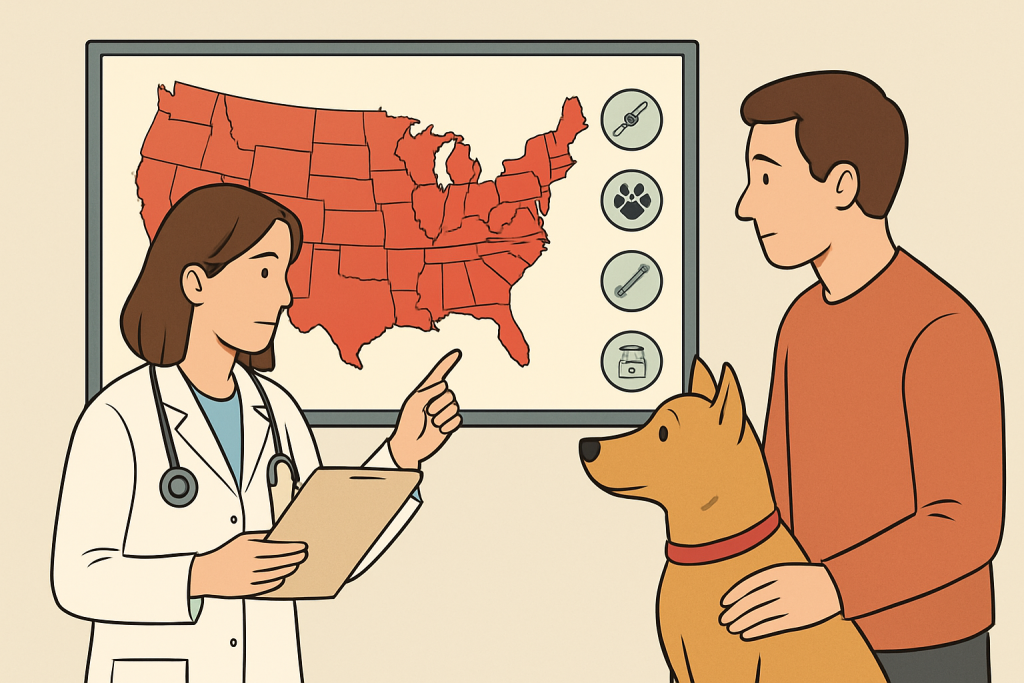
If you live in the United States, the only dog vaccine that is consistently treated as legally required across the country is rabies. Other vaccines are usually strongly recommended by veterinarians and often required by boarding, daycare, training facilities, or landlords, but they are not written into state law in the same way.
Because each state (and sometimes each county or city) can set its own rules, you cannot rely on a single national list. You need a simple way to check what applies where you live and where you travel with your dog.
Core vs non-core dog vaccines when you live in the US
Before comparing state rules, it helps to understand how vets think about vaccines. This makes it easier to decide what your dog really needs beyond the legal minimum.
Core vaccines (strongly recommended for almost all dogs)
Core vaccines are considered important for nearly every dog because the diseases are widespread or very serious. In the US, vets commonly treat the following as core:
- Rabies – required by law in most places; protects against a fatal disease that can spread to people.
- Combination vaccine often called DAPP or DHPP – typically covers distemper, adenovirus, parainfluenza, and parvovirus. These viruses can cause severe illness, especially in puppies.
Many clinics bundle core vaccines into a puppy series and then boosters at regular intervals. The exact timing can vary, so your vet’s schedule is the one to follow.
Non-core vaccines (recommended based on lifestyle and local risk)
Non-core vaccines are given when a dog’s lifestyle or local conditions make certain diseases more likely. Common examples include:
- Leptospirosis – often recommended in areas with standing water or wildlife exposure.
- Lyme disease – often recommended in regions with many ticks.
- Canine influenza – sometimes required by boarding or daycare facilities, especially in areas that have had outbreaks.
- Bordetella (kennel cough) – frequently required for boarding, grooming, and group training classes.
These non-core vaccines are usually not written into state law, but they can still be “required” by private businesses or housing rules. That is why you may hear different answers when you ask what is “mandatory.”
Rabies laws vs recommended vaccines: how the rules actually work
Across the United States, rabies vaccination is treated differently from other dog vaccines because rabies is a public health concern. Evidence from national summaries shows that most states require rabies vaccination for dogs once they reach a certain age, often somewhere between about three and six months. After that, boosters are required at intervals set by the state or local authority.
Other vaccines (such as distemper, parvo, or leptospirosis) are described in national guidance as strongly recommended, but not typically written into state law. Instead, they are handled through veterinary standards of care and private rules (boarding, daycare, training, landlords, and sometimes shelters).
Because local rules can change, the safest approach is to treat any summary you see as a starting point, then confirm details with your local animal control office, your vet, or your state agriculture/health department.
Comparison: legal rabies requirement vs vet-recommended full vaccine plan
Many owners ask whether they should only do what is legally required or follow the full veterinary schedule. The table below compares these two approaches so you can see the trade-offs.
| Aspect | Legal minimum (rabies-focused) | Vet-recommended full plan (core + lifestyle) |
|---|---|---|
| Main goal | Meet state and local rabies laws; avoid fines and quarantine issues. | Protect your dog’s overall health and reduce risk of common infectious diseases. |
| Typical vaccines | Rabies only, on the schedule required by your state or locality. | Rabies + DAPP/DHPP + lifestyle vaccines such as leptospirosis, Bordetella, Lyme, or canine influenza as advised by your vet. |
| Who sets the rules | State and local government (animal control, public health). | Your veterinarian, based on medical guidelines and your dog’s lifestyle. |
| Consequences of skipping | Possible fines, difficulty licensing your dog, problems if your dog bites someone, and quarantine or euthanasia risks in serious rabies investigations. | Higher risk of your dog catching preventable diseases; possible refusal by boarding, daycare, groomers, or training classes. |
| Flexibility | Very limited; exemptions are rare and tightly controlled. | More flexible; your vet can adjust timing, choose titers in some cases, or skip certain non-core vaccines if risk is low. |
| Record-keeping needs | Proof of current rabies vaccine from a licensed vet; often needed for licensing. | Full vaccine record, including dates and product names; often needed for boarding, travel, and long-term health tracking. |
For most owners, the practical answer is to always meet the legal rabies requirement and then work with a vet to decide which additional vaccines make sense for your dog’s age, lifestyle, and local disease patterns.
US “map-style” overview: how rabies vaccine rules vary by state
While a visual map is helpful, you can think of the United States as falling into a few broad patterns for dog rabies rules. These patterns are based on national summaries that describe how states typically handle rabies vaccination.
States where rabies vaccination is broadly required for dogs
National overviews describe rabies vaccination as legally required for dogs in all or nearly all US states. The common pattern is:
- Dogs must be vaccinated once they reach a minimum age (often in the range of a few months old).
- Boosters are required at regular intervals, often tied to whether a 1-year or 3-year vaccine product was used.
- Proof of rabies vaccination is usually needed to obtain or renew a dog license where licensing is required.
Within this broad pattern, details can differ from one state or city to another. For example, one city might require proof of rabies vaccination every year when you renew a license, even if your dog received a longer-duration vaccine.
States with additional local rules
Some states allow counties or cities to add their own rabies rules on top of state law. This can affect:
- How soon a newly adopted or newly arrived dog must be vaccinated.
- Whether rabies tags must be worn on the collar.
- What happens if a dog bites someone or is exposed to a wild animal suspected of having rabies.
Because of this, two neighboring towns in the same state can have slightly different enforcement practices, even if the basic state rule is the same.
Territories and special situations
US territories and certain regions can have their own animal health requirements, especially for rabies control. If you are moving or traveling with your dog between states or territories, federal guidance notes that your destination may have specific animal health requirements, such as a health certificate or updated vaccinations. Always check both your departure and destination rules before you travel.
State-by-state rabies requirement table: how to read and use it
Because exact legal wording and enforcement can change, the most reliable way to stay compliant is to use a simple table as a checklist and then confirm details locally. The table below is designed to help you ask the right questions in your state.
| State | Is rabies vaccine generally required for dogs? | Typical first-vaccine age range to confirm | Typical booster frequency to confirm | Where to verify current rules |
|---|---|---|---|---|
| All US states (overview) | National summaries describe rabies vaccination as required for dogs in all or nearly all states. | Often between about 3–6 months of age; confirm exact minimum age. | Commonly every 1 or 3 years, depending on vaccine product and local rule. | State agriculture or health department; local animal control; your vet. |
| Your home state | Ask whether rabies vaccination is mandatory for all dogs kept in the state. | Ask the minimum age by which a puppy must receive its first rabies shot. | Ask whether the state accepts 3-year vaccines or requires more frequent boosters. | Search for your state name + “dog rabies requirements” on an official government site. |
| States you travel to | Ask if visiting dogs must show proof of rabies vaccination. | Ask if there are special rules for puppies entering the state. | Ask if your current rabies certificate will be accepted for the duration of your stay. | Destination state’s official animal health or agriculture website. |
| Your county or city | Ask if local ordinances add extra rabies rules beyond the state minimum. | Ask if there is a deadline to vaccinate newly adopted or newly moved-in dogs. | Ask if local licensing requires annual proof even for multi-year vaccines. | County animal control, city clerk, or local public health department. |
Use this table as a script when you call or check official websites. Instead of searching for long legal texts, you can focus on four key facts: whether rabies is required, by what age, how often boosters are needed, and what proof you must keep.
Recommended vaccine schedule by life stage (puppy, adult, senior)
Veterinarians in the US follow broadly similar patterns for vaccine timing, but the exact schedule can vary by clinic, product, and your dog’s health. The outline below is a general comparison to help you plan; always follow your own vet’s instructions.
Puppies (birth to about 1 year)
- Core puppy series – Puppies typically receive a series of combination vaccines (such as DAPP/DHPP) starting at a young age and repeated every few weeks until they reach a certain age. This series helps build strong immunity as maternal antibodies fade.
- First rabies vaccine – Given once the puppy reaches the minimum age allowed by your state (often in the range of a few months). This shot usually starts the legal rabies schedule.
- Non-core vaccines – Your vet may recommend Bordetella, leptospirosis, Lyme, or canine influenza during the puppy period if your dog’s lifestyle or local disease patterns justify it.
Adult dogs (about 1 to 7 years, depending on breed and size)
- Rabies boosters – Given at the interval required by your state and consistent with the vaccine product used (for example, a 1-year or 3-year labeled vaccine). Your vet will time these so your dog stays continuously covered.
- Core boosters – Many vets give DAPP/DHPP boosters at regular intervals during adulthood. The exact frequency can vary; some dogs may receive them more often than others based on risk.
- Lifestyle vaccines – If your dog boards, attends daycare, goes to dog parks, or lives in a high-risk area for certain diseases, your vet may recommend regular Bordetella, leptospirosis, Lyme, or influenza boosters.
Senior dogs (roughly 7+ years, but varies by breed)
- Rabies – Senior dogs usually still need to follow the legal rabies schedule unless a medical exemption is granted under your state’s rules. Your vet can help you understand if an exemption is possible and appropriate.
- Other vaccines – Some vets adjust the frequency or choice of non-core vaccines for seniors, especially if the dog’s lifestyle changes (for example, no longer boarding or attending daycare).
- Health monitoring – Senior dogs may have more frequent checkups, and your vet may discuss whether titers (blood tests that measure antibodies) are appropriate for certain vaccines.
For more detail on how vaccines fit into your dog’s overall health plan, you can also review a broader annual vet care schedule for dogs and cats USA and then tailor it with your vet.
Who should prioritize which vaccine approach?
Different owners and dogs have different needs. Here is a practical way to think about which approach fits your situation.
If you want to focus on strict legal compliance
This approach may fit if you:
- Rarely travel with your dog.
- Do not use boarding, daycare, or group training.
- Have budget constraints and need to prioritize.
In this case, your non-negotiable task is to stay current on rabies according to your state and local rules. You can then discuss with your vet which additional vaccines are most important for your area, even if you cannot do all of them at once.
If you use boarding, daycare, or travel frequently
This approach may fit if you:
- Board your dog during vacations.
- Use dog daycare or group training classes.
- Travel across state lines or by air with your dog.
In this scenario, you will almost always need:
- Up-to-date rabies vaccine and certificate.
- Current core vaccines (such as DAPP/DHPP).
- Any additional vaccines required by the facility or airline, such as Bordetella or canine influenza.
Because requirements can differ between facilities, always ask for their current vaccine list before booking.
If your dog has health issues or a history of reactions
Some dogs have medical conditions that complicate vaccination decisions. In these cases:
- Work closely with your vet to weigh the benefits and risks of each vaccine.
- Ask whether your state allows medical exemptions for rabies and what documentation is needed.
- Discuss whether titers are appropriate for certain vaccines, recognizing that not all states or facilities accept titers in place of vaccination.
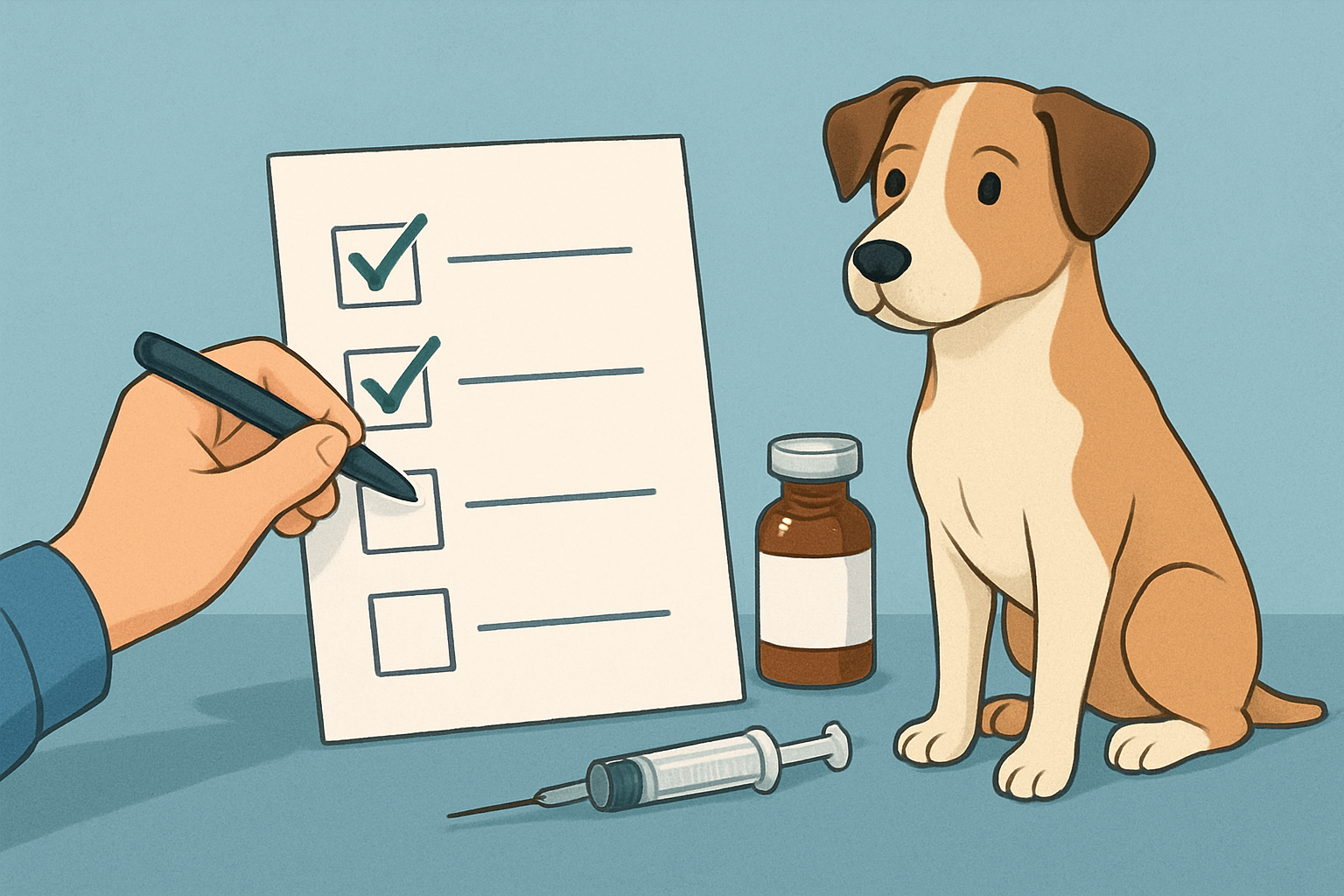
Decision checklist: how to plan your dog’s vaccines step by step
Use this checklist as a simple algorithm to move from confusion to a clear, written plan.
- Confirm your dog’s current status
- Locate any existing vaccine records, including rabies certificates.
- Note the dates and types of vaccines your dog has already received.
- If you have no records, assume you need to start fresh and talk to your vet.
- Check your state and local rabies rules
- Search for your state name plus “dog rabies vaccination requirements” on an official government site.
- Confirm the minimum age for the first rabies shot, required booster interval, and any licensing rules.
- Call local animal control if anything is unclear.
- List your dog’s lifestyle risks
- Do you board your dog, use daycare, or attend group training?
- Does your dog hike, swim in natural water, or live in a tick-heavy area?
- Does your dog visit dog parks or live in a multi-dog household?
- Book a vet visit to create a personalized plan
- Bring your vaccine records and your list of lifestyle factors.
- Ask which vaccines are core for your dog and which are lifestyle-based.
- Ask your vet to write down a simple schedule for the next 12–24 months.
- Align with boarding, daycare, or travel requirements
- Contact any facilities you use and request their current vaccine list.
- Compare their requirements with your vet’s plan and adjust timing if needed.
- For interstate travel, ask your vet about health certificates and any destination-specific rules.
- Set reminders and organize records
- Enter due dates for rabies and other vaccines into your phone or calendar.
- Create a dedicated folder (paper or digital) for vaccine certificates and receipts.
- Update the folder after each vet visit.
How to keep and organize your dog’s vaccine records
Good record-keeping saves time and prevents stressful last-minute scrambles when you need proof of vaccination.
What to keep
- Rabies certificate – Usually includes your dog’s description, vaccine date, product, lot number, and expiration date, plus the vet’s signature.
- Full vaccine history – Printouts or notes from your vet listing each vaccine, date, and product.
- Receipts – Helpful for tracking when vaccines were given and for budgeting.
- Any exemption letters – If your dog has a medical exemption, keep the original and a copy.
How to store records
- Physical folder – A simple labeled folder or binder for all pet documents.
- Digital copies – Scan or photograph certificates and store them in a cloud folder or secure app so you can access them while traveling.
- Wallet or glove box copy – Keep a copy of the rabies certificate where you can reach it quickly in case of an incident.
Tips to avoid common record-keeping mistakes
- Do not rely only on the tag on your dog’s collar; tags can be lost or outdated.
- Do not assume your vet can instantly send records at any time; having your own copies speeds up boarding and travel arrangements.
- Do not ignore expiration dates; set calendar reminders a few weeks before vaccines are due.
How to find low-cost vaccine clinics in the US
Cost is a real concern for many owners, but there are ways to keep your dog vaccinated without overspending.
Places to check for low-cost options
- Local animal shelters and humane societies – Many run periodic low-cost vaccine days or clinics.
- Community vaccine events – Some cities host pet wellness days with discounted vaccines.
- Mobile vaccine clinics – Vans or pop-up clinics that travel to different neighborhoods offering basic vaccines at reduced prices.
- Veterinary schools – Teaching hospitals sometimes offer lower-cost services supervised by licensed vets.
How to evaluate a low-cost clinic
- Confirm that a licensed veterinarian is supervising or administering vaccines.
- Ask what vaccines are included and whether the clinic follows your state’s rabies rules.
- Make sure you receive written proof of each vaccine, including rabies certificates where applicable.
- Ask how follow-up care works if your dog has a reaction or needs additional doses.
If you are planning your budget for the year, it can also help to look at an overview of annual vet costs for dogs and cats in the US so you can spread expenses out instead of facing them all at once.
Common mistakes owners make with required vaccines
Avoiding a few frequent errors can keep your dog safer and prevent legal or boarding problems.
- Assuming puppy shots include rabies automatically – In many places, rabies is given at a specific age and may not be part of the earliest puppy visits. Always confirm when your puppy will receive the first rabies shot.
- Letting rabies coverage lapse – If you miss a booster, your dog may be considered unvaccinated under local rules, even if a previous shot was given. This can cause issues if your dog bites someone or is exposed to wildlife.
- Relying on outdated information – State and local rules can change. Always check current requirements rather than relying on what a neighbor or online comment says.
- Not aligning vaccines with travel or boarding dates – Many facilities require vaccines to be given a certain number of days before arrival. Schedule vaccines early enough to meet those windows.
- Skipping vet input for non-core vaccines – Some owners either give every possible vaccine without discussion or avoid non-core vaccines entirely. A brief conversation with your vet can help you choose what truly fits your dog’s risk level.
FAQ: titers, exemptions, boarding rules, and travel to the USA
What states require dog vaccines?
National summaries describe rabies vaccination as required for dogs in all or nearly all US states, usually once the dog reaches a certain age and then at set booster intervals. Other vaccines (such as distemper or parvo) are strongly recommended but typically not written into state law. Because details can change, always confirm your state’s current rules with official sources or your vet.
Which dog vaccines are absolutely necessary?
From a legal perspective, rabies is the vaccine that states focus on. From a health perspective, veterinarians usually consider rabies plus a combination vaccine such as DAPP/DHPP (covering distemper, adenovirus, parainfluenza, and parvovirus) as core for most dogs. Additional vaccines like leptospirosis, Lyme, Bordetella, or canine influenza are recommended based on your dog’s lifestyle and local disease risk.
What are the mandatory vaccines for dogs?
In terms of law, rabies is the primary mandatory vaccine across US states. Some local areas or private facilities may effectively make other vaccines mandatory for participation (for example, Bordetella or canine influenza for boarding or daycare), but those are policy requirements rather than state-wide legal mandates. Always check both your local laws and the rules of any facility you use.
Can titers replace vaccines for my dog?
Titers are blood tests that measure antibody levels. Some vets use them to help decide whether certain vaccines are still providing protection. However, many states and facilities do not accept titers in place of a current rabies vaccine for legal or policy purposes. If you are considering titers, discuss with your vet which vaccines they might be useful for and ask your local authorities and boarding facilities whether titers are accepted.
Are medical exemptions from rabies vaccines allowed?
Some states allow medical exemptions from rabies vaccination under specific conditions, usually with documentation from a veterinarian. The rules for exemptions, and whether they are accepted at all, vary by location. If your dog has a serious health issue, talk to your vet about whether an exemption is appropriate and then confirm with your local animal control or health department how exemptions are handled.
What vaccines do dogs need to go to the USA?
Requirements for bringing a dog into the United States can depend on factors such as where the dog is coming from and current public health policies. Rabies vaccination is a key focus, and you should expect to need proof of a current rabies shot. Additional requirements, such as health certificates or other vaccines, can apply depending on the situation. Before traveling, check current federal guidance and talk to your vet about what documentation and vaccines your dog will need.
What vaccines do boarding and daycare facilities usually require?
Many boarding and daycare facilities require proof of current rabies and core vaccines, and often Bordetella. Some also require canine influenza or other vaccines, especially if there have been local outbreaks. Because each facility sets its own policy, always ask for their current vaccine list and timing rules before you book.
How often should my adult dog get vaccinated?
Rabies boosters are given at intervals set by your state and consistent with the vaccine product used. Other vaccines, such as DAPP/DHPP or lifestyle vaccines, are scheduled by your vet based on your dog’s health and risk factors. The best way to stay on track is to follow a written plan from your vet and schedule regular checkups, using tools like a recommended vet visit schedule for dogs USA as a starting point.
By combining a clear understanding of rabies laws with a personalized vaccine plan from your vet, you can keep your dog both legally compliant and well protected throughout life.