
For most US cat owners, a realistic monthly budget usually lands in a moderate range rather than “just food and litter.” Once you factor in routine vet care, parasite prevention, and a small emergency cushion, the true cost is higher than many first-time owners expect. You do not need an exact dollar figure to plan well, but you do need to think in categories and set aside money consistently.
This guide walks through those categories, compares indoor vs outdoor costs and risks, and ends with a simple checklist-style sanity check so you can see whether your planned budget is genuinely sustainable.
Real monthly cat costs: beyond food and litter
When people guess “how much does a cat really cost monthly,” they often think of a bag of food and a box of litter. Responsible pet ownership, though, means planning for all of these ongoing costs:
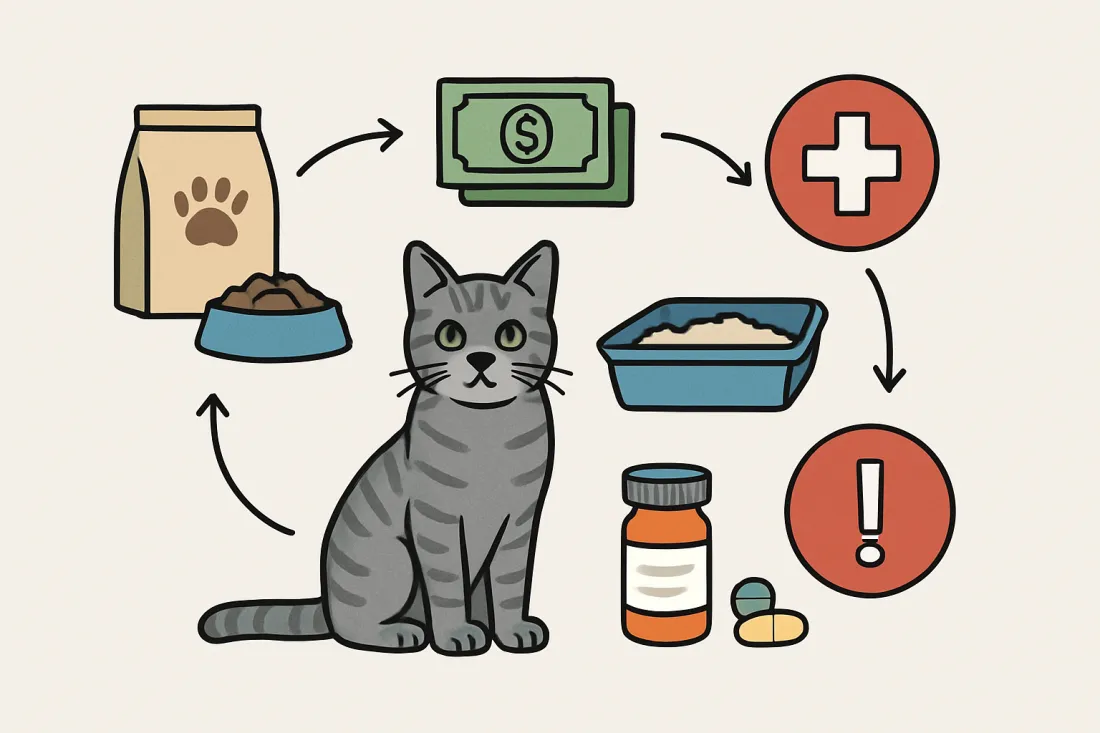
- Food – wet, dry, or a mix, plus occasional treats.
- Litter and waste supplies – litter, liners if you use them, poop bags, cleaning products.
- Routine health care – annual checkups, vaccines, parasite prevention, dental care spread out over months.
- Medications or supplements – for chronic issues like allergies, arthritis, or urinary problems.
- Insurance or vet savings – either a pet insurance premium or money you set aside monthly for future vet bills.
- Enrichment and replacement gear – toys, scratching posts, beds, grooming tools, and worn-out items.
If you want a deeper dive into how these pieces add up over time, you can also look at the monthly cost of owning a cat in the US and the average yearly cost of a cat for longer-term planning.
The key is not to chase a single “magic” number, but to build a realistic range and then check whether your income and savings can comfortably support it without risking future surrender if money gets tight.
Itemized monthly cat expenses: what to include in your budget
Use these categories as your basic monthly budget framework. You can plug in your own numbers based on local prices, your cat’s size, and your vet’s recommendations.
1. Food
Food is usually one of the biggest recurring costs. Your monthly spend will depend on:
- Type of food – budget, mid-range, or premium; wet, dry, or mixed feeding.
- Cat size and age – kittens and very active cats often eat more per pound of body weight.
- Special diets – prescription or limited-ingredient diets for allergies, kidney disease, or urinary issues are typically more expensive.
Budgeting tip: Check how long a bag or case of food actually lasts in your home. Divide the total cost by the number of days it lasts, then multiply by ~30 to estimate a monthly amount.
2. Litter and cleaning supplies
Litter costs depend on:
- Type of litter – clumping clay, silica, recycled paper, wood pellets, or specialty low-dust formulas.
- Number of cats and boxes – more cats and boxes mean more litter.
- Cleaning habits – how often you fully change the litter vs just scooping.
Remember to include:
- Litter itself.
- Deodorizers or baking soda if you use them.
- Poop bags or trash bags for scooped waste.
- Cleaning sprays or wipes for accidents.
3. Routine vet care (spread monthly)
Most routine vet costs are annual or semi-annual, but they are easier to handle if you treat them as a monthly sinking fund. Typical recurring items include:
- Wellness exams.
- Core vaccines and boosters as recommended by your vet.
- Flea, tick, and heartworm prevention where needed.
- Routine lab work or dental cleanings, especially for middle-aged and senior cats.
To estimate a monthly amount:
- Ask your vet for a rough yearly cost for a healthy cat’s routine care.
- Divide that number by 12 to get a monthly “vet fund” contribution.
- Transfer that amount into a separate savings bucket every month.
4. Medications and special health needs
Some cats have chronic conditions that require ongoing medication, special diets, or more frequent vet visits. Examples include:
- Hyperthyroidism.
- Diabetes.
- Chronic kidney disease.
- Allergies or asthma.
- Arthritis or mobility issues.
If your cat has a known condition, ask your vet:
- What a typical month of medication and monitoring looks like.
- Whether costs are likely to rise as your cat ages.
- Which parts are essential vs optional so you can prioritize if money is tight.
5. Insurance or self-funded vet savings
You can handle big, unexpected vet bills in two main ways:
- Pet insurance – you pay a monthly premium, and the insurer reimburses a portion of eligible vet bills after deductibles and co-pays.
- Self-funded emergency savings – you skip insurance and instead put a set amount into a dedicated savings account every month.
Either way, there is a monthly cost to prepare for emergencies. The right choice depends on your risk tolerance, your ability to save, and your cat’s age and health.
If you prefer a structured tool to plan this, a pet budget template annual and monthly can help you see how insurance premiums or savings contributions fit into your overall finances.
6. Enrichment, grooming, and replacements
These costs are easy to ignore until something breaks or your cat gets bored and destructive. Include a small monthly amount for:
- Toys and puzzle feeders.
- Scratching posts and pads.
- Cat trees or window perches.
- Brushes, nail clippers, and grooming wipes.
- Replacement of worn-out beds, collars, or carriers.
You may not spend this every month, but setting aside a modest amount means you can replace items without stress when needed.
Indoor vs outdoor cats: cost and risk comparison
Whether your cat lives strictly indoors or has outdoor access can change both the type of costs and the risk of large, unexpected bills.
| Factor | Primarily Indoor Cat | Outdoor or Indoor/Outdoor Cat |
|---|---|---|
| Routine vet care | Often limited to core vaccines and checkups, based on vet advice. | May need more vaccines and more frequent exams due to higher exposure to disease and injuries. |
| Parasite prevention | Still recommended in many areas, but risk may be lower if the cat never goes outside and other pets are protected. | Usually essential and more frequent due to higher exposure to fleas, ticks, worms, and other parasites. |
| Injury risk | Lower risk of car accidents, fights, and falls; injuries more likely from household hazards or rough play. | Higher risk of traffic accidents, animal fights, and getting trapped, which can lead to sudden, large vet bills. |
| Environmental damage | More indoor scratching and climbing; you may spend more on scratching posts and enrichment to prevent damage. | May scratch outdoor surfaces more, but indoor furniture can still be affected; boredom is less likely but risk shifts to safety outdoors. |
| Emergency fund pressure | Emergency fund is still important, but big injuries may be less frequent. | Emergency fund becomes even more critical due to higher odds of serious injury or disease exposure. |
Indoor cats are not “cheap,” but their risks are generally more predictable. Outdoor access can reduce boredom but often increases the chance of high, sudden vet costs. If your cat goes outside, plan a more generous emergency cushion and be diligent with parasite prevention.
Structured checklist: build your monthly cat budget
Use this checklist as a worked example. Go line by line and fill in your own numbers based on your local prices and your cat’s needs.
Step 1 – Core daily needs
- Food
- Check how long your current food supply lasts (in days).
- Divide the total cost by days to get a daily cost.
- Multiply daily cost by 30 to get your monthly food estimate.
- Add a small buffer for treats or occasional brand changes.
- Litter
- Track how many bags/boxes of litter you use in a month.
- Multiply the cost per bag/box by the number used per month.
- Add a small amount for poop bags and cleaning products.
Step 2 – Health and prevention
- Routine vet care
- Ask your vet for a rough yearly cost for a healthy cat (exams, vaccines, basic tests).
- Divide that yearly figure by 12 to get a monthly amount.
- Set up an automatic transfer or envelope for this amount.
- Parasite prevention
- Check how often your cat needs flea, tick, and heartworm prevention.
- Calculate the average monthly cost based on your vet’s recommendation.
- Add this to your monthly health budget.
- Chronic medications (if applicable)
- List each medication or special diet your cat needs.
- Note how often you refill or repurchase it.
- Convert that pattern into a monthly average cost.
Step 3 – Insurance or emergency savings
- Pet insurance (if you choose it)
- Get quotes for your cat’s age, breed, and location.
- Choose a plan that fits your risk tolerance and budget.
- Record the monthly premium as a fixed budget line.
- Self-funded emergency savings (if you skip or supplement insurance)
- Decide on a target emergency fund size (see guidance below).
- Choose how many months you want to take to reach that target.
- Divide target by months to get a monthly savings amount.
- Automate this transfer to a separate savings account.
Step 4 – Enrichment and replacements
- Toys and enrichment
- Estimate how often you buy new toys or puzzle feeders.
- Convert that into a small monthly average.
- Include DIY options (cardboard boxes, paper bags) to keep this modest.
- Gear and replacements
- List items that wear out over time (scratching posts, beds, carriers).
- Estimate how often you replace them (for example, every 1–3 years).
- Divide the replacement cost by the lifespan to get a monthly average.
Step 5 – Add it all up
- Add your monthly estimates for:
- Food.
- Litter and cleaning.
- Routine vet care fund.
- Parasite prevention.
- Chronic meds or special diets (if any).
- Insurance premium or emergency savings contribution.
- Enrichment and replacement gear.
- Compare the total to your monthly income and other obligations.
- Check whether you can still save for your own emergencies and long-term goals.
If the total feels tight, adjust how you spend (for example, switching to a good-quality but less expensive food or buying litter in bulk) rather than skipping essential health care.
How big should a cat emergency fund be?
There is no single perfect number, but planning ahead is crucial. Many owners underestimate how quickly vet bills can climb in emergencies, which can lead to painful decisions or even surrendering a cat when money runs out.
To choose a realistic emergency fund target:
- Ask your vet for typical emergency scenarios they see for cats in your area (for example, urinary blockages, accidents, sudden illnesses) and what a moderate case might cost.
- Use that as a reference point rather than a guarantee. Aim for a fund that could cover at least one moderate emergency, knowing that severe cases can cost more.
- Consider your cat’s risk profile:
- Outdoor or indoor/outdoor cats may justify a larger emergency cushion due to higher injury risk.
- Senior cats or those with chronic diseases may also benefit from a larger fund.
- Decide how quickly you want to build it – for example, over 12, 18, or 24 months – and divide your target by that number of months to get a monthly savings goal.
- Keep the fund separate from your everyday checking account so you are not tempted to spend it on non-emergencies.
If you also carry pet insurance, your emergency fund can be smaller, but it still helps cover deductibles, co-pays, and treatments that may not be fully reimbursed.
For a broader view of how an emergency fund fits into your overall pet finances, you can explore strategies in emergency vet fund how much per year, then convert your yearly target into a monthly savings amount.
Saving money without compromising your cat’s welfare
Responsible financial planning is not about cutting corners on essential care. It is about spending smarter so you can afford what truly matters for your cat’s health and happiness.
1. Buy staples in sensible bulk
- Purchase larger bags of litter or food only if your cat reliably eats that brand and you can store it properly.
- Check the “cost per pound” or “cost per ounce” on shelf labels to compare options.
- Avoid buying huge quantities of a new food until you know your cat tolerates it well.
2. Focus on preventive vet care
- Keep up with recommended vaccines and parasite prevention to reduce the risk of costly diseases.
- Schedule regular checkups so your vet can catch issues early, when they are often easier and less expensive to treat.
- Discuss dental health; routine dental care can sometimes prevent painful and expensive extractions later.
3. Use DIY enrichment and rotation
- Rotate toys so they feel “new” without constant buying.
- Use cardboard boxes, paper bags (handles removed), and DIY puzzle feeders for low-cost entertainment.
- Provide vertical spaces (shelves, window perches) to reduce stress and boredom.
4. Choose quality where it matters most
- Food: aim for a nutritionally complete diet that your vet approves, even if it is not the most expensive brand.
- Litter: choose a type your cat reliably uses; saving money on a litter your cat hates can backfire in the form of accidents and stress.
- Scratching posts: sturdy posts may cost more upfront but often last longer and protect your furniture.
5. Avoid “false savings” that cost more later
- Skipping vet visits or parasite prevention to save money now can lead to much higher bills later.
- Delaying treatment when your cat is clearly unwell can turn a manageable issue into an emergency.
- Feeding an unbalanced homemade diet without veterinary guidance can cause health problems that are expensive to fix.
Common mistakes when estimating monthly cat costs
Underestimating costs is one of the biggest reasons people feel overwhelmed and consider rehoming a pet. Avoid these frequent budgeting errors:
1. Ignoring non-monthly expenses
Many owners forget to spread out yearly or occasional costs, such as:
- Annual exams and vaccines.
- Dental cleanings.
- License fees where required.
- Replacement of carriers, beds, or scratching posts.
Solution: treat these as monthly sinking funds by dividing the expected yearly total by 12.
2. Budgeting for a “perfectly healthy” cat only
Even young, healthy cats can develop unexpected issues. Planning only for food and routine care leaves you vulnerable to:
- Sudden injuries.
- Urinary blockages or infections.
- Dental problems.
- Allergic reactions or toxin exposures.
Solution: build at least a modest emergency fund or consider insurance so you are not forced into impossible choices if something goes wrong.
3. Assuming indoor cats are “cheap”
Indoor cats may have fewer accidents, but they still need:
- Routine vet care and parasite prevention where recommended.
- Enrichment to prevent boredom and stress-related behaviors.
- Regular monitoring for weight gain, arthritis, and other indoor-lifestyle issues.
Solution: budget realistically for enrichment and preventive care, not just food and litter.
4. Forgetting about aging
Cats often live well into their teens. As they age, they are more likely to need:
- More frequent vet visits.
- Bloodwork and monitoring.
- Medications or special diets.
Solution: expect your monthly cat costs to rise over time. Build flexibility into your long-term budget so you can support your cat through all life stages.
5. Not checking local and personal factors
Costs vary widely across the United States depending on:
- Local vet pricing.
- Availability of low-cost clinics or wellness plans.
- Regional parasite risks (for example, heartworm or tick-borne diseases).
- Your cat’s specific health and behavior.
Solution: use guides as a starting point, then confirm details with your own vet, local shelters, and actual store prices where you live.
Decision criteria: is your planned monthly cat budget realistic?
Once you have a draft budget, use these criteria to stress-test it before adopting a cat or adjusting your current spending.
- Stability – Can you cover this monthly amount even if your income dips slightly or other bills rise?
- Emergency readiness – Are you building an emergency fund or paying for insurance, or are you hoping nothing serious happens?
- Flexibility – Do you have room to increase spending as your cat ages or develops new needs?
- Quality of care – Does your budget allow for recommended vet visits, a balanced diet, and basic enrichment, not just survival-level care?
- Impact on your own finances – After cat costs, can you still save for your own emergencies and long-term goals without constant stress?
If your answers are mostly “yes,” your budget is likely on the right track. If not, consider:
- Adjusting your expectations (for example, waiting to adopt until your finances are more stable).
- Looking for local support options like low-cost clinics or wellness plans.
- Rebalancing your spending in other areas to prioritize essential pet care.
Quick monthly budget sanity check
Use this short checklist to confirm that your plan is realistic and supports responsible pet ownership:
- I have included all major categories: food, litter, routine vet care, parasite prevention, meds (if any), insurance or savings, enrichment, and replacements.
- I have converted yearly and occasional costs into monthly amounts instead of ignoring them.
- I am setting aside something every month for emergencies, either through insurance, savings, or both.
- My cat’s lifestyle (indoor vs outdoor) and health risks are reflected in my emergency fund and vet budget.
- After covering cat costs, I can still pay my bills and save for my own needs without constant anxiety.
- If my income dropped slightly, I could still maintain essential cat care (food, litter, basic vet care).
If you cannot check most of these boxes, it may be worth revisiting your numbers, exploring cost-saving strategies that do not harm your cat’s welfare, or delaying adoption until your finances are more secure. Thoughtful planning now greatly reduces the risk of financial stress leading to surrender later.
FAQ: monthly cat costs and financial planning
What should I really understand about how much a cat costs monthly?
The most important point is that a cat’s monthly cost is not just food and litter. A realistic budget also includes routine vet care, parasite prevention, a cushion for emergencies, and some money for enrichment and replacements. Costs can change over time as your cat ages or develops health issues, so your budget needs flexibility. Planning in categories and setting aside money consistently is more reliable than chasing a single “average” number.
What budgeting mistakes lead cat owners into financial trouble?
Common mistakes include underestimating vet costs, failing to save for emergencies, assuming indoor cats are cheap to maintain, and planning only for a perfectly healthy young cat. Some people also forget to spread yearly expenses across the year, which makes routine care feel like a sudden “big bill.” These errors can create financial stress and, in the worst cases, pressure owners to delay care or consider rehoming when money is tight.
How can I tell if I can truly afford a cat before adopting?
Draft a monthly budget that includes all the categories in this guide, then compare it to your income and existing obligations. Ask yourself whether you could still cover essential cat care if your income dropped slightly or an unexpected human expense appeared. If the numbers only work when everything goes perfectly, it may be safer to wait, adjust your lifestyle, or build more savings before bringing a cat home.
What should I do next after planning my monthly cat budget?
After you have a draft budget, confirm your assumptions with real-world information: call a local vet for typical routine care costs, check current prices for your preferred food and litter, and explore insurance quotes or savings options. Then set up automatic transfers for your vet and emergency funds so saving becomes routine. Revisit your budget at least once a year, or sooner if your cat’s health or your income changes, to keep your plan realistic and sustainable.